
 he STIMLER (also spelled
  STIMMLER, but not consistently) family originally came from Alsace, which the
Germans called Elsaß because Germany never considered the region to be French, but the French never considered
the region to be German either. After the Thirty Years' War (1618-1648), the Holy Roman Empire of
the German Nation lost considerable territory and Alsace fell under French control. Always closely tied to the Rhine River which forms its eastern boundary,
Alsace has found itself a border region for most of its history. It has been observed that when France controlled this
very fertile and beautiful area, the people all spoke German, and when Germany controlled it, the people all spoke French.
(So we were originally French or German or . . . who knows?)
STIMMLER, but not consistently) family originally came from Alsace, which the
Germans called Elsaß because Germany never considered the region to be French, but the French never considered
the region to be German either. After the Thirty Years' War (1618-1648), the Holy Roman Empire of
the German Nation lost considerable territory and Alsace fell under French control. Always closely tied to the Rhine River which forms its eastern boundary,
Alsace has found itself a border region for most of its history. It has been observed that when France controlled this
very fertile and beautiful area, the people all spoke German, and when Germany controlled it, the people all spoke French.
(So we were originally French or German or . . . who knows?)
 The earliest historical reference to the Stimmler surname is to
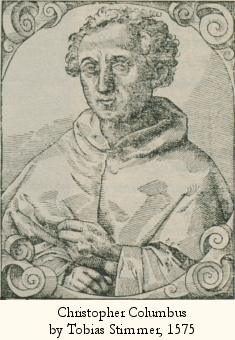
Tobias Stimmer of Schaffhouse, Germany. He is credited with being in charge of the paintings on the famous
astronomical clock of the Cathedral of Strasburg in 1570. An article
published in The New York Times Sunday Magazine on August 11,
1991 entitled Discovering Columbus by Pulitzer Prize-winning science writer John Noble Wilford showed
a number of depictions of Christopher Columbus by artists through the centuries. One of the most ancient portraits of
Columbus executed in 1575 was attributed to Tobias Stimmer and is pictured at right. Some of Tobias Stimmer's
work is at The Metropolitan Museum of Art in their Department of European Decorative Arts. It is in one of the most popular
period rooms, the so-called "Swiss Room" bought by the Rogers Fund shortly after J. P. Morgan
became a trustee of the museum. The 17th-century room's stove (c. 1684-1685) is attributed to David II Pfau
and Hans Heinrich III Pfau (as his possible assistant). The room is so richly carved that
one can look at all the woodcarvings and decipher what the room meant to the owner. The carvings and
decorations are from designs by Tobias Stimmer and Christoph Murer. The earliest historical reference to the Stimmler surname is to
Tobias Stimmer of Schaffhouse, Germany. He is credited with being in charge of the paintings on the famous
astronomical clock of the Cathedral of Strasburg in 1570. An article
published in The New York Times Sunday Magazine on August 11,
1991 entitled Discovering Columbus by Pulitzer Prize-winning science writer John Noble Wilford showed
a number of depictions of Christopher Columbus by artists through the centuries. One of the most ancient portraits of
Columbus executed in 1575 was attributed to Tobias Stimmer and is pictured at right. Some of Tobias Stimmer's
work is at The Metropolitan Museum of Art in their Department of European Decorative Arts. It is in one of the most popular
period rooms, the so-called "Swiss Room" bought by the Rogers Fund shortly after J. P. Morgan
became a trustee of the museum. The 17th-century room's stove (c. 1684-1685) is attributed to David II Pfau
and Hans Heinrich III Pfau (as his possible assistant). The room is so richly carved that
one can look at all the woodcarvings and decipher what the room meant to the owner. The carvings and
decorations are from designs by Tobias Stimmer and Christoph Murer.
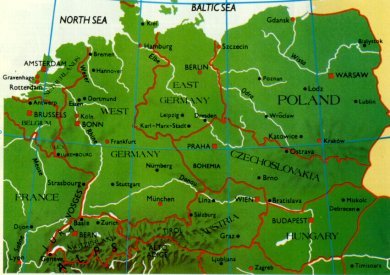 The Stimmler family spent about 250
years in the area of Waldolwisheim and Wilwisheim, Rhin-Bas,
France, a part of the fertile Rhine Valley. During 1570 to 1840 when our direct ancestors lived
there, this area changed hands between the Barvarians, French, Prussians, etc.
This period of time included the 30 Years War (1618-1648) in which the area was
economically devastated and the noble families invited our ancestors from
Switzerland to settle with the promise of religious freedom so that we would repopulate and work the farms.
The large number of Swiss families who moved into the area were Reformed but were offered a religious tolerance
and protection; they appear in the area records designated as Schirmer and Schirmsverwandten. The time
our ancestors lived in this area also included the French Revolution,
the Napoleanic Wars, and the beginning of the social revolutions that swept
through the middle of Europe in the 1840s. As these territories changed hands after each of the many
wars affecting the region, the religious denominations also changed. At the time the Stimmler family emmigrated from
France, their lands had been decimated by wars that had raged for decades.
Ancestor Johann Stimmler (1791-1870) was
a hussar under Napolean in the French calvary. There were six regiments of hussars at the start of
the Revolution. Their troopers were traditionally recruited from Alsace and Lorraine since the Royalist times
and as a result these units had a very Germanic flavor. Orders were given in German until 1793, and
The Stimmler family spent about 250
years in the area of Waldolwisheim and Wilwisheim, Rhin-Bas,
France, a part of the fertile Rhine Valley. During 1570 to 1840 when our direct ancestors lived
there, this area changed hands between the Barvarians, French, Prussians, etc.
This period of time included the 30 Years War (1618-1648) in which the area was
economically devastated and the noble families invited our ancestors from
Switzerland to settle with the promise of religious freedom so that we would repopulate and work the farms.
The large number of Swiss families who moved into the area were Reformed but were offered a religious tolerance
and protection; they appear in the area records designated as Schirmer and Schirmsverwandten. The time
our ancestors lived in this area also included the French Revolution,
the Napoleanic Wars, and the beginning of the social revolutions that swept
through the middle of Europe in the 1840s. As these territories changed hands after each of the many
wars affecting the region, the religious denominations also changed. At the time the Stimmler family emmigrated from
France, their lands had been decimated by wars that had raged for decades.
Ancestor Johann Stimmler (1791-1870) was
a hussar under Napolean in the French calvary. There were six regiments of hussars at the start of
the Revolution. Their troopers were traditionally recruited from Alsace and Lorraine since the Royalist times
and as a result these units had a very Germanic flavor. Orders were given in German until 1793, and
 thereafter in an Alsatian dialect of French. Prior to Johann's enlistment in the hussars, additional hussar
regiments were organized and manned during the revolution, recruitment being no problem as many men were attracted to
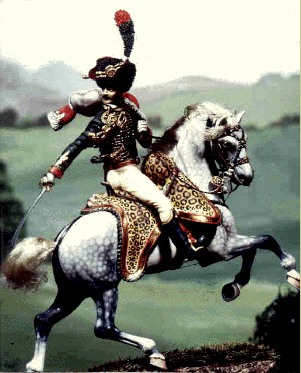
the dashing and flamboyant uniforms. The hussar uniform in 1783 was described as consisting of a
blue jacket and waistcoat embroidered with silver (and small sugar-loaf silver buttons), buckskin breeches,
boots of uncolored leather reaching to the knee and fitted as tight as silk stockings, a buff belt over the jacket with a full-length
scimitar hanging from it, and topped with a helmet on the head. The hussars were used for massed charges on the battlefield. Napoleon had three of the thirteen hussar regiments converted to dragoons in 1799. An eleventh regiment was
added in 1810. When the Grande Armée was ravaged from 1812 to 1813, Napoleon formed three more regiments, the 12th Regiment
and 13th and 14th Regiments which were lost and reformed in 1813-14. This war would prove to be the deadliest in human history (later
conflicts would claim more lives cumulatively, but none have offered worse odds of individual survival).
In response to the restoration of Napoleon,
in 1814 and 1815, Alsace was occupied by foreign forces, including over 280,000 soldiers and 90,000 horses in
Rhin-Bas alone. This had grave effects on trade and the economy of the region since former overland trade
routes were switched to newly-opened Mediterranean
and Atlantic seaports. At the same time, the population was growing rapidly, from 800,000 in 1814 to 914,000 in 1830 and
1,067,000 in 1846. The combination of factors meant hunger, housing shortages and a lack of work for young people.
Thus, it is not surprising that people fled, not only to Russia, but also to take advantage of a new opportunity
offered by the Austro-Hungarian Empire. The Empire had recently conquered lands in the East from the Turkish Empire
and offered generous terms for colonists in order to consolidate their hold on the lands. Many Alsatians also began to
sail for America, where after 1807 slave importation had been banned and new workers were needed for the cotton fields.
Many American and Russian recruiters worked for shipowners and made
grandiose, fictitious promises to the restless Alsatians. Once they agreed and surreptitiously left Alsace, they often
found themselves forced into indentured servitude. This was so abused in fact that in 1818 the Louisiana general
assembly enacted legislation protecting the rights of such immigrants, which sometimes led to new tactics such as
shipowners demanding exorbitant passage fees. Even so, tens of thousands of settlers emigrated to Russia and the
United States between 1817 and 1839. The Panic of 1825 can be cited as another spur to emigration.
So we see that the emigration from Alsace was
driven by rural overpopulation and the consequent competition for jobs at lower
wages than prevailed in the rest of France. Poverty, resulting in malnutrition
and disease, both in the cities and the countryside, was an added factor.
Some emigrants were evading conscription, particularly during the Crimean War
(1854-1856), and others were enlisted by recruiting companies such as the one
operated by Henry Castro (1786-1865), who settled Alsatians in Texas in 1843
and 1844. It has been established that between 1832 and 1867 more than
twenty thousand Alsatians emigrated to the United States, with scarcely a dip
during the Civil War. thereafter in an Alsatian dialect of French. Prior to Johann's enlistment in the hussars, additional hussar
regiments were organized and manned during the revolution, recruitment being no problem as many men were attracted to
the dashing and flamboyant uniforms. The hussar uniform in 1783 was described as consisting of a
blue jacket and waistcoat embroidered with silver (and small sugar-loaf silver buttons), buckskin breeches,
boots of uncolored leather reaching to the knee and fitted as tight as silk stockings, a buff belt over the jacket with a full-length
scimitar hanging from it, and topped with a helmet on the head. The hussars were used for massed charges on the battlefield. Napoleon had three of the thirteen hussar regiments converted to dragoons in 1799. An eleventh regiment was
added in 1810. When the Grande Armée was ravaged from 1812 to 1813, Napoleon formed three more regiments, the 12th Regiment
and 13th and 14th Regiments which were lost and reformed in 1813-14. This war would prove to be the deadliest in human history (later
conflicts would claim more lives cumulatively, but none have offered worse odds of individual survival).
In response to the restoration of Napoleon,
in 1814 and 1815, Alsace was occupied by foreign forces, including over 280,000 soldiers and 90,000 horses in
Rhin-Bas alone. This had grave effects on trade and the economy of the region since former overland trade
routes were switched to newly-opened Mediterranean
and Atlantic seaports. At the same time, the population was growing rapidly, from 800,000 in 1814 to 914,000 in 1830 and
1,067,000 in 1846. The combination of factors meant hunger, housing shortages and a lack of work for young people.
Thus, it is not surprising that people fled, not only to Russia, but also to take advantage of a new opportunity
offered by the Austro-Hungarian Empire. The Empire had recently conquered lands in the East from the Turkish Empire
and offered generous terms for colonists in order to consolidate their hold on the lands. Many Alsatians also began to
sail for America, where after 1807 slave importation had been banned and new workers were needed for the cotton fields.
Many American and Russian recruiters worked for shipowners and made
grandiose, fictitious promises to the restless Alsatians. Once they agreed and surreptitiously left Alsace, they often
found themselves forced into indentured servitude. This was so abused in fact that in 1818 the Louisiana general
assembly enacted legislation protecting the rights of such immigrants, which sometimes led to new tactics such as
shipowners demanding exorbitant passage fees. Even so, tens of thousands of settlers emigrated to Russia and the
United States between 1817 and 1839. The Panic of 1825 can be cited as another spur to emigration.
So we see that the emigration from Alsace was
driven by rural overpopulation and the consequent competition for jobs at lower
wages than prevailed in the rest of France. Poverty, resulting in malnutrition
and disease, both in the cities and the countryside, was an added factor.
Some emigrants were evading conscription, particularly during the Crimean War
(1854-1856), and others were enlisted by recruiting companies such as the one
operated by Henry Castro (1786-1865), who settled Alsatians in Texas in 1843
and 1844. It has been established that between 1832 and 1867 more than
twenty thousand Alsatians emigrated to the United States, with scarcely a dip
during the Civil War.The Stimmlers Come to America Johann and
Lenaney Stimmler and their family immigrated to the United States,
departing LaHavre aboard the packet ship Sully and arriving in New York on November 28, 1839. Johann was
48 years old at the time [Source: N.A. Film No. M237-40, List 862]. He and his family
were listed on the ship's manifest thusly:
Jean Stimler, age 48, M The packet ship Sully was built in New York in 1827 and sailed the
Atlantic as a part of the Havre Old Line until 1846. Packet ships caused a sensation in their time because of their speed
in crossing the Atlantic. Sully was a three-masted square rigger measuring 120 feet in length and displacing
456 tons. Not only was this vessel renowned for the longest term of trans-Atlantic service but it was aboard this ship in
the autumn of 1832 that Samuel F. B. Morse first developed theories resulting in the telegraph. Morse, a
noted artist of his time, was sailing home from an extended period of art study in Europe. He had little to do, and he
passed the time practicing fencing with the captain and absorbing some talk he had heard on the ship about electromagnets
in France. Morse thought about what he had heard and arrived at his concept for the telegraph during the long hours of the
voyage. He told the captain of the ship, "Captain, if you should in future hear of the telegraph as one of the wonders of
the world, please remember that the discovery was made aboard the Sully." The first telegraph
transmission occurred in 1844 between Baltimore and Washington, DC with the message, "What hath God wrought!"
Johann and his family
eventually settled in Manayunk, Pennsylvania as did many immigrants of Alsatian descent. He built a stone house
there at the corner of Tower Lane and Shurs Street which still stands and is inhabited to this day. Eventually his eldest
son Johann, wife Mary and their family moved into this
house after the rest of the family left for Minnesota.
Two of Johann's sons and two daughters had
preceded him to Minnesota. His son, Valentine,
left Manayunk, Pennsylvania on May 18, 1857 and traveled to Minnesota to become a priest; he eventually was associated with
St. John's Abbey, outside
of the town of St. John, north of St. Cloud. Father
Valentine worked in many small churches, specializing in aiding
churches experiencing financial trouble; he was also the head disciplinarian
at the Abbey school for awhile beginning in 1867.
Franz Anton
or François Antoine
(Anthony's father) served three tours in the Civil War, first as a sergeant
and then twice as a private. Franz came west lured by plentiful, cheap farm
land available in the "Northwest Territory" of which Minnesota was a part.
Before he left Pennsylvania at the end of the Civil War, he married
Crescentia Sohn, originally from Altwiessloch, Germany. They had two
children in Manayunk and then moved west to Minnesota with their family. Franz's father, Johann,
followed and they all settled in Carver County.
Anthony
Valentine was born in Laketown, Carver County, although he,
with his parents and siblings, eventually settled on a farm in Benton County. Here he met and married
Mary Theresa Kampa,
who was born in St. George. They raised their children and spent their lives
farming in Duelm, until Tony
Stimler moved his blacksmith shop to Foley in 1903. Here lived
many of the Stimlers and their allied families, the Kampa,
Latterell, Balder, Parent, and
Abfalter families.
In 1906 the family home was moved by
logging sled to Foley. Tony
established a automobile garage and
the first used car sales along with his Ford dealership in 1911. |

 ChronologicalBy RelationshipFamily StoriesFamily PhotographsOrphan Photographs MapsContact UsResourcesFamily ForumWhat's New