 s early as 1352 an astronomical clock was begun under bishop Berthold of Bucheck, and finished two years after by
an unknown artist, in the time of John of Lichtenberg. It was fixed to the wall facing the present one. The framework of
s early as 1352 an astronomical clock was begun under bishop Berthold of Bucheck, and finished two years after by
an unknown artist, in the time of John of Lichtenberg. It was fixed to the wall facing the present one. The framework of
 that first clock was all of wood; the stones that formed its basis are to this day seen projecting from the wall. It was
divided into three parts; the lower part contained a universal calendar; in the middle was an astrolabe, and in the
superior division were seen the three wise men and the Virgin Mary carved in wood; the wise men bent every hour before the
Virgin, by means of a peculiar mechanism, which at the same time put in motion a chime of harmonious sounds and a cock
crowing and flapping his wings.
that first clock was all of wood; the stones that formed its basis are to this day seen projecting from the wall. It was
divided into three parts; the lower part contained a universal calendar; in the middle was an astrolabe, and in the
superior division were seen the three wise men and the Virgin Mary carved in wood; the wise men bent every hour before the
Virgin, by means of a peculiar mechanism, which at the same time put in motion a chime of harmonious sounds and a cock
crowing and flapping his wings.
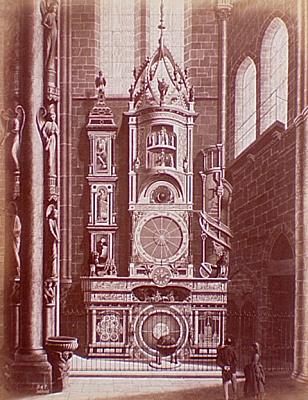
 The exact time at which this clock, which in the fourteenth century must have
been a wonderful piece of workmanship, and was called the clock of the three sages, ceased going, is not known; it had
been stopped for a long time, when in 1547 the magistrate of the town decided on having another made and putting it opposite
the old one, in the very place the clock now occupies. Three distinguished mathematicians furnished the plan and superintended
the execution of it; they were Dr. Michel Herr, Christian Herlin, professor of mathematics at the school of
Strasburg, and Nicholas Prugner, who, after preaching the reformation at Mulhouse and at Benfeld, occupied himself at
Strasburg with mechanics and astrology. These three learned men began this work, but did not terminate it; it was
resumed in the year 1570 by a pupil of Herlin, named Conrad Dasypodius of Strasburg, where he was a professor of
mathematics. Dasypodius drew the design of the clock, but its execution was confided to two skilful mechanics of
Schaffhouse, the brothers Isaac and Josiah Habrecht; Tobias Stimmer, also of Schaffhouse, had the charge of the
paintings. This master-piece of the mechanical art of the sixteenth century was completed in 1574; it ceased going in 1789.
As the exterior distribution of the present clock is nearly the same as that of the old clock, we shall abstain from describing
the latter. In 1386 the corporation of the town of Strasburg adopted the resolution of causing this curious monument to be
repaired. To Mr. Schwilgué preserved of the former clock only its fine case, the paintings and ornaments of which were carefully
repaired. In this he had many difficulties to overcome, as well for the proper arrangement of this mechanism and lodging it
in a space that was often very limited, as for making the old signs or indications accord with the movements of the clock-work.
Of these many were marked only in painting, and must have been renewed after a certain time, as for instance those of the eclipses,
which now by a most ingenious mechanical combination will henceforth last for ever. The little statues which hitherto had no
articulation, are now moveable; The exact time at which this clock, which in the fourteenth century must have
been a wonderful piece of workmanship, and was called the clock of the three sages, ceased going, is not known; it had
been stopped for a long time, when in 1547 the magistrate of the town decided on having another made and putting it opposite
the old one, in the very place the clock now occupies. Three distinguished mathematicians furnished the plan and superintended
the execution of it; they were Dr. Michel Herr, Christian Herlin, professor of mathematics at the school of
Strasburg, and Nicholas Prugner, who, after preaching the reformation at Mulhouse and at Benfeld, occupied himself at
Strasburg with mechanics and astrology. These three learned men began this work, but did not terminate it; it was
resumed in the year 1570 by a pupil of Herlin, named Conrad Dasypodius of Strasburg, where he was a professor of
mathematics. Dasypodius drew the design of the clock, but its execution was confided to two skilful mechanics of
Schaffhouse, the brothers Isaac and Josiah Habrecht; Tobias Stimmer, also of Schaffhouse, had the charge of the
paintings. This master-piece of the mechanical art of the sixteenth century was completed in 1574; it ceased going in 1789.
As the exterior distribution of the present clock is nearly the same as that of the old clock, we shall abstain from describing
the latter. In 1386 the corporation of the town of Strasburg adopted the resolution of causing this curious monument to be
repaired. To Mr. Schwilgué preserved of the former clock only its fine case, the paintings and ornaments of which were carefully
repaired. In this he had many difficulties to overcome, as well for the proper arrangement of this mechanism and lodging it
in a space that was often very limited, as for making the old signs or indications accord with the movements of the clock-work.
Of these many were marked only in painting, and must have been renewed after a certain time, as for instance those of the eclipses,
which now by a most ingenious mechanical combination will henceforth last for ever. The little statues which hitherto had no
articulation, are now moveable; 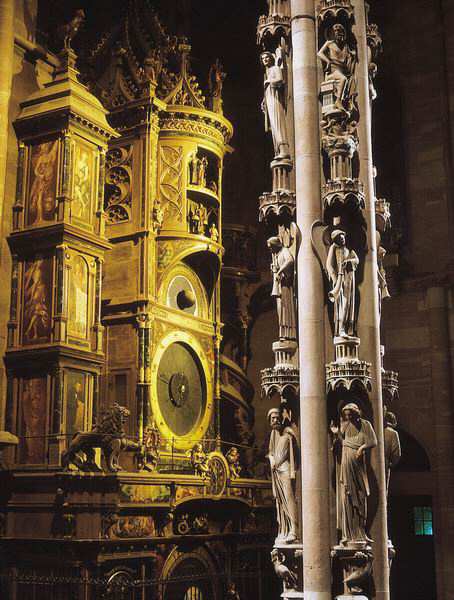 the twelve Apostles have been added to the former number of them. The figure of Death,
formerly on the same level with that of Jesus-Christ, is now placed in the centre of figures representing the four ages of
life and striking the quarters of hours, the idea of assigning this place to the image of death is assuredly a more rational and
finer one than that which prevailed in the old distribution of the figures. Childhood strikes the first quarters; Youth the
second; Manhood the third, and Old Age the last; the first stroke of each quarter is struck by one of the two genii seated
above the perpetual calendar; the four ages strike the second. Whilst death strikes the hours, the second of these genii
turns over the hourglass that he holds in his hand. The image of the Saviour stands now on a higher ground; at the hour
of noon the twelve Apostles pass bowing before him; he lifts up his hand to bless them, and during that time, a cock, whose
motions and voice imitate nature, flaps his wings and crows three times.
the twelve Apostles have been added to the former number of them. The figure of Death,
formerly on the same level with that of Jesus-Christ, is now placed in the centre of figures representing the four ages of
life and striking the quarters of hours, the idea of assigning this place to the image of death is assuredly a more rational and
finer one than that which prevailed in the old distribution of the figures. Childhood strikes the first quarters; Youth the
second; Manhood the third, and Old Age the last; the first stroke of each quarter is struck by one of the two genii seated
above the perpetual calendar; the four ages strike the second. Whilst death strikes the hours, the second of these genii
turns over the hourglass that he holds in his hand. The image of the Saviour stands now on a higher ground; at the hour
of noon the twelve Apostles pass bowing before him; he lifts up his hand to bless them, and during that time, a cock, whose
motions and voice imitate nature, flaps his wings and crows three times.
Mr. Schwilgué has altered the old calendar into a perpetual one with
the addition of the feasts that vary, according to their connection with Easter or Advent Sundays. The dial, nine metres
in circumference, is subject to a revolution of 365 or 366 days, according as the case may be. Mr. Schwilgué has
even indicated the suppression of the secular bisextile days. He has moreover enriched his work by adding to it an
ecclesiastic compute with all its indications; an orrery after the Copernican system, representing the mean tropical
revolutions of each of the planets visible to the naked eye, the phases of the moon, the eclipses of the sun and moon,
calculated for ever; the true time and the sideral time; a new celestial globe with the procession of the equinoxes,
solar and lunary equations for the reduction of the mean geocentric ascention and declension . . . . .
-- from Historical Sketch of the Cathedral of Strasburg, Twenty sixth Edition, published by Unims
Library (Librarie Unim Papeterie) MCMXXVI (1926), pp. 32-35.
|


