 |
 y 1840 the village has developed to such proportions that it withdraws from the old Roxborough Township and
becomes incoporated as a Borough. Joseph Ripka is made the first Burgess. Upon its incorporation as a Borough, a
public school board is elected, which this year builds a school up at the "Blocks"; starts another one in the basement of the
Fourth Reformed Church and still another in a house on Church Street, just above St. David's Church. Mr. Wm. P. Hodgson
is made schoolmaster of the one on Church Street.
y 1840 the village has developed to such proportions that it withdraws from the old Roxborough Township and
becomes incoporated as a Borough. Joseph Ripka is made the first Burgess. Upon its incorporation as a Borough, a
public school board is elected, which this year builds a school up at the "Blocks"; starts another one in the basement of the
Fourth Reformed Church and still another in a house on Church Street, just above St. David's Church. Mr. Wm. P. Hodgson
is made schoolmaster of the one on Church Street.
On January 13th, 1842, the Main Line of the Reading Railroad is
opened and the first train load of coal comes down. The cars are small, four wheeled, wooden affairs. They look like wagons.
There are fifty of them in the train. They weigh 2 tons apiece and carry 3 tons of coal each. The engine is either the
"Gowan and Marx" or the "Delaware" and weighs 10-1/2 tons. It takes a day for the train to come from Mt. Carbon
to Philadelphia.
In 1846 the Green Lane Grammar School is built and Mr. Hodgson is
transferred from the Church Street School to the new one. Three years later Ebenezer Church is built over on Gay Street. On
the 3rd of September, 1850, a great freshet occurs in the river. The Conshohocken bridge is carried away and as it
floats down the stream it strikes the Flat Rock bridge and carries it away also. In 1851 the Manayunk Baptist Church is built on
Green Lane just below Wood Street. Heretofore the streets have been lighted by oil lamps and the houses by lamps and candles,
but in 1852 the gas plant is erected away down Main Street, below Shurs Lane, so that from now on the lighting will be better.
1854. -- Now, as we have stood on this cliff for two hundred and twenty-one years,
watching the development of the village from the rear, let us change our position and look at it from the front. We climb
down the hill, go down Green Lane, cross the river and climb the hill just below the other end of the bridge.
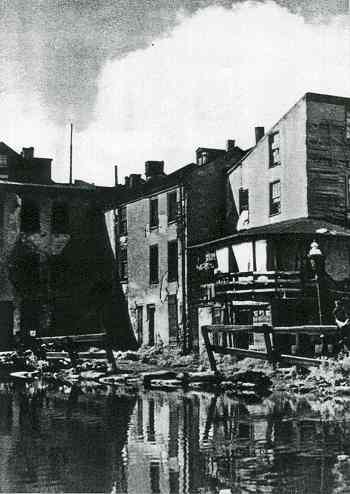
The view is a pleasant one. The town is built on the side of a steep hill with
the river at its foot. Trees and fields crown the hills in the background. Half a mile up river to the left -- woods and
fields. Half a mile down river to the right -- the same. A mile and half up stream, Flat Rock Dam sparkles in the sun.
A half mile down, the horse bridge crosses the river at the lower end of town. Immediately below to the left is Green Lane
bridge.
Mills line the opposite bank of the river, with trees between them and along
the waters edge. The clack-clack of the looms and the hum of the mules is heard. Immediately back of the mills is the canal.
The boats slowly pass each other, drawn by drowsy mules. The tinkle of the bells is heard as they go by and as the down
river boats near the lock, at the horse bridge, the horns blow for the lock tender to open the gate. Along the edge of the canal
is the Main Street, with stores and hotels. A stage coach pulls up to the Manayunk Hotel at the foot of Jackson Street. A
square beyond is the Reading Railroad parallel to the Main Street.
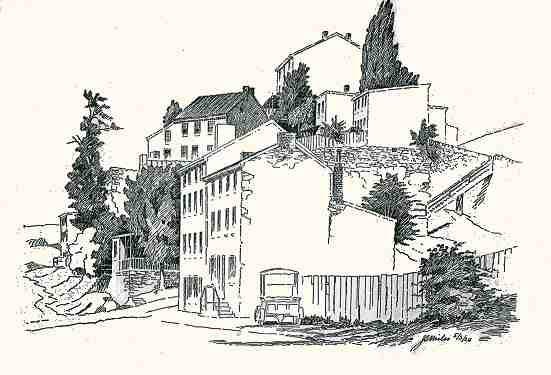
The houses are small, but sturdy and strong; with plastered stone walls and steep gable roofs,
stepped one above the other as they ascend the hill. Trees rear their heads above the housetops. Here and there a church is
seen; its white paint gleaming in the sun and standing out sharply against the green of the trees.
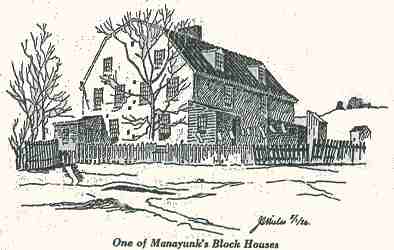
At the up river end of the town are open fields and trees, with here and
there a house. There stand the two block houses, after which that part of the town is named -- "The Blocks". These two houses,
with their great gambrel roofs -- four houses under each roof -- look like Duth wind-jammers. Green Lane, Levering Street and
Shurs Lane are the only streets running through to Roxborough. They run through gaps between the hills. The other streets in that
direction stop at the foot of the high cliffs. There is no house on Hatshop Hill. Mr. Ogle's house stands among the
trees on the cliff between Green Lane and Levering Street.
On Green Lane, almost opposite the Baptist Church lives Perry Levering,
the great-grandson of Jacob Levering, in the house that Jacob built in 1736. It is a small stone house, now plastered, with
a high porch right along the sidewalk. Steps go up to the porch from the sidewalk. Trees surround the house and one especially
big one overhangs it. Beyond the house, in the rear, is an orchard. The boys bother the life out of Perry in this orchard. As
they steal the apples, Perry chases them. After they have reached safety, they taunt him by shouting, "Perry in your lot, stealing
all you got."
The first house on the left side of Green Lane, beyond Manayunk Avenue -- the old
Keely homestead -- is the residence and private school of Rev. Samuel Burnstead. Like "Bishop" Ellis,
Mr. Bumstead takes a nap after the noon recess, but before doing so, smokes a long clay pipe. It is the daily duty of
one of the boys to fill this pipe and hold a lighted taped to it until the old man has it lit. One day the boys play a joke.
A little powder is mixed with the tobacco. The old man puffs complacently. The boys wait expectantly. Just as the old man
is falling into a doze -- Bang! The bowl of the pipe blows off the stem!
In thirty years Manayunk has grown from a small village of eight hundred
people, to a busy and prosperous town of over six thousand. It has gained the reputation of being the largest manufacturing
center in Philadelphia County. It is called the "Manchester of America." In these thirty years Philadelphia has also
grown out of bounds, so in this year 1854, Manayunk, Roxborough and Wissahickon, which, in the early days, were combined as
Roxborough Township, are all incorporated as the Twenty-first Ward of the great City of Philadelphia.
In 1858, Martin Nixon, of the Flat Rock Mills, which stand along the
canal bank, beyond the upper end of the town, improves the method of making straw paper, and furnishes the Public Ledger
with the first straw paper used by a newspaper press in this country. This adds to the fame of the town.
A horse car line to the city is completed in 1859 and the first car arrives. It
comes tinkling along Main Street, amid the hurrahs of the crowd. Both sides of the street are lined to see the new toy.
The horses are gayly decorated. The car is brilliantly colored -- yellow predominating, with red trimmings. It has six
windows on each side and the seats run along the sides of the car. The old stage coach will now have to take a back seat.
The American Wood Paper Company is organized in 1868, and erects the Pulp Works,
up at the "wide," along the canal bank, just above the Flat Rock Mills, to make paper out of wood pulp. This adds materially
to the prosperity of the town.
In the summer of 1868, Shawmont reservoir is completed and supply mains
are laid; "but little distributing pipe has yet been applied for or laid and very little anxiety has been exhibited by
the citizens of Manayunk and Roxborough to take the water." Water is pumped into the reservoir on April 5th, 1869, but
it leaks so badly that the pumping has to be discontinued until the leaks are repaired. Pumping is resumed in December.
The old town pump has had its day. No longer will the boys be able to put
their tongues on the iron pump handle on cold frosty mornings and have them stick to it. The passing of the old pumps
will also have a deterrent effect on the town gossip, as the good housewives will no longer be able to meet at these centers
with their buckets and pitchers and pass the time o'day.
On the 4th of October, 1869, the worst flood in the history of the river
occurs; surpassing those of '22, '39 and '50. The water rises higher and higher until the canal and the river are one. A
canal boat, full of coal, docked in front of the Pulp Works, breaks from its moorings and floats over into the river. On the boat
are the captain and a boy. The captain throws a yawl overboard and springs into it, calling to the boy to follow. For
some reason the boy fails to do so and is carried down the river on the boat. The water is a raging torrent, reaching almost
to the under side of the Green Lane bridge. The boat gathers tremendous momentum as it nears the bridge. Nearer and nearer
it comes. The people shout from the shore. The boy stands on deck, apparently dazed. -- Thud! Crash! Smash! Splintering
and rending timbers! A whole span of the bridge is town away. The boat reels, staggers and capsizes. The boy disappears and is
seen no more.
A movement is started in 1872 to erect an incline plane railroad from Manayunk to
Roxborough. The intention is to start at the foot of Gay Street and run to the top of the cliff. From here it is to
continue and connect with a horse car line up on Ridge Road, Roxborough. The location is changed to run up Levering Street.
The bill of incorporation is signed by Governor Hartranft, April 10, 1873. The "name, style and title" of the
Company is "The Manayunk and Roxborough Incline Plane Railway Company" or the "M. & R. I. P. R. W.," for short. A working
model is made by Thomas Shaw and a patent applied for. Ground is broken on the last day of 1873. On the 6th of June,
1874, a meeting of the Company is held and a dispute arises over the Incline. So much of the stock is withdrawn that the
Incline Plane proposition is abandoned and efforts are concentrated on the Ridge Road horse car line in Roxborough.
The Pennsylvania Railroad is built in 1884. It crosses the river, from the hill
on which we stand, to the Manayunk side, on the high steel bridge, shaped like the letter "S."
1888. -- The intercepting sewer and branches are being installed. The old
outhouse will have to go. The polluted air, which formerly on still hot summer nights, could be cut with a knife, will soon
clarify. Streets, which hitherto in the spring of the year and rainy seasons, have been veritable quagmires, and gutters, reeking
with green and black scum, are being graded and paved with Belgian blocks.
1890. -- Up to this time the Green Lane bridge has been a Pay Bridge, charging
a penny, each way, for each person. Pennies are scarce and very few boys have any at all. Stuart Lyle's orchard on the hill,
on the west side of the river, above the bridge, with its cherries and apples and pears, is a great temptation; the open country
over there is alluring; the races at Belmont Track can't be seen without crossing the river; so the boys without pennies, tie their
clothes in a bundle on their heads and swim across from "back o' Jims"; only to find when they have reached the other shore
that the bundle has slid to one side and is wet.
In this year, the bridge is purchased by the Philadelphia and Montgomery
Counties and made free, whereupon the boys troop across in droves and indulge in the dangerous sport of jumping the coal
trains of the Reading Railroad; riding up to Mill Creek and back; some going even further. They become such a pest that the
Company has to employ men to prevent it. On Thanksgiving Day the cry goes forth and spreads like wildfire that one of the
boys -- Jack B_________ has had both legs cut off, up at Mill Creek. Poor Jack; what a daredevil he's been; always up to
something; the dread of all other boys, big and little; always picking a fight; the first one to run ticklies on thin ice
in the winter and the first to go through. But he's still game; he buttons up his coat and gives directions as he is
lifted up and taken to St. Timothy's Hospital, where he lays for a long time. Even worse than having his legs cut off,
is when they put hot water bags around them at the hospital; one of the bags bursts and scalds him. Jack says his feet still
itch in hot weather and he has to scratch the butt ends of his legs.
Speaking of the boys swimming the river with their clothes on their heads; why, there isn't
a boy in Manayunk that can't swim. It's part of his education. There isn't a better swimming school in the world than at those
rocks along the west shore, three hundred yards above the bridge.
His first lessons are from shore to the Baby Rock; the distance is about fifty
feet; the water, three or four feet deep and the bottom of smooth solid rock. As soon as he learns to swim to this rock,
the next step is to swim from the Baby Rock to the Diver -- about fifty yards. The Diver is a smooth round knob of a rock
at the end of some great big rocks which extends a hundred yards from shore to mid-stream. Not every boy will forget this feat --
how he was almost winded before he reached the goal.
His next feat is to swim across the channel, from the Diver to east shore,
stopping for wind on the sand bar half way over. While performing this feat the dirty beggars on the big rocks "chaw beef"
on him; they tie knots in his undershirt. On his way back he hears them shout "Chaw beef! Chaw beef! Chaw your mutton,
chaw your beef!" When he comes to put his shirt on he finds so many knots in it he has to take it home in his pocket.
One hot summer day a dozen or so fellows went up to Stuart Lyle's orchard, and
after eating a lot of apples, came down to the Diver to go into swim. They hadn't been in long before big Bill T________
got a cramp and called for help. The fellows swam out to him and had quite a time dragging him in. He was a tall, long-legged
fellow and the cramp had him all tied up into knots; howasever they managed to get him to the rocks and after rubbing him awhile
he was all right.
As for fishing and boating -- there is no better place. The sunfish up at
the tunnel are as big as the palm of his hand and plenty of them. All he has to do is get a wasp nest full of young grubs;
go up there and he'll come home with a sunny for every grub. Black Bass are also good there but he must be careful or he'll
get his hook caught. It's very rocky. The bottom of the river up there must be covered with hooks and dipsies. Bass and
Yellow Neds are also good in the channel off those rocks beyond the Diver, and for eels and catfish -- the canal is full of
them. He can get suckers, too, in the spring of the year, when the water is still cold; in the swift water, just below Flat
Rock Dam.
If he has an old canoe or some kind of a light boat that two can carry and
he isn't afraid if a hole gets stove in it; there isn't a better sport, when the water is high, not too high, though, than to go
up the canal; carry the boat over to the river; launch it at a point opposite the tunnel, and shoot the rapids. He had
better be careful, though, for the rocks are bad.
For hikes, why there's all outdoors over there on the west side; around Rock
Hill, up to Mill Creek, or over to Boulder's Woods. In the summer -- wild cherries galore. In the fall -- chestnuts,
walnuts, hickory nuts, shellbarks, butternuts and persimmons by the bushel!
Out in the field, just before he comes to Boulder's Woods, is a great big
chestnut tree, just loaded with chestnuts. He'll have to keep a sharp eye out for Sim Jones' dog, though, he's a bad one.
If he fond of gunning, he'll find plenty of rabbits and squirrels over there, and in the
hollow near the duck pond, this side of the woods, are robins, flickers, and meadow larks. When the water's high, there are
muskrats by the score up along the river at the tunnel; the water routs them out of their holes and they scamper along the
water's edge. There are possums up there, too, on Tunnel Hill.
Skating is another part of a Manayunk boy's education. His first lessons are
taken on Rudolph's Dam -- a small dam on the west side along Belmont Road in the hollow just beyond the Reading Railroad.
Having learned the rudiments of the sport here, he walks a mile and a half further on to where the more accomplished skaters
go -- Schofield's Dam. This is a pretty dam, a couple o' hundred yards long and a hundred wide, situated among wooded
hills along State Road. Here he is initiated into the game of "Shinny" (developed in later years into ice hockey).
After having his shin cracked several times with a shinny stick or the wood block he is introduced to the game of "Crack-the-whip."
He is placed at the end of a long line of skaters, at the upper end of the lake; each man with his arms outstretched and holding tightly
the hand of his neighbor. Down the lake they come, faster and faster; all swinging together. Presently the hub man shouts, "Turn!"
He digs his skate into the ice and stops abruptly, holding tight to the fellow next to him, who hold tight to the fellow
next to him and so on. The skaters stop skating and glide by the momentum they have gained. The line swings in a circle.
The tension becomes greater and greater to those farther from the hub. The novice at the end of the line can hold on no
longer. Away he goes and either sprawls all over the ice or, if he can hold his feet, he flies like an arrow.
There's a place over there by the east shore, that rarely freezes over, on
account of a spring at the bottom of the lake. One day during a "Crack-the-whip" game, Bill B___________ was at the
end of the line; he was slung so hard, toward this place, that he couldn't stop. C-r-a-ckle! S-w-sh! In he goes, over his head,
skates and all. "Man overboard. Quick! Get that fence rail over there on the shore! Throw it to him! Take hold of this rail,
Bill!" Billy grabs the rail and manages by the help of the others to make shore. He's a bedraggled mess; soaking wet, and it's cold.
"Build a fire, fellows! Chipper go! Who's got a match? More wood!" Pretty soon a good blaze is kindled and it isn't long
before a big fire is roaring. Steam begins to rise from Billy's wet clothes. After he has gotten pretty well dried out and heated up,
he puts his skates on again and depends on the crisp dry air and exertion to complete the drying process.
Returning to our young skater, he learns to skate backward; then the "Circle" and the
"Roll," forward and backward; likewise the "Figure Eight." When he has mastered the convolutions of the "Grape vine," he is
a full-fledged skater and exhibits his skill with pride before the onlookers.
For long distance he skates up the canal to the "Wide"; then on to the upper lock,
where he takes his skates off, walks over the lock and dons them again on Flat Rock Dam, where he skates to Conshohocken -- four
miles; or he skates down the river from Wissahickon to Fairmount -- five miles. These long distance feats are rare, though, for
it isn't often that the river freezes over to this extent. The last time this was done was in the winter of 1895.
The hills of Manayunk were just made for sledding and they're full of them when
sledding's good. There's danger, though, where the railroad crosses at the foot of the steep streets and it keeps the "cops"
busy preventing accidents. Many a boy has been "nabbed" by Billy Green; taken to the station house and had his sled taken from
him for sledding across the tracks. Gay Street is one of the best to sled on because there's not so much traffic. There's an
old man lives half way up that street that doesn't like boys and he doesn't like sleds. His name is "Daddy" Small.
For a livelihood he brings something or other home from the mills and picks all the little steel stickers out of it. These
stickers he saves until he has about a bushel; then, when sledding is at its best and the street has been worn smooth as glass, old
man Small brings this bushel of stickers out and maliciously scatters them over the street. The next fellow down the hill strikes
these stickers and sprawls all over the street. This puts an end to sledding on Gay Street until enough snow can be gathered
to cover them up.
Sleighing is indulged in along the Wissahickon by the more fortunate; although
many a box has been rigged up on a pair of runners; an old plug of a horse hitched to it; a couple of bobsleds tied on behind and
away they go. Why, there isn't a better place in the country 'round for the liberal education of a boy than Manayunk!
May 19th, 1894. -- The trolley line, up the hill, from Manayunk to
Roxborough is completed. This line will take the place of the Inclined Plane, abandoned twenty years ago.
May 25th, 1894. -- Another big freshet, rivaling the one of '69. The
people in the houses along the river get out the second story windows in boats. The canal and the river are one. The water
reaches to within three and a half feet of the high mark of '69. Great damage is done and great loss of property, but fortunately
-- this time -- no lives are lost.
August 29th, 1894. -- The trolley line from the city is finished and the first
car comes up Main Street. The old horse, that has stood for so many years under the railroad bridge at the Falls, to be hitched to
the car and drag it up Strawberry Hill, can now take a long rest.
1902. -- The filtering beds are built at Shawmont. The water from the spigot,
which formerly was raw -- just as it came from the river -- will soon be clear. Hitherto, during a freshet, the water from the
spigot would turn yellow, as coming from the region below Norristown; then red as the Perkiomen water came down, then dark brown
from Reading and finally black, as it came from the coal regions, and black it would stay for weeks and weeks; all types leaving a
sediment in the container, like powdered coffee in a percolator, accompanied by their various odors and flavors. Germs?
Whew! It's a wonder any one lives to tell the tale. Prudent housewives used to constantly keep a pot on the fire to kill
the germs; permitting it to cool after coming to a boil and drawing off the clear after it has cooled. It wasn't fit to wash
in, not to mention drink.
March 1st, 1902 -- After a long rainy spell the river begins to move about
mid-afternoon of February 28th. The movement at first is sluggish. It grows more rapid as evening approaches. Toward
midnight it begins to look like a flood. About 1 A.M. the good housewife shakes her husband by the shoulder and says, "John,
John! Get up. The whistles are blowing!" Lights appear in the houses. Men hurry through the streets. Lanterns flicker
along the river bank. Stakes are driven in at the water's edge to measure the rise. The report is that the water is rising
two inches in ten minutes -- twelve inches an hour. The indications are that it will be a bad one. Lights are seen in the
lower stories of the mills. Men move the stock out of danger. Belts are cut from the machinery and taken away. Ropes
are lashed around lumber piles along the River Road. The larger piles are tied to trees, telegraph poles -- anything.
The smaller ones are loaded onto wagons and hauled to higher ground. Men work frantically. They shout, swear, curse. Horses kick
and snort. Ropes squeak. Chains clank. Wheels creak.
By morning the word has spread. People breakfast hurriedly and run to the river.
The Bridge is crowded and the banks of the river are lined with people. It's a fascinating sight for those who have nothing at
stake, but it's awful for those who have. A strange ominous sound is heard. It's more than a murmur. It isn't a roar. It's
an uncanny washy sound. It means destruction.
River Road is flooded. The water is a dirty brown color. The black water
hasn't come down yet. All sorts of things are floating down -- drift wood, boards, planks, small logs, big logs; huge
tree trunks, that have lain along the banks of small streams for years; too heavy to be moved, except by deep water -- they wallow
and pitch and roll; disappear and reappear. The water boils around the bridge piers, forming big mounds on the upper sides and
great hollows on the lower sides. A cradle races down stream, followed by a chicken coop; a rowboat, that has broken its
moorings; an outhouse, the gable end of a frame barn, the whole roof of a frame building. The ropes around one of the big
piles of lumber loosen; a board slides out then another and another. Presently the whole pile floats out and down it goes.
Another one follows. Four of them go.
All sorts of rumors spread -- the Main Street is flooded at Shurs Lane; the trolley
cars can't get beyond Wissahickon! -- The railroad is flooded at Spring Mill; the trains can't go beyond Lafayette! -- It's
still raining at Reading! -- A bridge above Reading has been carried away! -- The first dam below Reading has burst! -- The Big
Catfish Dam has broken!
The water is almost up to the eaves of the one-story houses in front of
Rudolph's Mill. The people living along River Road have long since carried everything to the upper stories. They get out of
the second-story windows in boats. The canal and the river are one. The water touches the eaves of the one-story houses --
the high mark of '69.
It has stopped raining at Reading. The water hovers 'round the high mark for an hour.
It begins to fall. The worst is over. It falls one inch in fifteen minutes. The people come and go until late in the
evening. During the night and the following day the water lowers gradually. The banks are strewn with driftwood, debris
and wreckage. River Road, the lower stories of the mills, the first floor of the houses -- everything is covered with
soft, dirty, foul-smelling mud. Men shovel it up, scrape it out and haul it away. It takes days and days to clean it up.
Thousands and thousands of dollars are lost, but fortunately -- again -- no lives are lost.
February 9th, 1910, 7:30 P.M. The watchman has just gone his rounds.
All's well. What's that light in the window? It's red. Is it a reflection? No. It can't be a fire. Everything was all
right a bit ago. Smoke curls out of the cracks of the frame structure. It must be on fire. It is on fire!
Quick! Blow the whistle! The sash and door factory at West Manayunk is on fire! It spreads rapidly. Here come the men.
Get the horses out o' the stable! Get the safe out o' the office! The shavings feed the flames. Boards, frame walls and
shingle roof are an easy prey. The flames shoot out the windows and through the roof.
The Manayunk Fire Company, just across the river, is out in a jiffy. Here
they come over the bridge. The bridge shakes like a leaf. The planks jump and rattle. Easy there, go easy! There are
no fire plugs on the west side. They draw water from the river. The fire is away beyond control. The flames leap high
in the air. The lumber sheds have caught. The sky is lit up for miles around. People run from all directions. The
bridge is full and every point of vantage is taken. The hill above the mill is crowded. More alarms are rung and more
firemen arrive. Hose lines are stretched across the bridge and attached to plugs on the Manayunk side. The stable's in
flames. The office is gone. The fire jumps to the lumber piles. Never was there such a fire since Campbell's mill burnt down,
back in the early '90's. It's a seething furnace. The flames are hill-top high. A locomotive brings several tenders full
of water up from the Falls. No use. You might as well squirt a garden hose at it. There isn't enough water in the river to
stop it. By midnight there's nothing left but piles of glowing embers. The people go home. The firemen hang on. By
morning there isn't enough left to haul away in a cart, except the brick boiler house, the chimney and a tangled mass of machinery.
A conference is held. Insurance is adjusted. The office of the Justice of
Peace nearby is commandeered. Plans are drawn. Bricklayers, stone masons and carpenters are engaged. Up goes a new
brick structure superior to the old one. New machinery is installed. In two months, from the time it burnt down, it is in
operation again. American ingenuity! Never-say-die! Tiger!!
In 1917 the big steel "S" bridge of the Pennsylvania Railroad has become so
weak that trains have to go over it very slowly, so in this year it is replaced by a concrete structure. In 1928, the bridge
at Green Lane also has become so shaky and so narrow that it cannot accommodate the heavy traffic; so in this year it is removed
and a new concrete bridge is built twice the width of the old one.
1930. -- Away back in 1838 Samuel Lawson suggested that the Fourth Reformed
Sunday School take a picnic on the Fourth of July. The suggestion was adopted and a picnic was taken on the hill, above
Tower Street, which at that time was called "The Barracks." It was so successful that all the other Sunday Schools of
Manayunk adopted the custom which has continued to the present day. It is unique in this section of the city and has
gained for it a wide reputation. In 1873 the Manayunk Baptist Sunday School made it still more unique by going to Spring
Mill on a canal boat, accompanied by the Haddington Cornet Band.
This custom has grown to such extent that early in the morning of the Fourth
of July each year, the Sunday Schools of the Twenty-first Ward turn out en masse and march up Lyceum Avenue, Roxborough;
filling the street from curb to curb and end to end, with bands playing and flags flying, bedecked in gay colored costumes,
carrying banners and insignias of different types. At the end of the parade they disperse and go to their respective woods to spend
the day playing games, eating ham sandwiches and drinking lemonade.
When Samuel Lawson, son of the original Samuel Lawson, died in 1922,
he left, as a memorial to his father, a legacy of $2,000 to the Manayunk Baptist Sunday School and a like amount to the
Fourth Reformed Sunday School, the income from which was to help deffray the expenses of the Fourt of July picnic of these
two schools. May this custom live for generations to come!
And now in the year of our Lord, 1930, Manayunk is fully developed and fitted
with all modern conveniences. Grade crossing are this year, being eliminated by elevating the tracks. Work has begun on
electrifying both railroads. Electric light is at hand though some of the houses still burn gas. Many of the houses have
telephones but more have radios. Besides a Bank, a Trust Company, two libraries and two theatres there are numerous garages.
The streets are all paved. Auto trucks haul coal and merchandise up the
steep hills with ease, whereas in times past horses did this work; tugging, straining and dragging under the lash of the
whip; clawing for a foothold, blowing and sweating; stopping now and again for wind and finally reaching the top, steaming,
all in and covered with foam.
The houses are so thick that no more can be built. Some are perched up on the
rocks; others sunk down in the holes. Some are so high as to have twenty-three steps from the street up to the first floor.
Others so far down that two stories are below the street level. All the houses are connect with the sewer. Many of the
old outhouses, however, still stand as relics of the past, but are used now as receptacles for shovels, rakes, hoes and clothes
poles. The old town pump and the other pumps have gone. All the houses have clear running water, but not all have bathtubs; in
such, the Saturday night ablutions are taken in a wash boiler in the kitchen.
A little narrow street called Harrison Street running from Oak Street to Gay
Street is lined on both sides with small houses. Years ago these houses were filled with Poles. Every now and then there
was a wedding. A Polish wedding lasts all day and all night. The dancing is accompanied by a fiddler playing on two
strings of a violin; first on one and then on the other; this and the shuffle of the dancers' feet was distracting.
At the corner of Harrison and Gay Streets lived an Irishman, named Bob B__________.
Bob was also an Orangeman and on the first day of July, each year, he wanted everybody to know it. Almost directly opposite,
on Gay Street, lived Pete D_____________. Pete was also an Irishman but not an Orangeman. On hot summer nights
Bob and Pete slept on the door step. On such nights arguments arose over the Battle of the Boyne. The arguments were usually
ended with bricks.
Stuart Lyles' orchard is gone. There's no more swimming at the Baby
Rock and the Diver. Chestnuts are but a memory. Squirrels and rabbits are scarce. The muskrats have disappeared and
the only fish in the river are those miserable carp. Sledding is a thing of the past. Skating is a rarity and a sleigh is
an antique. Rudolph's dam and Schofield's dam have long since been filled up. Boulder's Woods is a residental section; so
is Belmont Race Track. The last canal boat was locked through in 1916 and the old boatmen have "crossed the bar" along with
a great host of others that have contributed to the name and the fame of this town, built upon the bank of the Schuylkill,
more than a hundred years ago -- Manayunk.
A Historical Sketch of Roxborough, Manayunk, Wissahickon compiled from the records of Joseph Starne Miles
and Rev. William H. Cooper (1940), pp. 90-98
|


