|
". . . Late in 1864 Prior Othmar
was able to send the first Minnesota candidate for the priory to St. Vincent
to make his canonical novitiate. On 6 January 1862 Prior Benedict had
invested five of the pioneer students with the Benedictine habit. Their names
were Fratres Benedict M. Duerr, Boniface Emmel, Willibald Michel, Augustine
Marshall, and Valentine Stimmler. They attended
college classes with the other students while preparing gradually as
scholastics for monastic life. The community was proud of these first
candidates for their priory, and thanked God that so many of the first
students had chosen to follow St. Benedict's age-old way of life. But the
indecision, differences and instability of the Minnesota Benedictine
pioneers militated against installing the virtues and ideals that these
candidates needed. Accordingly, only one, Valentine
Stimmler, persevered in his original determination by the time of
Prior Othmar, and it was he who was sent to St. Vincent for the novitiate.
He completed his training, took solemn vows and was ordained in 1869, thus
becoming the Minnesota priory's first candidate who persevered. . . ."
(pp. 74-75)
"During the winter of
1865-66 a primitive road was cut through the maple forest from the old farm
to the new building site. In April, as soon as the spring thaws set in, the
Benedictines, with a few hired laborers, began cutting down trees where the
monastery, school and stables were to stand. The frame house was moved up
from the Collegeville farm to serve as lodging for the laborers. Then
excavations for foundation walls were made, a well dug, and on 28 May 1866
Brother Thaddaeus drove up the winding road with the first wagon load of
boards from the saw mill in St. Cloud. As he came over the hill Fathers
 Prior, Meinulph, Joseph, Wolfgang and Valentine
chanted the Salve Regina, seasonal hymn in honor of the Blesséd
Virgin Mary.
Prior, Meinulph, Joseph, Wolfgang and Valentine
chanted the Salve Regina, seasonal hymn in honor of the Blesséd
Virgin Mary.
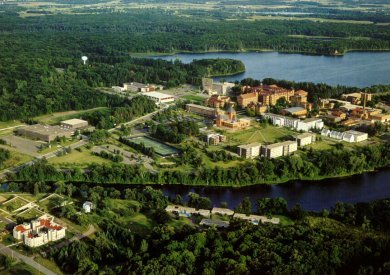
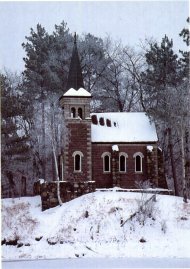
"The most intriguing aspect of
this move was the type of building the monks decided to erect on the lake
shore. In St. Cloud, St. Joseph and the Indianbush they had rushed ahead
with frontier frame structures indicative of the pressures of their first
ten years. Now, clearly convinced that they had made their last move, and
with abbey status soon to become a reality, they chose to build with stone.
They could scarcely have chosen a better medium to express the stability and
security they were seeking. Large boulders were hauled from the hill tops
and smaller rubble stones collected along the lake shore . . . ."
(p. 82)
"The new abbot began
to function in a room twelve feet square on the first floor of the Stone
House. The building was not entirely plastered and lacked even necessary
furniture. The only monks at home were Prior Benedict, Father Joseph Vill,
who had been ordained by Bishop Grace in February, Frater
Valentine Stimmler, a cleric in minor orders, and six Brothers. The
other nine priests and two Brothers were stationed on the missions. . . ."
(p. 100)
"During that summer of
1867 the largest faculty in the ten years of St. John's Seminary and College
was assembled. Prior Benedict was to teach dogmatic theology; Father Wolfgang,
Church history, Latin, Greek, mathematics, bookkeeping and music; Father
Augustine, moral theology, religion, rhetoric, English grammar and composition;
Father Alexius, philosophy, Latin, Greek, history, English and German;
Father Valentine, religion and arithmetic, and to
serve as prefect of students with the imposing title of 'chief disciplinarian.' . . ."
(p. 103)
". . .
Father Valentine Stimmler was given the unenviable
responsibility of taking charge at the Assumption, and Father Meinrad Leuthard
was sent from the Commerical College to audit the parish books. By December the
full picture was clear; the total indebtedness of the parish was $151,000,
and for years one of the new abbot's main concerns was to liquidate this debt
while maintaining peace in the parish itself. It was eventually accomplished
through the efforts of successive pastors and the good will of the German
Catholics of St. Paul. Fairs were held, drives made, and the pioneer
missionary, Father Bruno Riess, came back to Minnesota for a few months to help
collect money. These accumulated debts were a serious drawback for a new
administration. But with a characteristic zeal and energy which would soon
be the talk on every side, Abbot Alexius declared 'it is never too late to
do a thing well.' With a mixture of felicitous ingenuity and frontier
practicality, he moved toward positive results. Yet such uncertainties were to
continued to plague him throughout his administration." (p. 133)
". . . All monks and
nuns were heard, and a set of questions asked of each. Cardinal Simeoni had
sent Archbishop Ireland copies of the documents which had been submitted at
different times to the Propaganda against Abbot Alexius and his administration.
The questions asked by Archbishop Ireland in his capacity as visitator were
strikingly similar to the charges Abbot Zilliox had made during his visit to
Minnesota in 1888. At Red Lake Father Shanley told Father Aloysius, after
the latter had finished an ardent defense of the abbot, that he 'felt sorry
for Abbot Alexius and that no Benedictine would be a bishop of the new province,
he believed, under the circumstances.' When the archbishop arrived at the
abbey, Fathers Chrysostom, Francis, Valentine and
Gerard headed a petition which they requested the visitator to forward to Rome
with his own papers. In the protest they stated that 'the Rev. Othmar Erren
is a fugitivus and as such excommunicated. Msgr. Marty could not
legally receive him into his Vicariate, could not give him Faculties and
having done so in violation of Canon Law, the Msgr. Marty has also fallen
into censures. He is an abettor of bad monks and a danger to all monastic life.'
"Archbishop Ireland informed
Father Chrysostom, vice-president of the school, 'that the whole visitation
would amount to nothing except the two points: 1) spiritual and 2) intellectual
training.' The questions asked by the visitator of the abbey were, as
Abbot Alexius recorded:
"'. . . How is the order or
Rule kept? Does the Abbot -- Alexius Edelbrock -- attend choir? Does the
Abbot run around much? Is the Abbot cruel and tyrannical? Is the Chapter
free? How many Fathers were expelled? How many ran off? Is the Abbot after
money? Why have you so many missions? Have the clerics time to study? Do
they teach classes? He placed great stress on the time allowed the clerics
for studying; he thought the clerics ought not to teach, they ought to have
five years in the clericate and should not be Prefects, should stand
under strict obedience. The intellectual and spiritual
training at St. John's Abbey and University was by him considered too low.
Yet is is a fact that no secular clergyman up to the present time has
received as much spiritual training as our folks, and very few secular clergy
have gone through a five years' classical and three years' theological
course, such as all our men O.S.B. have had. Of course, a longer and more
thorough course would be very desirable, yet as long as the priest is for
the people, and as long as people are going to destruction for want of
priests, so long would it be cruel not to have priests ordained when they
possess sufficient knowledge. We must first look to what is
necessary, then to what is merely desirable. . . ." (p. 181)
|