
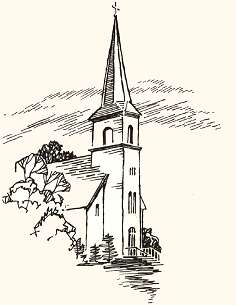
A History of
1863-1963
by Rev. Val J. Klimek
July 23, 1963
St. Lawrence Parish, Duelm, MN
Centennial Jubilee1863-1963
by Rev. Val J. Klimek
July 23, 1963
|
|
A History of
St. Lawrence Parish, Duelm, MNCentennial Jubilee1863-1963 by Rev. Val J. Klimek July 23, 1963 |
|
"A good starting point might
well be a very abbreviated history of Benton County, in which Duelm lies.
This county was once the home of Sioux and Ojibwa Indians. It received its
name from Thomas Benton, a Senator from Missouri, who piloted the Homestead
Act through Congress in 1862. The first people to come to the new County were fur
traders who settled here in 1844. In 1850 the population of the entire huge county
was 418. They found great stands of pine and ponderosa to the East and North.
Oak and maple were thickly sowed in the middle and Eastern sections. There
was also some open prairie, where buffalo roamed. There were even more lakes
than now, many having since dried up. At that date the county existed as one
of only three counties in the entire Territory of Minnesota, with boundaries
extending far South and North of its present limits. It comprised then some four
hundred and five square miles, or some 200,000 acres.
 "In 1849 the First Legislative
Assembly convened, and the state was divided into nine counties, but even then,
three of these, Benton County included, was recognized as pre-eminent. We
learn that the first board of County Commissioners met in 1850 at the home
of Jeremiah Russell. It was they who further divided the county into three
elective precincts or districts, which continued for many decades.
"The first settler in the
county was a David Gilman, who made a claim at Watab already in 1848. He
was followed a year later by Jeremiah Russell, mentioned above.
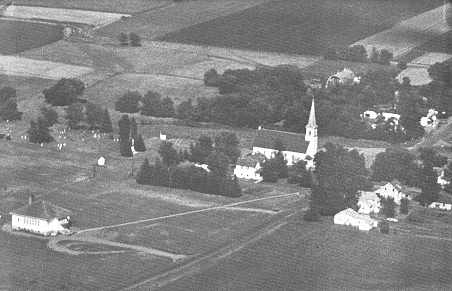
"St. Lawrence Parish is located
in St. George Township, so of course we have a particular interest in that portion
of the county. It is located in the Southern part of the county, and comprises
an area of 23,040 acres. Probably the first man to settle in this area was also
a Mr. Russell, perhaps the same Jeremiah once more, who moved from Sauk Rapids and
laid claim to section #29 in the year 1855. But we learn that he remained only two years and then moved on
once more.
"In the S.E. part of the Township of
St. George, the first settler was Peter Abfalter. He was a native of Germany,
who settled on section #24 in 1862, soon to be followed by Godfrey Attermor and
Vincent Schindler. Peter Abfalter was born in Prussia May 4, 1829. He came
to America in 1844 with his parents, and moved to Minnesota, settling first on a farm
near present Cold Spring, and then in 1867 moving to Benton County. He had
married in 1854, and his wife bore him ten children whose descendants still
live in St. George Township.
"In 1849 the First Legislative
Assembly convened, and the state was divided into nine counties, but even then,
three of these, Benton County included, was recognized as pre-eminent. We
learn that the first board of County Commissioners met in 1850 at the home
of Jeremiah Russell. It was they who further divided the county into three
elective precincts or districts, which continued for many decades.
"The first settler in the
county was a David Gilman, who made a claim at Watab already in 1848. He
was followed a year later by Jeremiah Russell, mentioned above.
"St. Lawrence Parish is located
in St. George Township, so of course we have a particular interest in that portion
of the county. It is located in the Southern part of the county, and comprises
an area of 23,040 acres. Probably the first man to settle in this area was also
a Mr. Russell, perhaps the same Jeremiah once more, who moved from Sauk Rapids and
laid claim to section #29 in the year 1855. But we learn that he remained only two years and then moved on
once more.
"In the S.E. part of the Township of
St. George, the first settler was Peter Abfalter. He was a native of Germany,
who settled on section #24 in 1862, soon to be followed by Godfrey Attermor and
Vincent Schindler. Peter Abfalter was born in Prussia May 4, 1829. He came
to America in 1844 with his parents, and moved to Minnesota, settling first on a farm
near present Cold Spring, and then in 1867 moving to Benton County. He had
married in 1854, and his wife bore him ten children whose descendants still
live in St. George Township.
 "When St. George Township was
first organized in 1858, it included all of what is now Minden and Glendorado Townships
as well. The latter was detached in the year 1867, and the former in 1868. The first
elections in the then larger township was held in 1859. After the township was
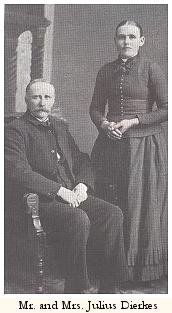
reduced to its small, present size, the first officers were: Supervisors Anthony Carey,
Chairman, Julius Dierkes and Frank Shero; clerk was John Fothergill; Assessor
was Peter Abfalter; Constables were William Hezek and Louis Latterell; and
the Treasurer was Prosper Latterell. These names are noteworthy, as so many
of their descendants still live in this area, and the names are common still.
"In a 'History of the Upper Mississippi
Valley,' kindly provided by members of the Voerding family, we discover that
religious services were first held in Duelm in 1863 by Father Pierz, the great
missionary Priest of the Diocese of St. Cloud. Father Pierz is recognized as
the 'Father of the St. Cloud Diocese.' He came to America when he was already a
comparatively old man, and he was the first Priest to offer Holy Mass in many
places within the present boundaries of the St. Cloud Diocese. Crow Wing has
been designated a State Park, and there we find an historical marker in honor
of this intrepid missionary. His life and work was recalled for all in a book,
'In Charity Unfeigned,' written by Father William Furlan of this Diocese, on
the occasion of the Centennial of the coming of Father Pierz.
"Holy Mass was first offered
in the home of Vincent Schindler, which continued as a place of worship for
some years until the erection of a small log church in section 34. We are
told that Father Pierz returned quite regularly, as there must have been a
goodly number of Catholic people settled in the area. The Vincent Schindler home
was located on what is now the property of Mrs. Agnes Schendzielos. She is
happy to point out that each year, even now, the corn grows bigger and better
where the Schindler home used to stand, where Father Pierz first offered the
Holy Sacrifice.
"After Father Pierz, we learn
that Father Buch came to Duelm to offer Mass and minister to the spiritual needs
of the people there. But it was Father Wilkins who first became a regular
pastor of the Duelm flock. Early settlers came long distances to attend Mass
"When St. George Township was
first organized in 1858, it included all of what is now Minden and Glendorado Townships
as well. The latter was detached in the year 1867, and the former in 1868. The first
elections in the then larger township was held in 1859. After the township was
reduced to its small, present size, the first officers were: Supervisors Anthony Carey,
Chairman, Julius Dierkes and Frank Shero; clerk was John Fothergill; Assessor
was Peter Abfalter; Constables were William Hezek and Louis Latterell; and
the Treasurer was Prosper Latterell. These names are noteworthy, as so many
of their descendants still live in this area, and the names are common still.
"In a 'History of the Upper Mississippi
Valley,' kindly provided by members of the Voerding family, we discover that
religious services were first held in Duelm in 1863 by Father Pierz, the great
missionary Priest of the Diocese of St. Cloud. Father Pierz is recognized as
the 'Father of the St. Cloud Diocese.' He came to America when he was already a
comparatively old man, and he was the first Priest to offer Holy Mass in many
places within the present boundaries of the St. Cloud Diocese. Crow Wing has
been designated a State Park, and there we find an historical marker in honor
of this intrepid missionary. His life and work was recalled for all in a book,
'In Charity Unfeigned,' written by Father William Furlan of this Diocese, on
the occasion of the Centennial of the coming of Father Pierz.
"Holy Mass was first offered
in the home of Vincent Schindler, which continued as a place of worship for
some years until the erection of a small log church in section 34. We are
told that Father Pierz returned quite regularly, as there must have been a
goodly number of Catholic people settled in the area. The Vincent Schindler home
was located on what is now the property of Mrs. Agnes Schendzielos. She is
happy to point out that each year, even now, the corn grows bigger and better
where the Schindler home used to stand, where Father Pierz first offered the
Holy Sacrifice.
"After Father Pierz, we learn
that Father Buch came to Duelm to offer Mass and minister to the spiritual needs
of the people there. But it was Father Wilkins who first became a regular
pastor of the Duelm flock. Early settlers came long distances to attend Mass
 and especially to receive the Sacraments. Long journeys were made, even in
inclement weather, that infants might be baptised; that children might receive
their First Communion; that marriages might be entered with the blessing of
God. These pioneers found great comfort and solace in their faith and the
blessings thereof.
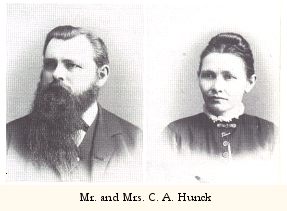
"In January of 1877 C. A. Hunck
appeared on the scene, settling on section 34, the same section as the church.
There he immediately erected a general store. He was a very proper gentleman,
and his store and property was a showplace of the young community. Shortly
afterward, Reichert and Blattner also set up a general store nearby. The settlement,
blessed with a church, was growing. This is always the story of history. 'At
the coming of a parish, Catholics spring up out of the ground.' Whenever a new
parish is founded anywhere, even in our own day, somehow Catholics settle
nearby, so as to more easily share the blessings and benefits of their faith.
The growth of Duelm might well be attributed to the coming of Father Pierz
and the parish he founded! Who can tell what it might be like today if he
had gone elsewhere! It is interesting to ponder!
and especially to receive the Sacraments. Long journeys were made, even in
inclement weather, that infants might be baptised; that children might receive
their First Communion; that marriages might be entered with the blessing of
God. These pioneers found great comfort and solace in their faith and the
blessings thereof.
"In January of 1877 C. A. Hunck
appeared on the scene, settling on section 34, the same section as the church.
There he immediately erected a general store. He was a very proper gentleman,
and his store and property was a showplace of the young community. Shortly
afterward, Reichert and Blattner also set up a general store nearby. The settlement,
blessed with a church, was growing. This is always the story of history. 'At
the coming of a parish, Catholics spring up out of the ground.' Whenever a new
parish is founded anywhere, even in our own day, somehow Catholics settle
nearby, so as to more easily share the blessings and benefits of their faith.
The growth of Duelm might well be attributed to the coming of Father Pierz
and the parish he founded! Who can tell what it might be like today if he
had gone elsewhere! It is interesting to ponder!
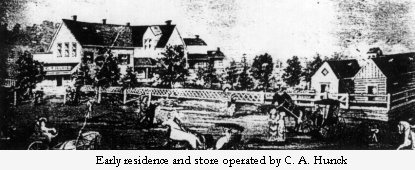 "Henry Voerding is another name
important in the history and growth of Duelm. Through his efforts a post-office
was established here as early as 1870. It was set up in his own home, and he
was the first post-master, of course. He remained post-master for seven years,
after which the post-office was moved to the general store operated by Mr. Hunck.
Mail was distributed once a week, on Sunday morning after Mass. Mail was distributed
by calling out the names of those who received precious letters, perhaps from
relatives still in Germany or elsewhere. Perhaps the news was shared with others.
"Much of the early history of
the area and of the parish is associated with the name Voerding, and much is
owed to him. It was Henry Voerding who gave the name Duelm to the growing
community, beginning to buzz with activity. He named it after the city of
Duelmen in Prussia, land of his own origin. There he had been born in 1818.
He enlisted in the Prussian army from 1840 to 1843 and then farmed there for a
time. In 1852 he came to America. First he lived in several places in
Wisconsin and then moved to Minnesota, where he settled first near St. Augusta.
In 1869 he came to St. George Township, and the following year, as stated above,
he became the first post-master. His nine children continued to live in the
area after him, and continued to make their contribution to its growth and
development.
"It is interesting to find a
list of the produce of the Township of St. George in the year 1880. In that
year, there was produced: 20,597 bushels of wheat; 11,161 bushels of oats;
6,755 bushels of corn; 65 bushels of barley; 923 bushels of rye; 2,904 bushels of
potatoes; 12 bushels of beans; 1,312 tons of wild hay; 158 lbs. of wool; 14,750 lbs.
of butter; 150 lbs. of honey. Although there is some change, of course, most of
these remain the main products of the area today. There is little rye or wheat now,
but oats, corn, hay, butter, and potatoes are produced in great abundance
still. And there is a tremendous increase in the amount of beans that are grown
in modern St. George Township.
"Other names that must be mentioned
among the very earliest pioneers are: Robert Brennan, Joseph Balder, John Brennan,
"Henry Voerding is another name
important in the history and growth of Duelm. Through his efforts a post-office
was established here as early as 1870. It was set up in his own home, and he
was the first post-master, of course. He remained post-master for seven years,
after which the post-office was moved to the general store operated by Mr. Hunck.
Mail was distributed once a week, on Sunday morning after Mass. Mail was distributed
by calling out the names of those who received precious letters, perhaps from
relatives still in Germany or elsewhere. Perhaps the news was shared with others.
"Much of the early history of
the area and of the parish is associated with the name Voerding, and much is
owed to him. It was Henry Voerding who gave the name Duelm to the growing
community, beginning to buzz with activity. He named it after the city of
Duelmen in Prussia, land of his own origin. There he had been born in 1818.
He enlisted in the Prussian army from 1840 to 1843 and then farmed there for a
time. In 1852 he came to America. First he lived in several places in
Wisconsin and then moved to Minnesota, where he settled first near St. Augusta.
In 1869 he came to St. George Township, and the following year, as stated above,
he became the first post-master. His nine children continued to live in the
area after him, and continued to make their contribution to its growth and
development.
"It is interesting to find a
list of the produce of the Township of St. George in the year 1880. In that
year, there was produced: 20,597 bushels of wheat; 11,161 bushels of oats;
6,755 bushels of corn; 65 bushels of barley; 923 bushels of rye; 2,904 bushels of
potatoes; 12 bushels of beans; 1,312 tons of wild hay; 158 lbs. of wool; 14,750 lbs.
of butter; 150 lbs. of honey. Although there is some change, of course, most of
these remain the main products of the area today. There is little rye or wheat now,
but oats, corn, hay, butter, and potatoes are produced in great abundance
still. And there is a tremendous increase in the amount of beans that are grown
in modern St. George Township.
"Other names that must be mentioned
among the very earliest pioneers are: Robert Brennan, Joseph Balder, John Brennan,
 Patrick Carey, J. H. Cullen, John Dunnewold, Martin Herbst, P. J. Jacquemart,
Joseph Kampa, and John Marshal. The
Brennans, Balders, Herbsts, and Kampas remain today in goodly number, and generally
they possess a deep faith, even as their ancestors. For the greater part, they
are still pillars of the church and of the parish, as were their fathers and
grandfathers before them.
"Martin Herbst was born on
November 1st (All Saints Day) in 1844, in Baden Germany. When only nine years old,
he came to America with his parents. The family first settled in Indiana, where
they farmed until the year 1865. Then they moved to St. Cloud, where Martin was
employed by the freight company until 1871. But his love of the independence of
farming induced him to move to Glendorado Township, and then to St. George Township.
In 1871 he had married Caroline Balder, and from this union four children were
born: Joseph, Charles, Albert, and Adolph, names known in Duelm today.
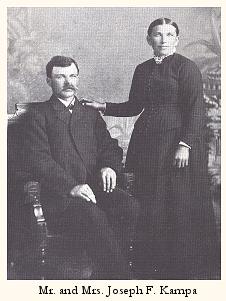
"Joseph Kampa,
also born in Prussia, came to America and to St. George Township in the year of
1870, when he was only 20 years of age. In that same year he married a
Miss T. Balder and his
descendants too remain in the area and in the parish.
"Joseph Balder must also be especially
named, as the forerunner of many descendants of the same name who live in the
area today. He was born November 17th, 1841, in Peterwitz, Prussia, and came to
America the same year as Joseph Kampa,
in 1870. The following year he settled in St. George Township, and four years
later he married Johanna Baron. Four children were born of this union, from
whom today's descendants spring.
Patrick Carey, J. H. Cullen, John Dunnewold, Martin Herbst, P. J. Jacquemart,
Joseph Kampa, and John Marshal. The
Brennans, Balders, Herbsts, and Kampas remain today in goodly number, and generally
they possess a deep faith, even as their ancestors. For the greater part, they
are still pillars of the church and of the parish, as were their fathers and
grandfathers before them.
"Martin Herbst was born on
November 1st (All Saints Day) in 1844, in Baden Germany. When only nine years old,
he came to America with his parents. The family first settled in Indiana, where
they farmed until the year 1865. Then they moved to St. Cloud, where Martin was
employed by the freight company until 1871. But his love of the independence of
farming induced him to move to Glendorado Township, and then to St. George Township.
In 1871 he had married Caroline Balder, and from this union four children were
born: Joseph, Charles, Albert, and Adolph, names known in Duelm today.
"Joseph Kampa,
also born in Prussia, came to America and to St. George Township in the year of
1870, when he was only 20 years of age. In that same year he married a
Miss T. Balder and his
descendants too remain in the area and in the parish.
"Joseph Balder must also be especially
named, as the forerunner of many descendants of the same name who live in the
area today. He was born November 17th, 1841, in Peterwitz, Prussia, and came to
America the same year as Joseph Kampa,
in 1870. The following year he settled in St. George Township, and four years
later he married Johanna Baron. Four children were born of this union, from
whom today's descendants spring.
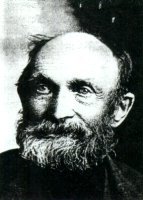 "And we dare not omit the name of Lawrence Balzer,
for it was after him that the parish was named, or rather after his own patron
Saint. Mr. Balzer, at the time of the building of the first St. Lawrence Church,
was the oldest living pioneer. Moreover, with the help of just a few others,
he build the first parish church, a humble log cabin church, where Holy Mass
would often be celebrated for the next twenty years. We are St. Lawrence
parish forever, because of Mr. Balzer. We reverence his patron Saint as our
own patron Saint, and are happy in the heavenly intercession of St. Lawrence
on our behalf."
"And we dare not omit the name of Lawrence Balzer,
for it was after him that the parish was named, or rather after his own patron
Saint. Mr. Balzer, at the time of the building of the first St. Lawrence Church,
was the oldest living pioneer. Moreover, with the help of just a few others,
he build the first parish church, a humble log cabin church, where Holy Mass
would often be celebrated for the next twenty years. We are St. Lawrence
parish forever, because of Mr. Balzer. We reverence his patron Saint as our
own patron Saint, and are happy in the heavenly intercession of St. Lawrence
on our behalf."Die Geschichte der St. Lawrence Pfarrgemeinde zu Duelm
MN in deutscher Sprache
(translated by Friedrich Fister) * Comment: C. A. Hunck: Clemens August Huenck named Diekaemper, a second name for C. A. Hunck in Westphalia, was born in Duelmen, Westphalia, on September 30, 1846. When he was 28 years old, he went to New York on board the ship Neckar from Bremen via Southampton. There were 412 passengers on board. He arrived in New York on May 4, 1874. C A. Hunck, as he was called in the United States, was a deputy of Benton County and a very respected man. Due to his willpower he contributed a lot to the growth and the prosperity of the Benton area. Clemens August was a brother inlaw of Bernard Voerding (born Dec. 7 1855 ). He married Bernadine (Dinah) Schulte in 1877; this was probably in Newburg, Washington County, WI. They had four children. Henry Voerding: Henry Voerding was not born in Duelmen but in Osterwick, a village close to Duelmen (21 km or 13 miles distance). He was born in 1818 and enlisted in the Prussian army from 1840 to 1843. After that he was farmer and shoemaker in Osterwick. In 1851 he came to the United States together with his wife and his two children. First the family lived at several places in Wisconsin, then they moved to Minnesota in 1859 and settled near St. Augusta. Peter Abfalter: Peter Abfalter was born on May 4, 1829. With his parents he came to the United States in 1844, where the family settled in Clinton County MI. In 1860 he moved to Cold Spring City, Stearns County, MN. In 1867 he came to Benton County. He married on Jan, 1, 1854. His wife, Mary King, bore him 10 children, six boys and four girls. ( from: History of the Upper Mississippi Valley , pub. 1881 at Seattle Public Library.) (Comment: Martin Holz, July 2001). |

 ChronologicalBy Relationship
Family StoriesFamily PhotographsOrphan Photographs
MapsContact UsResourcesWhat's New
ChronologicalBy Relationship
Family StoriesFamily PhotographsOrphan Photographs
MapsContact UsResourcesWhat's New