 |
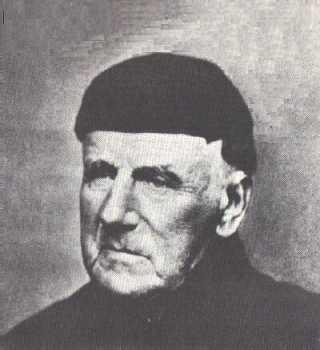
Reverend Francis Xavier Pierz, a missionary, was an exceptional man among the
American pioneers who left their native land to introduce Christianity to the Indians, and get them civilized. One has to
be dedicated and ardent on living the native land at the age when the majority long for a rest after hard work. This is the
case of Rev. Pierz. He was born in the village of Godic near Kamnik on November 20, 1785, and was ordained in
1813. He spent several years as an assistant pastor in Kranjska Gora. For several years he was pastor in the villages of
Pece and Podbrezje. He was a tireless worker and improved the living conditions in the villages where he worked. He was a
man of practice. Whatever he started, he successfully finished. He published the book A Gardener of Carnolia (Kranjski
vrtnar) which enabled many farmers to improve their income. When the news about the works of Bishop Baraga
reached Slovenia, Father Pierz was longing for more hard work and sacrifice. He left his well-organized parish and
came to America.
On October 18, 1835, he landed in New York, but in the harbor all his luggage
caught fire, a sign that he would have to face hard times. Many times he had tears in his eyes, but he had an iron will and
overcame all difficulties. He started his missionary work in Baraga's diocese in Upper Michigan. He was very successful
at his work. He spent 17 years at the missions in La Croix, Fort William, Sault Ste. Marie, Grand Portage,
Arbre Croche, Middletown, Sheboygan, Isle de Castor, Manistique, Grand Travers, Meshkigong, and some others. In Baraga's
diocese the missions were rather well organized, but he wanted some additional duties. He went to northern Minnesota, the
territory had no permanent missionary.
In June 1852 Bishop Cretin from St. Paul, Minnesota, handed over to him the
counties which were parts of diocese St. Cloud and Duluth. The center of the mission activities was Crow Wing and he
had to take care of the Indians in Mille Lacs, Cass Lake, Red Lake, and some others. We mentioned already that Father Pierz
was a very practical person and would give the white settlers advice to settle down on the rich soil of the prairies. In
the diocese of St. Cloud with Bishop J. Trobec who is retired by now, Father Pierz offered Mass for the
first time in the house of Mr. Schwarz on May 20, 1855. In 1885 the anniversary of this event was observed.
Father Pierz took care of the Indians, but at the same time he did not forget his fellow Slovene immigrants. He
introduced a number of new missions, such as St. Joseph, St. Jacob, Richmond, Rich Prairie, Little Falls,
Sauk Center and Sauk Rapids. The community of Pierz, Minnesota was named after the hard worker. He was trying hard to
enroll new helpers and co-workers. He was successful in recruiting monks of the Benedictine Order to come to northern
Minnesota. He worked very hard for 21 years. He was already 90 years old and his vision was getting poor.
He returned to his beloved native land where he spent seven years. Besides Bishop Baraga, Father Pierz is the
most famous Slovene pioneer in the American northwest.
-- from Appendix, "List of Prominent Slovenes" by Rev. J. M. Trunk
(1912), translated by the Slovenian Genealogy Society.
|
|
The story of the settlement of Richmond and its growth is the story of the
German immigrants coming into the whole of the Sauk River Valley in the 1850's. They rushed in to fill the land vacuum
created by the opening of land west of the Mississippi through treaties with the Sioux two years after Minnesota was
proclaimed a territory on March 3, 1849, by President Polk. The waterways in those years were the best means of
transportation. Prospects were good, and settling in the Sauk Valley meant being on the main thoronghfare of the Red
River trade route between St. Paul on the south and Pembina on the north.
There were early enthusiasts ready to trumpet forth the call for settlers
in this section. Two of these were James M. Goodhue, the spirited editor of the Minnesota Pioneer, and the
Rev. Francis Pierz, organizer in 1853 of the first Catholic parish in Sauk Rapids. Both published glowing reports
of the delights of the Eden which awaited the hearty soul. Goodhue had tremendous faith in the future destiny of Minnesota.
The editorial pages of the Pioneer predicted "a rapidity of growth unparalleled even in the annals of Western progress,"
and promised that "Here they will find an unqualifiedly healthy climate, fertile and well drained lands, and upon the
Mississippi the best market for mechanical products im the Union. With such a population will come not only the arts but
science and morals. Our Falls of St. Anthony with hundreds of water powers upon other streams will be turned to
manufacturing purposes. Thrifty towns will arise upon them. Our undulating prairies will rejoice under the hand of
husbandry; these hills and valleys will be jocund with the voices of school children, and churches shall mark the moral
progress of our land."
Goodhue's appeal was of a general promotional character, while that of
Father Pierz was centered on getting German immigrants into the Sauk Valley. During 1854 and 1855 he published
articles which extolled the homestead possibilities in his mission field. He pictured the area as a most favorable place
for settlement. Concerning the nature of the soil, the missionary wrote glowingly: "More than half the open meadows in
Minnesota have an excellent black loamy soil, with a splendid mixture of sand and clay and a rich top-soil formed by the
plant decay of thousands of years, so that it would be hard to find anywhere in the world a soil better suited to yield a
rich return for the farmers' toil." A good water supply was also available, Pierz observed. "I can assure my readers that
not half the rivers and hardly a third of the lakes of this beautiful region are indicated on the maps. Moreover, in many
places one will find springs of ice-cold drinking water, and if here and there a farmer does not happen to have such a
supply at his door, he can in a few days and at little cost dig a splendid well at a depth of from eight to twelve feet.
Hence immigrants need not fear any lack of water." The missionary wrote enthusiastically of the Minnesota winters,
assuring all that they could blot from their minds all notions of their frigid character: "During the three years that
I have spent here I have not seen more than a foot of snow, and with the exception of some fifteen or twenty cold days
the weather was generally so pleasant that one could work outdoors. During the past winter I have seen German settlers
at work in their shirt-sleeves, cutting their wood for building and fencing." Furthermore, the "summer in Minnesota,"
Pierz declared, "is more favorable for human health and for the growth of farm and garden products than in any other
country in the world."
Father Pierz made a special effort to prevent German immigrants temporarily
located in Indiana and Ohio from moving into the South. He had nothing but contempt for the climate below the Ohio River.
Thus we find him writing: "In the southern states of North Ameriea the climate, the air and the health of the people are
quite different. There the winter is much shorter, but it is very changeable and damp and hence injurious to the health ..
During the hot summer days a host of noxious miasmas and poisonous gases arise from the marshes and mineral-charged soil
and hang like a heavy fog and taint the air and the crops. Thus serious fevers, cholera and other epidemies appear and
fill the hospitals with patients and the cemeteries with corpses and especially the German immigrants who are not
accustomed to such air fall victims in great numbers." In contrast, wrote Pierz, central Minnesota offered many special
advantages for settlement. Wild fruits grew in abundance, while pheasants, elk and deer abounded. The prairies and meadows
offered unlimited space for cattle grazing. There was no Indian threat, as he saw it, for they offered no difficulty unless
plied with firewater. With the government making treaties with the tribes, Pierz' aim was to convert the aborigines to
Catholicism and make them good neighbors.
The missionary invited all Germans who were living in the unhealthy and
disagreeable localities of the United States to settle near his missions and to take up land claims at Sauk Rapids and
Belle Prairie. He held out the promise of a church already open at the former place. Furthermore, there was a new church
under construction west of the Mississippi for settlers along the Sauk River. Father Pierz raised the trumpet to his lips:
"Hasten then, my dear German people, those of you who have in mind to change your abode and settle in Minnesota. Do not
delay to join the stream of immigration, for the sooner you come the better will be your opportunity to choose a good place
to settle. Several hundred families can still find good claims along the Sauk River and in the surrounding country no
doubt several thousand families can find favorable places for settlement."
All was not the unbridled bliss of which Pierz spoke. He failed to tell the
German immigrants of some of the hardships he had undergone in this paradise. Elsewhere he had written of a trip he had
made between Crow Wing and Mille Lacs in 1853: "Two-thirds of the distance was made on foot over poor roads through brush
and timber and one-third was made by water. We crossed six lakes in a birch-bark canoe weighing two hundred pounds,
which my catechist had to carry on his shoulders when crossing portages. My cook carried the kitchen utensils and food
weighing about one hundred and fifty pounds. My burden was the whole portative chapel with the articles for Mass and the
books, as well as blankets weighing seventy pounds.
"It is impossible to travel on horseback in summer because the road lies
through five deep, dirty swamps and over thousands of fallen trees and execrable hunters' trails. For two days we traveled
amid indescribable hardships. On such a wretched way I often stumbled over roots and once I had such an unfortunate fall
that I was obliged to remain where I fell for some time until I was rested and could rise.
"The worst feature of this trip was that in my hasty departure I forgot my
mosquito netting and my gloves and for two days I had to keep waving a leafy branch about my head to keep off the mosquitoes
who came in neverceasing swarms. In this process my hands were tortured. Nevertheless I was so badly stung about the face
and on the hands by the bold attackers that I suffered as much pain from the bites as if I had a severe case of nettlerash.
At the close of the second day we came so close to the Indian village that we could see their wigwams. Our attention being
taken away from the canoe for a moment, it struck a tree in the water and we had to land at once and spend the night in a
swamp."
-- from "Richmond, Minnesota Centennial History, 1856 to 1956
Pfarrer Francis Xavier Pierz, dem Missionar in deutscher Sprache
(translated by Ingrid Seliger) 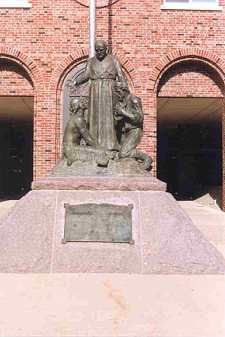
Memorial to Father Francis Xavier Pierz St. Cloud Hospital, St. Cloud MN (By sculptor D. Mastroianni) |

 ChronologicalBy Relationship
Family StoriesFamily PhotographsOrphan Photographs
MapsContact UsResourcesWhat's New
ChronologicalBy Relationship
Family StoriesFamily PhotographsOrphan Photographs
MapsContact UsResourcesWhat's New