Up to the second half of the nineteenth century, the transport of
emigrants was only a subsidiary branch of cargo transport, and emigrants
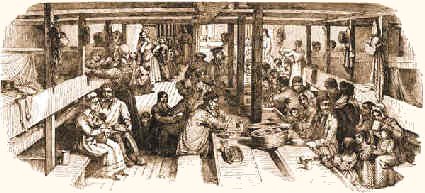
consequently traveled in cargo ships temporarily adapted for passengers. Up to the second half of the nineteenth century, the transport of
emigrants was only a subsidiary branch of cargo transport, and emigrants
consequently traveled in cargo ships temporarily adapted for passengers.
A deck was built between the upper deck and the hold -- in German this
was known as Zwischendeck. Steerage was primitive. The berths were removed again at the end of the voyage
since the space was needed on the return journey for cargo. They were knocked together out of mere planks, narrow and
mostly too short.
Mattresses and bedding were provided by the passengers. There were
few latrines and ventilation was poor. All the passengers were crowded into this poorly-lit deck both day and night.
Only if the weather was good was it possible for them to emerge onto the upper deck.
Medical care was not available. Passengers provided their own food
and crockery. (They were provided with water.) For cooking there was a fireplace or two, insufficient -- this
problem often led to quarrels between passengers and many went for days without a hot meal.
By about the end of the 1870s, the steamship had replaced the
sailing ship which improved conditions almost at once. The passage was reduced to seventeen days -- compared to
the sailing vessel's ninety days. Fast steamers in the 1890s made the crossing in nine days. These were fitted
especially for passengers and were better ventilated, had doctors, had privacy for women, and food was more plentiful.
|