
by John H. Stevens
from Minnesota and Its People and Early History of Minneapolis
(Minneapolis, 1890)
 |
 come now to the Sioux Massacre of 1862; not to write a history of its momentous events; but
to present a brief narration of some of the incidents that made such a painfully-vivid impression upon
the frontier settlers of the Northwest; presenting, as it does, an exhibition of the darkest
passions, and the perpetuation of crimes the most revolting that a savage nature can conceive. It
was infamous in its conception, fiendish in its execution, and fearfully disastrous alike to whites
and Indians. There are those who freely express their conviction that no reference to the immediate
precipitation of that massacre can be complete, correct and just, that does not include, among
the other numerous causes, the statement that the leaders engaged in it thought the union of the
states would be destroyed, and that then was their opportunity to repossess the lands they had
ceded to the government. The withdrawal of the troops from the frontier, the battles disastrous
to the Union arms, the seemingly financial embarrassment that delayed the payment of their annuities,
gave plasibility to those ideas. The combined result was the massacre of 1862, that was one of
unparalleled mutilation, murder and rapine.
come now to the Sioux Massacre of 1862; not to write a history of its momentous events; but
to present a brief narration of some of the incidents that made such a painfully-vivid impression upon
the frontier settlers of the Northwest; presenting, as it does, an exhibition of the darkest
passions, and the perpetuation of crimes the most revolting that a savage nature can conceive. It
was infamous in its conception, fiendish in its execution, and fearfully disastrous alike to whites
and Indians. There are those who freely express their conviction that no reference to the immediate
precipitation of that massacre can be complete, correct and just, that does not include, among
the other numerous causes, the statement that the leaders engaged in it thought the union of the
states would be destroyed, and that then was their opportunity to repossess the lands they had
ceded to the government. The withdrawal of the troops from the frontier, the battles disastrous
to the Union arms, the seemingly financial embarrassment that delayed the payment of their annuities,
gave plasibility to those ideas. The combined result was the massacre of 1862, that was one of
unparalleled mutilation, murder and rapine.
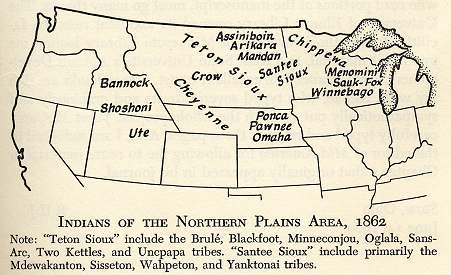
SOME OF THE CAUSES OF THE OUTBREAK - NEAR AND REMOTE. The Dakota annuity tribes in Minnesota at the time of the outbreak were
the Medawakontons, Wapatons, Sissetons, and Wapakutas, numbering in all about 6,200 persons.
Their annuities aggregated about $555,000. These tribes were connected with wild lands scattered over
a large extent of country, including Dakota and west of the Missouri to the Rocky mountains. The
government had provided a civilization fund to be taken from their annuities and expended in improvements on the lands of such of them
as should abandon their tribal relations and adopt the mode of life of the whites. The wild, blanket
Indians denounced the measure as a fraud upon their rights.
Major Galbraith, Sioux Agent, writes:
"The radical, cause of the outbreak is, I am satisfied, the ingrained and fixed hostility of the savage barbarian to reform and civilization. As in all barbarous communities, in the history of the world, the same people have, for the most part, resisted the encroachments of civilization upon their ancient customs; so it is in the case before us. Nor does it matter materially in what shape civilization makes its attack. Hostile, opposing forces meet in conflict, and a war of social elements is the result - civilization is aggressive, and barbarism stubbornly resistant. Sometimes, indeed, civilization has achieved a bloodless victory, but generally it has been otherwise." 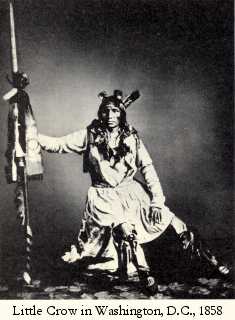 Whatever the cause of the tragedy, the execution was the result of a conspiracy
under the guise of a "Soldiers' Lodge", and matured in secret Indian councils. In all these secret
movements Little Crow was the moving spirit.
Whatever the cause of the tragedy, the execution was the result of a conspiracy
under the guise of a "Soldiers' Lodge", and matured in secret Indian councils. In all these secret
movements Little Crow was the moving spirit.
THE SITUATION AT THE CRITICAL MOMENT. Now the opportune moment seemed to have come.
Only thirty soldiers were stationed at Fort Ridgely. Some thirty were all that Fort Ripley could
muster; and at Fort Albercrombie one company was all the whites could depend upon to repel any attack
in that quarter. The whole effective force for the defense of the entire frontier, from Pembina to the
Iowa line, did not exceed two hundred men.
It was evident that Little Crow repeatedly stated in the secret
councils that the Indians could kill all the white men in the Minnesota Valley, and get all their lands
back as well as finally receive double annuities.
THE FIRST VICTIMS OF THE SAVAGES. The first blow fell upon the town of Acton, thirty-five
miles northeast of the Lower Sioux Agency, in Meeker county, on Sunday, August 17th, 1862 at
1 o'clock p. m., where six Indians of Shakopee's band killed Mr. and Mrs. Jones, Mr. Baker,
Mr. Webster, and Miss Wilson, and then fled. This attack seems to have been unauthorized
and premature, for on the same day a counsel was held, presided over by Little Crow, in Rice creek,
some forty miles distant, at which it was decided that a general massacre of the whites should commence
the next morning. The final decision was made about sundown, and early the next morning the entire
force of warriors of the Lower tribes, painted and armed, were scattered over a region forty miles
in extent, ready for the slaughter. There were some two hundred and fifty of these at the Lower
Agency, who surrounded the houses and stores, before some of the inmates were awake. The blow was
entirely unexpected. The traders and government employees were killed, the stores plundered, and the buildings
burned. Nathan Myrick, James W. Lynd, A. J. Myrick, and G. W. Divoll
were amont the first victims. W. H. Forbes and G. H. Spencer, though severely wounded,
escaped.
THE INDIANS SPARE NOT THEIR EARLIEST AND BEST FRIENDS. Early on this fatal Monday morning, Mr. Prescott and
Rev. J. D. Hinman learned from Little Crow that the storm of savage wrath was
gathering, and that their only safety was in instant flight. Mrs. Hinman was, fortunately, at
Fairbault. The white-haired interpreter, Philander Prescott, nearly seventy years of age, hastily
left his house soon after his meeting with Little Crow, and fled toward Fort Ridgely. The other
members of his family remained behind, knowing that their relations to the tribe would save them.
Mr. Prescott had gone several miles along the west bank of the Minnesota river when he was
overtaken. His murderers came and talked with him. He reasoned with them, saying: "I am an old
man; I have lived with you now 45 years, almost half a century. My wife and children are among you,
of your own blood; I have never done you any harm, and have been your true friend in all your
troubles; why should you wish to kill me?" Their reply was: "We would save your life if we could,
but the WHITE MAN MUST DIE; we cannot spare your life; our orders are to kill all white men; we cannot
spare you." It is said upon the authority of the Indians that he was shot while talking with them and
looking calmly into their eyes. Mr. Prescott was the true, tried, and faithful friend of
the Indian, and had labored long in their interest. His benevolence to the red-men kept him ever
poor. Mr. Hinman escaped to Fort Ridgely.
The number of persons who reached Fort Ridgley from
the Lower Agency was forty-one. Some arrived at other places of safety. Among those who escaped were
J. C. Whipple, C. B. Hewitt; and J. C. Dickinson and family, including
several girls, who kept the government boarding-house. Mr. Hunter was killed on the way, as was
also Dr. P. P. Humphrey, the physician to the Lower Sioux, with his sick wife and two
children. The doctor's eldest boy of about twelve years escaped.
At the Redwood river ten miles above the Agency, on the road to
Yellow Medicine, resided Mr. Joseph B. Reynolds, in the employment of the
government as a teacher. His house was within one mile of Shakopee's village. His family consisted
of his wife and niece - Miss Mattie Williams - Mary Anderson and Mary Schwandt,
hired girls. William Landmeier, a hired man, and Legrand Davis, a young man from
Shakopee, was also stopping with them temporarily. Mr. Patoile, a trader from Yellow Medicine,
was also there on his way to New Ulm. On Monday morning, learning of their danger, they started out
on the prairie and when nearly opposite Fort Ridgely, Petoile and Davis were killed. Mary Schwandt
was wounded and died soon after. Mary Anderson and Miss Williams were catured unhurt.
On Sunday, the 17th, George Gleason, government
storekeeper at the Lower Agency, accompanied the family of Agent Galbraith to Yellow
Medicine, and on Monday afternoon, ignorant of the terrible tragedy enacted below, started to return.
He had with him the wife and two children of Dr. J. S. Wakefield, physician to the
Upper Sioux. On the way he was killed, and Mrs. Wakefield and two children captured.
Early on the morning of the 18th, the settlers on
the north side of the Minnesota river, adjoining the reservation, were surprised to see a large number of
Indians in their immediate neighborhood. There were seen soon after the people arose, simultaneously,
all along the river from Birch Coolie to Beaver Creek, and beyond, on the west, apparently intent
on gathering up the horses and cattle. When interrogated, they said they were after Chippewas. At
about 6 or 7 o'clock they suddenly began to repair to the various houses of the settlers, and then
the flight of the inhabitants and the work of death began.
In the immediate vicinity of Beaver Creek, the neighbors,
to the number of about twenty-eight, men, women, and children, assembled at the house of John W. Earle
and, with several teams, started for Fort Ridgely, having with them the sick wife of S. R. Henderson,
her children, and the family of N. D. White, and the wife and two children of
Jas. Carothers. There were also David Carothers and family, Earle and family, Henderson,
and a German named Wedge, besides four sons of White and Earle; the rest were women and children.
They had gone but a short distance when they were surrounded by Indians. When asked, by some of the party who could
speak their language, what they wanted, the Indians answered, "We are going to kill you." Wedge,
Mrs. Henderson and children, Eugene White, and N. D. White, and Redner, son of
J. W. Earle, were killed. The other men escaped, and the women and children were captured.
WHOLE GERMAN SETTLEMENTS ANNIHILATED. Some two miles above the neighborhood of Earle and White
was a settlement of German emigrants, numbering some forty persons. Early on the morning of the 18th these
had assembled at the house of John Meyer. Very soon after, some fifty Indians, led by Shakopee, appeared in
sight. The people all fled, except Meyer and his family, going into the grass and bushes.
Peter Bjorkman ran toward his own house. Shakopee, whom he knew, saw him and exclaimed,
"There is Bjorkman; kill him!" but keeping the building between him and the savages, he plunged into a
slough and concealed himself, even removing his shirt, fearing it might reveal his whereabouts to the
savages. Here he lay from early morning until the darkness of night enabled him to leave, mosquitos
swarming upon his naked person, and the hot sun scorching him to the bone. The Indians immediately
attacked the house of Meyer, killing his wife and all his children. Seeing his family butchered, and
having no means of defense, Meyer effected his escape and reached Fort Ridgely. In the meantime the
affrighted people had got together again at the house of a Mr. Sitzon, near Bjorkman's to the
number of about thirty, men, women, and children. In the afternoon the savages returned to the
house of Sitzon, killing every person there except Mrs. Eindefield and her child. From his
place of concealment Mr. Bjorkman witnessed this attack and massacre of an entire neighborhood.
At night he escaped. On the way he overtook a woman and two children, one an infant of six months,
the wife and children of John Sateau, who had been killed. Taking one of the children in his arms,
these companions in suffering hurried on together. Mrs. S. was nearly naked, and without shoes
or stockings. They finally reached the Fort, where Mrs. Sateau found two sons, aged ten and
twelve years, who had reached there before her.
A flourishing German settlement had sprung up twelve
miles below Yellow Medicine. They learned of their danger on the evening of the 18th, and the
whole neighborhood with the exception of one family, assembled at the house of Paul Kitzman,
and struck out on the prairie toward the head of Beaver creek. They traveled all night, and in
the morning changed their course toward Fort Ridgely. They continued in this direction until the sun
was some two hours high when they were met by eight Sioux Indians, who told them that the murders
were committed by Chippewas, and that they had come over to protect them and punish the murders;
and then induced them to turn back toward their homes. One of the savages spoke English well.
He was acquainted with some of the company, having often hunted with Paul Kitzman. He kissed
Kitzman, telling him he was a good man; and they shook hands with all of the party. The simple-hearted
Germans believed them, gave them food, distributed money among them and, gratefully receiving their
assurances of friendship and protection, turned back. When near their home they were suddenly
surrounded by fourteen Indians who instantly fired upon them. All of the eleven white men were
killed. Only two of the women and a few of the children escaped death. Over forty bodies were afterwards
found and buried on that field of slaughter.
BATTLE AT THE LOWER AGENCY FERRY. On Monday morning, the 18th of August, 1862, at about 9 o'clock,
a messenger arrived at Fort Ridgely from the Lower Sioux Agency, with news that the Indians were massacring
the whites at that place. Captain John S. Marsh, of Company B, Fifth Regiment
Minnesota Volunteers, then in command, took a detachment of forty-six men (there were then in the Fort only
seventy-five or eighty men), and accompanied by Interpreter Quinn, immediately started for the agency,
distant twelve miles. They made a very rapid march. When within about four miles of the ferry,
opposite the Agency, they met the ferryman, Mr. Martelle, who informed Captain Marsh that
the Indians were in considerable force, and were murdering all the people and advised him to return.
He replied that he was there to protect and defend the frontier and he should do so if it was in his
power, and gave the order "Forward!" Between this point and the river they passed nine dead
bodies on or near the road. Arriving near the ferry, the company halted, and Corporal Ezekiel Rose
was sent forward to examine the ferry, and see if it was all right. The captain and interpreter were
mounted on mules, the men were on foot, and formed in two ranks in the road, near the ferry-house,
a few rods from the banks of the river. The corporal had taken a pail with him to the river, and returned,
reporting the ferry all right, bringing with him water for the exhausted and thirsty men.
In the meantime an Indian had made his appearance on the
opposite bank, and calling to Quinn, urged them to come across, telling him all was right on that
side. The suspicions of the captain were at once aroused, and he ordered the men to remain in their
places, until he could ascertain whether the Indians were in ambush in the ravines on the opposite shore.
The men were in the act of drinking, when the savage on the opposite side, seeing they were not going to
cross at once, fired his gun as a signal; when instantly there arose out of the grass and brush,
all around them, some four or five hundred warriors, who poured a terrific volley upon the devoted band.
The aged interpreter fell from his mule, pierced by more than twenty balls. The captain's mule fell
dead, but he himself sprung to the ground unharmed. Several of the men fell at this first fire.
The testimony of the survivors of this sauguinary engagement is that their brave commander was as
cool and collected as if on dress parade. They retreated down the stream about a mile and a half,
fighting their way inch by inch, when it was discovered that a body of Indians, taking advantage of a
bend in the river, had gone across and gained the bank below them.
The heroic little band was already reduced to about half
its original number. To cut their way through this large number of Indians was impossible. Their
only hope now was to cross the river to the reservation, as there appeared to be no Indians on that
shore, retreat down that side and recross to the fort. The river was supposed to be fordable where they
were and, accordingly, Captain Marsh gave the order to cross. Taking his sword in one hand
and his revolver in the other, accompanied by his men, he waded out into the stream. It was very soon
ascertained that they must swim, when those who could not do so returned to the shore and hid in the
grass as best they could, while those who could dropped their arms and struck out for the opposite side.
Among these latter was Captain Marsh. When near the opposite shore he was struck by a ball, and
immediately sank, but arose again to the surface and grasped the shoulder of a man at his side,
but the garment gave way in his grasp, and he again sank, this time to rise no more. Thirteen
of the men reached the bank in safety, and returned to the fort that night. Those who were unable to cross
remained in the grass and bushes until night, when they made their way to the fort or settlements.
These are only a few of the incidents of this terrible massacre
near the Lower Sioux Agency. The horrible details of mutilation, and worse crimes than murder, are here unrecorded out of respect for the
victims, living and dead. Turn we now to tragedies of the same day enacted elsewhere.
|

 ChronologicalBy Relationship
Family StoriesFamily PhotographsOrphan Photographs
MapsContact UsResourcesWhat's New
ChronologicalBy Relationship
Family StoriesFamily PhotographsOrphan Photographs
MapsContact UsResourcesWhat's New