
 t wasn't really intended to be a genealogical research trip.
But, since Bill and I were visiting our new grandaughter, born on Easter, and our daughter Cathlyn, her husband Milos and
his 10-year-old daughter Ivona in Switzerland, why not make an excursion to Poland, my grandmother's homeland? [The heritage of Odile Jeanne,
named after my French-Canadian grandmother and sister, includes Irish-English, French-German (maternal) and Serbo-Croatian
(paternal). Her parents speak five languages and her sister two.] Tiny Odile is simply adorable, but as grandparents, we
now had the option of having fun and leaving the cares and work behind.
So, after spending two enjoyable but occasionally noisy weeks giving support to
the little family, we celebrated Cathlyn's birthday at an old Swiss inn and promised to be back in two weeks on May 10
for a joint Mother's Day and Bill's birthday. And on May 17, our last Sunday in Basel, we would celebrate the baptism of
both Ivona (my godchild) and Odile at Basel's French Catholic Church followed by a dinner for 20 at a German castle nearby.
The next day, we would take the train back to Paris, spend an evening in the City, and a flight home the following day.
My maternal grandmother, Anna Kampa, was born
in 1866 in a village near Opole, Silesia, the western region of Poland bordering the Sudeten mountains and near the Oder/Odra River.
A few years after her arrival in 1881 at age 16 in central Minnesota with her brothers and sisters (her parents came later),
she married John Maier [May 1885] from West Berlin (Spandau), who had immigrated earlier. She spoke Polish, German,
and English. In 1945 when she died, I was eight years old but I remember her well as she was the only grandparent I knew,
the others having died before my birth.
For several years, I've been searching for her origin in Silesia, exhausting
all resources with no luck. When Westchester County Genealogical Society member Herb Mahler gave a workshop on Silesia two years ago, I learned a lot about a
country first governed by the Piast Dynasty which became an industrial region of rich resources eventually seized by the
Austrian Empire, then by the Prussians. Herb also warned us that the Polish roads were narrow, two-lane and bumpy. Then
last summer while in Minneapolis for a family reunion, we were having lunch with my high school friend, Marlene, and her
husband, Bob. When I asked where he was from in Minnesota, he answered North Prairie (a tiny village near Opole, Minn., close
to my hometown of Little Falls). "Really," I said, and sounding too much like a genealogist, I told him my grandparents had
married there in 1885. He said, "So did mine." I remarked that I suspected that the immigrants there may have come from
the Opole area in Poland. He said, "You're absolutely right, Jeanne!"
To my amazement, he produced a copy of his recent article published in the
newsletter of the Polish Genealogical Society of Minnesota which tells the story of the group of settlers, the Silesian
villages in which they had lived, the local priest who built the first parish and had married our grandparents. What an
unexpected surprise! Bob also had a list of the immigrant names in his article which included the two - Kampa and Brenny -
I was researching. He told me there were three Silesian villages inhabited by these German/Polish settlers and all I need
do is to check the LDS Family History Center's IGI to locate the exact place. (He does his research regularly at the
Minnesota State Library, a beautiful new building in St. Paul near the state capitol, which includes the historical
society, genealogical groups, library and museum/gift shop). Naturally, I'll always be grateful to him for his work.
And he was pleased that he could provide the right key to my closed door.
When I returned home to Rye, NY from Minnesota, I went to the Scarsdale Family History
Center and quickly found all the Kampas came from two neighboring villages and later lived in Benton County, Minn. So I
ordered Catholic Church records - in German - from the Opole, Poland area, which were filmed in the 1970's. I found an
Anna, the daughter of Franz (Frank) Kampa, with a similar birth date, but the mother's name was different from
that written on Anna Kampa Maier's death certificate. (The information was provided by my aunt, the youngest
of 12 children and her knowledge may be incorrect as she didn't know her grandmother's name in her later years.
"We called her grandma," she remembered.) According to records, her parents were Valentin Kampa and Agnes Brenny.
No death certificates, obituaries or graves for Anna's parents have been found.
Our trip to Poland began with a train ride from Basel to Munich where we
rented a car for travel through Germany, the Czech Republic and Poland. (France & Switzerland won't rent cars to drive
in Poland because of the high theft rate. The Germans gave us an orange underpowered Fiat not even the Poles would covet.)
Many Polish ride bicycles or hitchhike because they can't afford cars.
t wasn't really intended to be a genealogical research trip.
But, since Bill and I were visiting our new grandaughter, born on Easter, and our daughter Cathlyn, her husband Milos and
his 10-year-old daughter Ivona in Switzerland, why not make an excursion to Poland, my grandmother's homeland? [The heritage of Odile Jeanne,
named after my French-Canadian grandmother and sister, includes Irish-English, French-German (maternal) and Serbo-Croatian
(paternal). Her parents speak five languages and her sister two.] Tiny Odile is simply adorable, but as grandparents, we
now had the option of having fun and leaving the cares and work behind.
So, after spending two enjoyable but occasionally noisy weeks giving support to
the little family, we celebrated Cathlyn's birthday at an old Swiss inn and promised to be back in two weeks on May 10
for a joint Mother's Day and Bill's birthday. And on May 17, our last Sunday in Basel, we would celebrate the baptism of
both Ivona (my godchild) and Odile at Basel's French Catholic Church followed by a dinner for 20 at a German castle nearby.
The next day, we would take the train back to Paris, spend an evening in the City, and a flight home the following day.
My maternal grandmother, Anna Kampa, was born
in 1866 in a village near Opole, Silesia, the western region of Poland bordering the Sudeten mountains and near the Oder/Odra River.
A few years after her arrival in 1881 at age 16 in central Minnesota with her brothers and sisters (her parents came later),
she married John Maier [May 1885] from West Berlin (Spandau), who had immigrated earlier. She spoke Polish, German,
and English. In 1945 when she died, I was eight years old but I remember her well as she was the only grandparent I knew,
the others having died before my birth.
For several years, I've been searching for her origin in Silesia, exhausting
all resources with no luck. When Westchester County Genealogical Society member Herb Mahler gave a workshop on Silesia two years ago, I learned a lot about a
country first governed by the Piast Dynasty which became an industrial region of rich resources eventually seized by the
Austrian Empire, then by the Prussians. Herb also warned us that the Polish roads were narrow, two-lane and bumpy. Then
last summer while in Minneapolis for a family reunion, we were having lunch with my high school friend, Marlene, and her
husband, Bob. When I asked where he was from in Minnesota, he answered North Prairie (a tiny village near Opole, Minn., close
to my hometown of Little Falls). "Really," I said, and sounding too much like a genealogist, I told him my grandparents had
married there in 1885. He said, "So did mine." I remarked that I suspected that the immigrants there may have come from
the Opole area in Poland. He said, "You're absolutely right, Jeanne!"
To my amazement, he produced a copy of his recent article published in the
newsletter of the Polish Genealogical Society of Minnesota which tells the story of the group of settlers, the Silesian
villages in which they had lived, the local priest who built the first parish and had married our grandparents. What an
unexpected surprise! Bob also had a list of the immigrant names in his article which included the two - Kampa and Brenny -
I was researching. He told me there were three Silesian villages inhabited by these German/Polish settlers and all I need
do is to check the LDS Family History Center's IGI to locate the exact place. (He does his research regularly at the
Minnesota State Library, a beautiful new building in St. Paul near the state capitol, which includes the historical
society, genealogical groups, library and museum/gift shop). Naturally, I'll always be grateful to him for his work.
And he was pleased that he could provide the right key to my closed door.
When I returned home to Rye, NY from Minnesota, I went to the Scarsdale Family History
Center and quickly found all the Kampas came from two neighboring villages and later lived in Benton County, Minn. So I
ordered Catholic Church records - in German - from the Opole, Poland area, which were filmed in the 1970's. I found an
Anna, the daughter of Franz (Frank) Kampa, with a similar birth date, but the mother's name was different from
that written on Anna Kampa Maier's death certificate. (The information was provided by my aunt, the youngest
of 12 children and her knowledge may be incorrect as she didn't know her grandmother's name in her later years.
"We called her grandma," she remembered.) According to records, her parents were Valentin Kampa and Agnes Brenny.
No death certificates, obituaries or graves for Anna's parents have been found.
Our trip to Poland began with a train ride from Basel to Munich where we
rented a car for travel through Germany, the Czech Republic and Poland. (France & Switzerland won't rent cars to drive
in Poland because of the high theft rate. The Germans gave us an orange underpowered Fiat not even the Poles would covet.)
Many Polish ride bicycles or hitchhike because they can't afford cars.
 This was our first foray into Eastern Europe. We spent three days in
beautiful Baroque Prague, the "Paris of the East" and drove near the lovely Tatra mountains enroute to Poland. Our
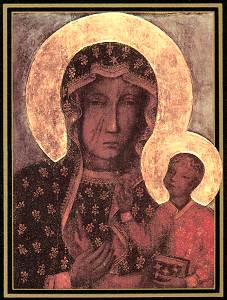
destinations there were Kracow, a well-preserved medieval city and ancient university center, Jasna Gora (Our Lady of
Czestochowa or the Black Madonna), less than 100 kilometers from my grandmother's village near Opole. Unfortunately,
Opole, which was settled in the 9th century, suffered significant destruction in the last war and was mostly rebuilt in the
Communist modern cement block style.
When I visited the Opole Archives in the city marketplace (Rynek)
reconstructed with Baroque and Rococco facades near the City Hall and Franciscan Church (1330) with its Piast Chapel, I
learned that French was the only common language I could use. (However, most people there speak German as they do in most of
Eastern Europe). Since their records began only after 1875, they referred me to my grandmother's local parish for records.
Since I had already seen the filmed LDS records, which was done extensively in Poland, I was not too concerned, but was
quite curious to see the area and take pictures to share with family members.
Like central Minnesota, the rural landscape in Lower Silesia around
Opole was flat with clusters of trees, tilled land and various long low buildings for livestock and other farm animals.
Unlike rural Minnesota, however, a monstrous power complex could be seen from both these ancestral villages about 7 k. away
overshadowing this peaceful pastoral scene. And even closer to Opole were several industrial plants including an ugly
cement block factory emitting a grey grittiness over the area. Very disappointing!
These ancient hamlets were marked by a spirituality not often seen elsewhere,
except possibly in northern France. Throughout the region, we saw outdoor shrines with statues of saints and calvaries at
many homes and alongside the roads. When we reached the village of Chroscice, the home of many Brenny families, I entered
the pretty church completely
ringed by pansies and many blossoming trees. The large graveyard nearby was a scene of beauty and order, all its graves
planted with fresh or fake flowers and each tomb separated by neatly raked sand and evergreens. It was obvious that someone
here cared, quite a contrast to the grim unpainted and dilapidated buildings throughout Poland. Though I didn't look at the
entire cemetery, I found several Kampa families who were born in the late 19th century and died in this century, contemporaries
of my mother.
The next village was Stare Silkowice where many Kampa families
originated. At the parish house of St. Michael the Archangel
only the barking dog greeted us, but the modern church was open for visitors. Outside, I noted a memorial to those
soldiers killed in the Great War. In every year from 1914 to 1917, there was a Kampa. No cemetery was to be found, but
there were a few tombstones on one side. A large tomb surmounted by a lifesize angel caught my attention! It was inscribed
"Anna Kampa, born in 1900." No doubt, my grandmother had left relatives here, which I knew as I recalled my eldest aunt and grandmother
writing letters "back home." Too bad no one saved the letters received. I wondered how they fared during all those tragic
years of war, Communist rule and deprivation? The current phone books lists no more Kampas in the two villages, but a few remain in
the region.
One of the traditions that Anna Kampa brought from the Old World to
America was her recipe for the delicious poppyseed coffeecake with a sugar-crunchy streusel topping (mohnstreizel kuchen)
that she made every Christmas and for special occasions. Everyone who married into the family quickly became a devotee of this irresistible
sweet treat, which has been passed down for at least four generations. It's often served at family reunions through the
country. In her 80's, my mother continued to bake this specialty in California for our summer visits. And I watched and
carefully recorded the ingredients and her method despite her unmeasured approach so that my daughters could learn how to produce this magical of
breads for their future families. Although it takes a day to prepare, from the grinding of the poppyseeds through two or three risings,
this fabulous butter and cream-rich yeast cake bread is always expected and enjoyed on our holidays. Would I be able to
find it in Silesia?
While walking around Opole, we met a salesman in a shop who spoke English and
chatted with him about these villages. (He had lived in London, New York and Hartford.) On a hunch, (Bill thought I was a
bit crazy) I inquired if he knew about poppyseed kaffe kuchen,
telling him about our family tradition. He smiled knowingly. Enthusiastically, he directed us to the local bakery only two
blocks away where we could purchase some. It was a plain little store with nothing much left except for some eclairs and
buns. But on one side, there it was - poppyseed coffeecake just like my Grandmother's: a rich cake-like bread filled with
a sweet moist bluish-black poppyseed layer and topped with the crumbly cinnamon streusel. We bought a huge piece and savored
morsels of our treasure slowly during the next three days. I knew now I had finally found Grandmother's home and it was worth all
the bumpy roads in Poland to get there!
This was our first foray into Eastern Europe. We spent three days in
beautiful Baroque Prague, the "Paris of the East" and drove near the lovely Tatra mountains enroute to Poland. Our
destinations there were Kracow, a well-preserved medieval city and ancient university center, Jasna Gora (Our Lady of
Czestochowa or the Black Madonna), less than 100 kilometers from my grandmother's village near Opole. Unfortunately,
Opole, which was settled in the 9th century, suffered significant destruction in the last war and was mostly rebuilt in the
Communist modern cement block style.
When I visited the Opole Archives in the city marketplace (Rynek)
reconstructed with Baroque and Rococco facades near the City Hall and Franciscan Church (1330) with its Piast Chapel, I
learned that French was the only common language I could use. (However, most people there speak German as they do in most of
Eastern Europe). Since their records began only after 1875, they referred me to my grandmother's local parish for records.
Since I had already seen the filmed LDS records, which was done extensively in Poland, I was not too concerned, but was
quite curious to see the area and take pictures to share with family members.
Like central Minnesota, the rural landscape in Lower Silesia around
Opole was flat with clusters of trees, tilled land and various long low buildings for livestock and other farm animals.
Unlike rural Minnesota, however, a monstrous power complex could be seen from both these ancestral villages about 7 k. away
overshadowing this peaceful pastoral scene. And even closer to Opole were several industrial plants including an ugly
cement block factory emitting a grey grittiness over the area. Very disappointing!
These ancient hamlets were marked by a spirituality not often seen elsewhere,
except possibly in northern France. Throughout the region, we saw outdoor shrines with statues of saints and calvaries at
many homes and alongside the roads. When we reached the village of Chroscice, the home of many Brenny families, I entered
the pretty church completely
ringed by pansies and many blossoming trees. The large graveyard nearby was a scene of beauty and order, all its graves
planted with fresh or fake flowers and each tomb separated by neatly raked sand and evergreens. It was obvious that someone
here cared, quite a contrast to the grim unpainted and dilapidated buildings throughout Poland. Though I didn't look at the
entire cemetery, I found several Kampa families who were born in the late 19th century and died in this century, contemporaries
of my mother.
The next village was Stare Silkowice where many Kampa families
originated. At the parish house of St. Michael the Archangel
only the barking dog greeted us, but the modern church was open for visitors. Outside, I noted a memorial to those
soldiers killed in the Great War. In every year from 1914 to 1917, there was a Kampa. No cemetery was to be found, but
there were a few tombstones on one side. A large tomb surmounted by a lifesize angel caught my attention! It was inscribed
"Anna Kampa, born in 1900." No doubt, my grandmother had left relatives here, which I knew as I recalled my eldest aunt and grandmother
writing letters "back home." Too bad no one saved the letters received. I wondered how they fared during all those tragic
years of war, Communist rule and deprivation? The current phone books lists no more Kampas in the two villages, but a few remain in
the region.
One of the traditions that Anna Kampa brought from the Old World to
America was her recipe for the delicious poppyseed coffeecake with a sugar-crunchy streusel topping (mohnstreizel kuchen)
that she made every Christmas and for special occasions. Everyone who married into the family quickly became a devotee of this irresistible
sweet treat, which has been passed down for at least four generations. It's often served at family reunions through the
country. In her 80's, my mother continued to bake this specialty in California for our summer visits. And I watched and
carefully recorded the ingredients and her method despite her unmeasured approach so that my daughters could learn how to produce this magical of
breads for their future families. Although it takes a day to prepare, from the grinding of the poppyseeds through two or three risings,
this fabulous butter and cream-rich yeast cake bread is always expected and enjoyed on our holidays. Would I be able to
find it in Silesia?
While walking around Opole, we met a salesman in a shop who spoke English and
chatted with him about these villages. (He had lived in London, New York and Hartford.) On a hunch, (Bill thought I was a
bit crazy) I inquired if he knew about poppyseed kaffe kuchen,
telling him about our family tradition. He smiled knowingly. Enthusiastically, he directed us to the local bakery only two
blocks away where we could purchase some. It was a plain little store with nothing much left except for some eclairs and
buns. But on one side, there it was - poppyseed coffeecake just like my Grandmother's: a rich cake-like bread filled with
a sweet moist bluish-black poppyseed layer and topped with the crumbly cinnamon streusel. We bought a huge piece and savored
morsels of our treasure slowly during the next three days. I knew now I had finally found Grandmother's home and it was worth all
the bumpy roads in Poland to get there!
Resources for Polish Genealogy:
Polish Roots by Rosemary A. Chorzempa, 1993.
Genealogical Publishing Co. Inc., 10001 N. Calvert St. Baltimore, MD 21202. Paper $17.95 Also available
through Jonathan Sheppard Books, Box 2020 Empire State Plaza Station, Albany, NY 1220. This pioneering work on Polish
family history is designed to provide the American researcher with enough information in language, religion, geography,
and history for successful research. A national director of the Polish Genealogical Society of America, Ms. Chorzempa
offers the benefit of her experience in the US and in Poland. An enthusiastic genealogist for over 25 years, she has
traced some branches of her Polish family back to the early 1700's. She conducts classes and workshops and has written
books for beginners, an introduction to heraldry, and a genetic survery of Americans of Polish descent.
Part I includes Research in America listing all the valuable
records available, research libraries with materials in the US and Canada, sources for regional research, Polish
Genealogical Societies; Part II, Research in Poland, life in Poland, other ethnic groups in Poland, geographic &
ethnic areas of Poland; maps & gazeteers, research using records from Poland, church & civil records, surnames, Christian or
first names, breaking the language barrier, writing letters to Poland, and when you visit Poland. It proved to be very
interesting as well as informative and will be helpful as I continue my research.
Societies/Organizations:
Staffed by experts with many years of research experience, these societies
will help guide you through the process of reconstructing your family's history.
Polish Genealogical Society of the Northeast:-- from WCGS Newsletter, Vol. 14 No. 10, June 1998, reprinted with permission of the author
8 Lyle Road, New Britain, CT 06053.
Jonathan D. Shea, archivist, will do translations and has written directories of Roman Catholic Parishes and a Translation Manual for Genealogists.
Genealogical Society of Poland:
Towarzystwo Genealogiczno - Historyczne
Wodna 27 Palac Gorkow
61-781 Poznan, Poland
Zaklad Onomastyki Polskiej:
Instytutu Jezyka Polskiego Pan
ul Straszewskiego 25
31-113 Kracow, Poland (write here for meaning of and background on your surname)
Polish-Roots List
(Poland-Roots-L@rootsweb.com)

