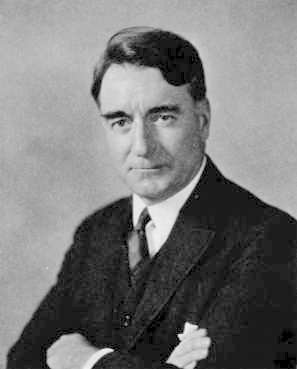
 |
Royal Samuel Copeland was born in Dexter, Washtenaw County,
Michigan, on November 7, 1868. He attended the public schools and Michigan State Normal School at
Ypsilanti, MI and graduated from the medical department of the University of Michigan at Ann
Arbor in 1889. After graduation he travelled extensively in Europe where he took postgraduate courses. When he
returned to the United States he became the house surgeon in the University of Michigan Hospital
from 1889 to 1890, and practiced medicine in Bay City, MI from 1890 to 1895. From 1895 to 1908
he was professor of homeopathic medicine in the medical school of the University of Michigan.
After building a successful ophthalmology, otology, and laryngology practice, a second career
bloomed. At the age of 33 he was elected mayor of Ann Arbor, MI and served a two-year term
from 1901 to 1903. Dr. Copeland became president of the park board in 1905 and 1906, and
was president of the Ann Arbor board of education in 1907 and 1908. He was a member of the
Michigan State tuberculosis board of trustees from 1900 to 1908. At the time, Dr. Copeland
was a Republican.
In 1908 he married Ann Spaulding and the
couple moved to New York City where he became dean of the
New York Homoeopathic Medical College and
director of Flower Hospital from 1908-1918. During that
decade he enjoyed a growing reputation as an eye specialist, teacher, and medical author.
He was a member of the United States pension examining board in 1917, and was appointed the
commissioner of public health and president of the New York Board of Health from 1918 to 1923.
It was in New York that Copeland's popularity
surged. His syndicated medical column appeared in William Randolph Hearst's
newspapers nationwide. As health commissioner, Copeland used newspapers to circulate health
warnings to the public in an effort to curb epidemics. According to The New York Times'
archives, Copeland built a credible record as health commissioner. He also became friendly
with newspaper magnate William Randolph Hearst, then one of the leading supporters
of John F. Hylan, New York City's mayor at the time.
By 1922, Copeland was a Tammany Democrat, and
as such his economic views were not noted for their liberalism. He got the Senate nomination
at the party's state convention, some have said through Hearst's influence. Others have said
that Rockefeller financed his campaign for the Senate, in which race he was successful.
According to a 1938 New York Times article, Copeland's first term in the Senate was unremarkable.
"As a physician," the Times wrote, "he spoke for pure food and drug legislation and was
assiduous in his attendance." Dr. Copeland was reelected in 1928 and 1934, and served from
March 4, 1923, until his death on June 17, 1938 in Washington, D.C.
Dr. Copeland was a debonair man, who bore
himself jauntily and was widely known for the fresh red carnation worn in his buttonhole each
morning. Courteous in debate, he gave the impression of being much more anxious to compromise
than to stand resolute. He was chairman of Committee on Rules (Seventy-third Congress),
Committee on Commerce (Seventy-fourth and Seventy-fifth Congresses), and the author of several
scientific works. He was nationally known for his writings and radio broadcasts on health
problems, and was devoted to the value of drugless healing. In the 1930s, Senator Copeland
introduced the federal Anti-Racketeering Act. He also was the author of the "Copeland Act," an
anti-union law against merchant seamen.
In 1932, Copeland supported the nomination of
Franklin D. Roosevelt for president, but soon found himself at odds with Roosevelt's
New Deal policies. Two years later, in 1934, as Copeland, the incumbent senator, prepared
himself for the state Democratic Party's Senate nomination, Thomas F. Conway, a former
lieutenant governor from Plattsburgh, announced his candidacy for Copeland's seat. It's
believed that Conway's candidacy came at the suggestion of FDR's administration, most likely
as a way to punish Copeland. Despite a possible snub from the White House, Copeland won a
third term.
In 1937 he was an unsuccessful candidate for
nomination as mayor of New York City, losing out to Fiorello LaGuardia.
His greatest legacy was winning passage of one of
the first food and drug regulatory laws in that third and last term, the Federal Food, Drug,
and Cosmetic Act of 1938. His final act as Senate Commerce Committee Chairman was
sponsorship of what became the National Firearms Act. As its provisions were being debated
on the Senate floor, Senator Copeland had a stroke. He was carried out of the chamber and
died within days of passage of the act. As the only physician serving in Congress at the time,
he had warned his colleagues against the dangers of overworking. Ironically, as a senator serving
on at least nine committees, Copeland became a victim of his own strenuous schedule in addition
to circulatory complications and kidney failure. He was 69 years old.
Prominent political figures from both parties
mourned his passing. "He could not be persuaded to retire until the close of the last
session. … He sacrificed his life for his duty," said Benjamin F. Schreiber, a member
of the Democratic National Committee. During a memorial broadcast, Schreiber also said,
"Senator Copeland, friend of the masses, will not be forgotten." Senator Copeland was
interred in Mahwah Cemetery, Mahwah, New Jersey.
In 1941, the Christ Church of Ramapo in Michigan
dedicated a memorial nave window in Copeland's honor. The Ramapo Valley Independent, the
village's former newspaper, described the window as a depiction of St. Luke, "patron saint of
physicians and writers."
After his death, a Liberty merchant marine cargo
ship was named after him, the SS Royal S. Copeland. It ferried 480 men and
about 120 Army vehicles to Normandy, France in June 1944.

SS Royal S. Copeland
Liberty merchant marine cargo ship 1944 |

 ChronologicalBy Relationship
Family StoriesFamily PhotographsOrphan Photographs
MapsContact UsResourcesWhat's New
ChronologicalBy Relationship
Family StoriesFamily PhotographsOrphan Photographs
MapsContact UsResourcesWhat's New