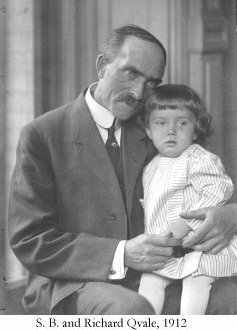
 "My father was SIGURDT BERGER QVALE. He was born in Norway in
either Haugesund or Bergen, the middle child of five. His father owned a
fishing business in Norway and went down with one of his ships; he was born
in Lofoten. S.B. had a sister, KAJA, who was a homemaker and had one son.
S.B.'s brother Steven owned a saloon in Wisconsin. Brother Alex was pretty
bright; he raised different kinds of grapes and made good wine from them on
his farm outside of Willmar. He had kids Olga, Stella, Ameena and three boys
for a total of six. Brother EMIL GAUTHE QVALE was a district judge for
49 years. He had two decisions reversed by the Supreme Court. Emil was a
hunter. He taught me how to shoot and, to a certain extent, how to swear but
was very quiet and extremely intelligent.
"My father was SIGURDT BERGER QVALE. He was born in Norway in
either Haugesund or Bergen, the middle child of five. His father owned a
fishing business in Norway and went down with one of his ships; he was born
in Lofoten. S.B. had a sister, KAJA, who was a homemaker and had one son.
S.B.'s brother Steven owned a saloon in Wisconsin. Brother Alex was pretty
bright; he raised different kinds of grapes and made good wine from them on
his farm outside of Willmar. He had kids Olga, Stella, Ameena and three boys
for a total of six. Brother EMIL GAUTHE QVALE was a district judge for
49 years. He had two decisions reversed by the Supreme Court. Emil was a
hunter. He taught me how to shoot and, to a certain extent, how to swear but
was very quiet and extremely intelligent.
 "Dad came over from Norway and passed the Minnesota State Bar Exam
when he was 17 years old. He owned quite a few businesses: an insurance
company, a lumber yard, three banks, and a half interest in a whale oil business
in the state of Washington. He was on the school board and had a general
store. He was also a prohibition administrator and later had five states under
him.
"Dad wanted to build a 22-room cottage at the property on Green Lake.
Mother objected to it so he scaled it back to a 5-bedroom cottage. We had
constant company all summer long. It was a beautiful place on nine acres --
simply beautiful.
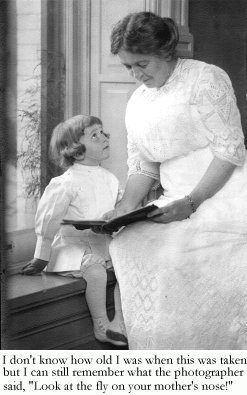
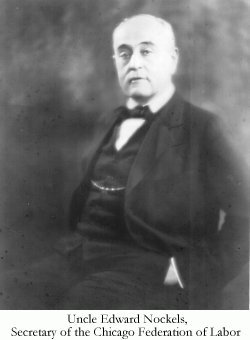
"Mother was MAYME NOCKELS who was born in Iowa. Her family
was from Luxemborg. Mom's brother was EDWARD NOCKELS, the
Secretary of the Chicago Federation of Labor. I have no idea how he got
started in labor. He was tough, fun to be with -- embarassing to be with! He
gave me my first car.
"Dad came over from Norway and passed the Minnesota State Bar Exam
when he was 17 years old. He owned quite a few businesses: an insurance
company, a lumber yard, three banks, and a half interest in a whale oil business
in the state of Washington. He was on the school board and had a general
store. He was also a prohibition administrator and later had five states under
him.
"Dad wanted to build a 22-room cottage at the property on Green Lake.
Mother objected to it so he scaled it back to a 5-bedroom cottage. We had
constant company all summer long. It was a beautiful place on nine acres --
simply beautiful.
"Mother was MAYME NOCKELS who was born in Iowa. Her family
was from Luxemborg. Mom's brother was EDWARD NOCKELS, the
Secretary of the Chicago Federation of Labor. I have no idea how he got
started in labor. He was tough, fun to be with -- embarassing to be with! He
gave me my first car.
 "Uncle Ed liked to fish. His wife, Aunt Edna, didn't want him getting the
family car dirty on his fishing trips so he bought a brand new Model T Ford
just for fishing. I learned how to drive in it when I was 13 or 14 years old.
Uncle Ed never drove except like a bat out of hell and he never asked
directions. He had a wonderful black chauffeur named George. George was
about 6'4" and weighed all of 160 or 70 pounds. He worked long days;
sometimes after driving all day for Uncle Ed he then would chauffeur a date
and me around all evening and into the early morning hours. He'd catch a
couple of hours' sleep and start all over again.
"One day I heard Uncle Ed coming down the road at Green Lake,
swearing. When he came into view I could see he was bandaged and bleeding.
He told me he had tipped the Model T over by the lake and if I wanted it I
could have it. I said, "Sure!" So that was how I got my first car.
"I was the smallest boy in my high school class. However, I grew up to a
little over 6 feet tall in one year at the U. [University of Minnesota]. I went out
for all kinds of sports at the U. I was on varsity track, tried football (which
accounts for my two bad knees), boxed (that was fun), went horseback riding,
sailing, and played handball -- I think I had more fun with that than anything
else. I remember Dad asking me once if handball was a "sissy" game so I
asked him to sit in on a game I played. Dad had a lot of respect for handball
after that. I sustained a number of injuries in these various sports, so much so
that for awhile at the U. my nickname was "The Wreck."
"I enjoyed duck hunting and fishing; large-mouth bass were my favorites.
I shot a pretty good game of pool -- I made a fair amount of money at the
Nevada Test Site playing pool. The first time I played someone I'd tell them
I'd take it easy on them and shoot left-handed. [Grins] I normally shoot left-handed.
"Uncle Ed liked to fish. His wife, Aunt Edna, didn't want him getting the
family car dirty on his fishing trips so he bought a brand new Model T Ford
just for fishing. I learned how to drive in it when I was 13 or 14 years old.
Uncle Ed never drove except like a bat out of hell and he never asked
directions. He had a wonderful black chauffeur named George. George was
about 6'4" and weighed all of 160 or 70 pounds. He worked long days;
sometimes after driving all day for Uncle Ed he then would chauffeur a date
and me around all evening and into the early morning hours. He'd catch a
couple of hours' sleep and start all over again.
"One day I heard Uncle Ed coming down the road at Green Lake,
swearing. When he came into view I could see he was bandaged and bleeding.
He told me he had tipped the Model T over by the lake and if I wanted it I
could have it. I said, "Sure!" So that was how I got my first car.
"I was the smallest boy in my high school class. However, I grew up to a
little over 6 feet tall in one year at the U. [University of Minnesota]. I went out
for all kinds of sports at the U. I was on varsity track, tried football (which
accounts for my two bad knees), boxed (that was fun), went horseback riding,
sailing, and played handball -- I think I had more fun with that than anything
else. I remember Dad asking me once if handball was a "sissy" game so I
asked him to sit in on a game I played. Dad had a lot of respect for handball
after that. I sustained a number of injuries in these various sports, so much so
that for awhile at the U. my nickname was "The Wreck."
"I enjoyed duck hunting and fishing; large-mouth bass were my favorites.
I shot a pretty good game of pool -- I made a fair amount of money at the
Nevada Test Site playing pool. The first time I played someone I'd tell them
I'd take it easy on them and shoot left-handed. [Grins] I normally shoot left-handed.
 "While I was at the U. my fraternity won the All-University Drinking
Championship. There were four on each team and I was on our fraternity's
team. The first time I tasted scotch I liked it -- I must have been around 18 or
19. But the most civilized drink in the world is a damn fine cognac, straight up
-- no rocks or mix. Martells Cordon Blue is good, so is Corvosier VSOP.
"Dad wanted me to specialize in corporate law and
get a degree at the University of Minnesota, go for my Masters at Harvard and then a short time at Oxford. (I'd
probably be just getting out of school right now.) I took one quarter pre-law
which was enough for me. I recall one class in particular, English constitutional history.
I have never come across a more boring subject. I barely got through. For awhile Dad was ready to
put me up for sale on a used kid lot. After that I told Dad I wanted to go into
mining engineering with a major in geology. S.B. wanted me to take more English and to take a language,
so I took French and Spanish. I majored in geology, took extra courses in Aeronautical Electronics and
Metallurgy, and graduated with 45 credits in advanced English literature. That was O.K. with Dad.
"Some of Dad's friends wanted him for the U.S. Senate. I
went to Washington and fell in love with Georgetown. If I had stayed there would I have
wound up in prison or President? -- I don't know.
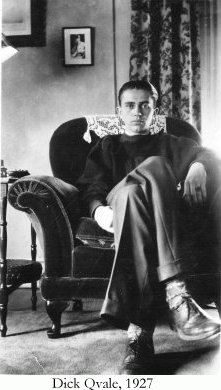
"In 1927 I graduated from high school. S.B. took me down Hennepin
Avenue where there was a big Buick garage. There it was in the corner
window, a gorgeous thing -- a two-door black coupe with fancy trimming.
Dad said, "Do you like it?"
"While I was at the U. my fraternity won the All-University Drinking
Championship. There were four on each team and I was on our fraternity's
team. The first time I tasted scotch I liked it -- I must have been around 18 or
19. But the most civilized drink in the world is a damn fine cognac, straight up
-- no rocks or mix. Martells Cordon Blue is good, so is Corvosier VSOP.
"Dad wanted me to specialize in corporate law and
get a degree at the University of Minnesota, go for my Masters at Harvard and then a short time at Oxford. (I'd
probably be just getting out of school right now.) I took one quarter pre-law
which was enough for me. I recall one class in particular, English constitutional history.
I have never come across a more boring subject. I barely got through. For awhile Dad was ready to
put me up for sale on a used kid lot. After that I told Dad I wanted to go into
mining engineering with a major in geology. S.B. wanted me to take more English and to take a language,
so I took French and Spanish. I majored in geology, took extra courses in Aeronautical Electronics and
Metallurgy, and graduated with 45 credits in advanced English literature. That was O.K. with Dad.
"Some of Dad's friends wanted him for the U.S. Senate. I
went to Washington and fell in love with Georgetown. If I had stayed there would I have
wound up in prison or President? -- I don't know.
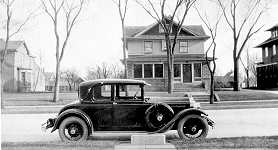
"In 1927 I graduated from high school. S.B. took me down Hennepin
Avenue where there was a big Buick garage. There it was in the corner
window, a gorgeous thing -- a two-door black coupe with fancy trimming.
Dad said, "Do you like it?"
 "I said, "Yeah!"
"Do you want it?"
"Sure!" I replied. Dad gave me the car.
"When I was older I used to drive for Dad. Because of his position, I
usually carried a .45 automatic and was a pretty good shot. Once Dad and his
assistant were working late at the office and there were four or five characters
they were interrogating on a prohibition-related matter. They took one guy
into the office and told me to cover the other men. One of them said he had
to go to the bathroom and I told him he just would have to hold it.
"Once I graduated I moved to Chicago and went to work as an engineer
at radio station WCFL, The Voice of Labor. What a wonderful town Chicago
was -- I thought they made the place just for me! I had fun at that job. We
used to play a lot of practical jokes. I remember one night three of us from
engineering staff made the speakeasys and got loaded as hell. We went back to
the transmitter on the Navy pier. R. B. Pappin, a little guy -- it was summer
and he passed out. We put him on a day bed, smeared glue on his back, and
tied sheets around him to the bed. Hours later we hear a weak voice call out,
"Dick! Dick!"
"You look sick," I said. "Are you well?"
"I can hardly move."
"Should I get your wife or a priest first?" I enquired. After that I
couldn't keep a straight face and we all peeled the sheets off of him.
"I remember another incident with R. B. Pappin where a group of us
were out for the evening and he wanted to tip over an old-fashioned shit
house. We drove all over the countryside looking for an outhouse and finally
found one. "There you go, R.B., there's your outhouse. Go tip it over." So
off goes Pappin into the night. We hear this huge crash, then a long silence.
Then from out of the darkness we hear, "Dick!" He had fallen in the hole.
"We did a broadcast once from a joint on Rush Street in Chicago, a street
known for its saloons. There was this girl, the star of either George White's
Scandals or the Ziegfield Follies, who played the violin beautifully and was
going to play the violin on air. She had the worst case of air fright I had ever
seen; she was absolutely scared stiff. She asked me to hold her hand while she
was on the air. I explained to her that would probably have a very serious
impact on her performance, so she played the violin for the radio audience
with me standing next to her.
"While in Chicago I spent time with some very interesting people. I
knew Tex Guinan, an outspoken lady who had a bizarre nightclub in Chicago
with a good floor show. She looked after her employees as if they were her
own family. I knew the last Republican Mayor of Chicago, Big Bill Thompson.
He was one of the finest civilian sailors in the country -- he was excellent. Bill
had a license enabling him to sail any type of ship anywhere in the world. His
yacht was 105 feet long.
"Someone else I knew was Maurice Lynch, the financial Secretary of the
Federation of Labor. Maurice's name was magic. I could park anywhere. If a
cop appeared, I'd say, "I know Maurice Lynch." They would never ticket me.
"I said, "Yeah!"
"Do you want it?"
"Sure!" I replied. Dad gave me the car.
"When I was older I used to drive for Dad. Because of his position, I
usually carried a .45 automatic and was a pretty good shot. Once Dad and his
assistant were working late at the office and there were four or five characters
they were interrogating on a prohibition-related matter. They took one guy
into the office and told me to cover the other men. One of them said he had
to go to the bathroom and I told him he just would have to hold it.
"Once I graduated I moved to Chicago and went to work as an engineer
at radio station WCFL, The Voice of Labor. What a wonderful town Chicago
was -- I thought they made the place just for me! I had fun at that job. We
used to play a lot of practical jokes. I remember one night three of us from
engineering staff made the speakeasys and got loaded as hell. We went back to
the transmitter on the Navy pier. R. B. Pappin, a little guy -- it was summer
and he passed out. We put him on a day bed, smeared glue on his back, and
tied sheets around him to the bed. Hours later we hear a weak voice call out,
"Dick! Dick!"
"You look sick," I said. "Are you well?"
"I can hardly move."
"Should I get your wife or a priest first?" I enquired. After that I
couldn't keep a straight face and we all peeled the sheets off of him.
"I remember another incident with R. B. Pappin where a group of us
were out for the evening and he wanted to tip over an old-fashioned shit
house. We drove all over the countryside looking for an outhouse and finally
found one. "There you go, R.B., there's your outhouse. Go tip it over." So
off goes Pappin into the night. We hear this huge crash, then a long silence.
Then from out of the darkness we hear, "Dick!" He had fallen in the hole.
"We did a broadcast once from a joint on Rush Street in Chicago, a street
known for its saloons. There was this girl, the star of either George White's
Scandals or the Ziegfield Follies, who played the violin beautifully and was
going to play the violin on air. She had the worst case of air fright I had ever
seen; she was absolutely scared stiff. She asked me to hold her hand while she
was on the air. I explained to her that would probably have a very serious
impact on her performance, so she played the violin for the radio audience
with me standing next to her.
"While in Chicago I spent time with some very interesting people. I
knew Tex Guinan, an outspoken lady who had a bizarre nightclub in Chicago
with a good floor show. She looked after her employees as if they were her
own family. I knew the last Republican Mayor of Chicago, Big Bill Thompson.
He was one of the finest civilian sailors in the country -- he was excellent. Bill
had a license enabling him to sail any type of ship anywhere in the world. His
yacht was 105 feet long.
"Someone else I knew was Maurice Lynch, the financial Secretary of the
Federation of Labor. Maurice's name was magic. I could park anywhere. If a
cop appeared, I'd say, "I know Maurice Lynch." They would never ticket me.
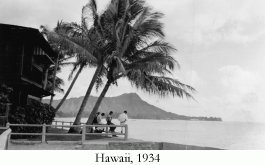 "I first saw San Francisco in 1936 on the way back from the Hawaiian
Islands which, by the way, Irv and I claimed for Norway. Irv's my second
cousin, two years younger. We went to Hawaii when I had turned 24 and Irv
was 22. We got in two fights the first day we were there and won them both.
At that time there were only three hotels on Wakiki -- the Halekulani (opened in 1932), the
Royal Hawaiian (shocking coral pink, Moorish style and built in 1927) and the Moana (which calls itself "the first
lady of Waikiki" -- Beaux Arts-style and dating back to 1901).
We spent three months in the Islands, ran out of money, and spent $35 on a tramp steamer back to the States. Our first
night out we ran into a typhoon and I don't think I've ever been so sick in my
life.
"I first saw San Francisco in 1936 on the way back from the Hawaiian
Islands which, by the way, Irv and I claimed for Norway. Irv's my second
cousin, two years younger. We went to Hawaii when I had turned 24 and Irv
was 22. We got in two fights the first day we were there and won them both.
At that time there were only three hotels on Wakiki -- the Halekulani (opened in 1932), the
Royal Hawaiian (shocking coral pink, Moorish style and built in 1927) and the Moana (which calls itself "the first
lady of Waikiki" -- Beaux Arts-style and dating back to 1901).
We spent three months in the Islands, ran out of money, and spent $35 on a tramp steamer back to the States. Our first
night out we ran into a typhoon and I don't think I've ever been so sick in my
life.
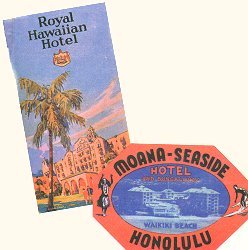 [Beginning in 1935 and for nearly 40 years afterward, the Moana courtyard
was the scene of the weekly radio show in which host Webley Edward would announce, "From the Banyan Court of the Moana Hotel
overlooking bee-you-tiful Waikiki Beach, it's Hawaii Calls." As singers like Hilo Hattie and Arthur Godfrey
performed, Edwards announced the balmy air and water temperatures and dispatched a technician with a microphone
to send "the sounds of the waves of Waikiki" back to the mainland. The effect this must have had on snowbound
listeners in Chicago or Detroit is hard to overestimate. -- Ed. note]
"While in Hawaii I had a chance to sail around the world with five or six
other people on an old sailing boat. They wanted me to go along as a
navigator but didn't have room onboard for Irv so I had to turn them down.
They later published a book about their exploits called "Around the World on
a Shoestring."
"I remember when Irv started a fight with the Pacific Fleet once in a
waterfront bar. He stood on the bar, threw his drink at the mirror, and
shouted, "_______ ________ the Navy! They do their own wash!" I went
through the screen door with Irv right behind me. Thank God I was on the
track team; I could outrun any of them.
"From San Francisco Irv and I road the rails back to Minnesota. I
remember walking in to see Dad when I returned. He looked up from his desk
and asked if I had had a good time. I replied in the affirmative. Then he asked
if I had managed to save any money during my trip. I held up a $5 bill. "You
must have had a very good time then," he said.
"After the trip to Hawaii I returned to the job at the radio station. I
worked there for three years, 1931 through 1933. The pay was $65 a week --
good money during the Depression.
"Another cousin I had a lot of fun with was Maury, the judge's son. He
was a John-Wayne type, even looked like John Wayne -- an Annapolis grad
who resigned from the Navy and went to work for General Motors. He was
a good hunter, a great shot. I remember being snowed in once for 11 days
with Maury in a backwoods cabin at Wagonga Lake with nothing to eat or drink but beans and
whiskey. The cabin had only an outhouse. Another time Maury and I went
sailing on the lake in a C-Class scow. We had been drinking and Maury's
partial plate fell out into the lake in about eight to ten feet of water. It took us
an hour and a half of diving to find it.
"I remember cousin Maury coming to see me in Chicago. We went out
and did the town and came back to my place to rest. When I woke up I didn't
see him anywhere. He wasn't on the bed; I checked out the window and he
hadn't fallen out the window. Then I saw him asleep on the floor on the other
side of the bed. I uncorked a bottle of whiskey and waved it under his nose.
Immediately his eyes opened and he said, "Rich! Where's the mix?"
[Beginning in 1935 and for nearly 40 years afterward, the Moana courtyard
was the scene of the weekly radio show in which host Webley Edward would announce, "From the Banyan Court of the Moana Hotel
overlooking bee-you-tiful Waikiki Beach, it's Hawaii Calls." As singers like Hilo Hattie and Arthur Godfrey
performed, Edwards announced the balmy air and water temperatures and dispatched a technician with a microphone
to send "the sounds of the waves of Waikiki" back to the mainland. The effect this must have had on snowbound
listeners in Chicago or Detroit is hard to overestimate. -- Ed. note]
"While in Hawaii I had a chance to sail around the world with five or six
other people on an old sailing boat. They wanted me to go along as a
navigator but didn't have room onboard for Irv so I had to turn them down.
They later published a book about their exploits called "Around the World on
a Shoestring."
"I remember when Irv started a fight with the Pacific Fleet once in a
waterfront bar. He stood on the bar, threw his drink at the mirror, and
shouted, "_______ ________ the Navy! They do their own wash!" I went
through the screen door with Irv right behind me. Thank God I was on the
track team; I could outrun any of them.
"From San Francisco Irv and I road the rails back to Minnesota. I
remember walking in to see Dad when I returned. He looked up from his desk
and asked if I had had a good time. I replied in the affirmative. Then he asked
if I had managed to save any money during my trip. I held up a $5 bill. "You
must have had a very good time then," he said.
"After the trip to Hawaii I returned to the job at the radio station. I
worked there for three years, 1931 through 1933. The pay was $65 a week --
good money during the Depression.
"Another cousin I had a lot of fun with was Maury, the judge's son. He
was a John-Wayne type, even looked like John Wayne -- an Annapolis grad
who resigned from the Navy and went to work for General Motors. He was
a good hunter, a great shot. I remember being snowed in once for 11 days
with Maury in a backwoods cabin at Wagonga Lake with nothing to eat or drink but beans and
whiskey. The cabin had only an outhouse. Another time Maury and I went
sailing on the lake in a C-Class scow. We had been drinking and Maury's
partial plate fell out into the lake in about eight to ten feet of water. It took us
an hour and a half of diving to find it.
"I remember cousin Maury coming to see me in Chicago. We went out
and did the town and came back to my place to rest. When I woke up I didn't
see him anywhere. He wasn't on the bed; I checked out the window and he
hadn't fallen out the window. Then I saw him asleep on the floor on the other
side of the bed. I uncorked a bottle of whiskey and waved it under his nose.
Immediately his eyes opened and he said, "Rich! Where's the mix?"
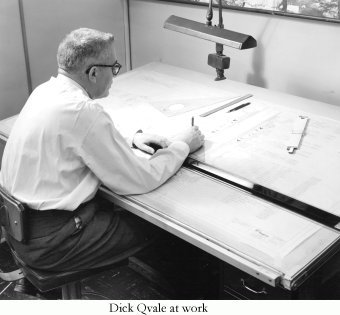 "As far as worthwhile accomplishments go, I was involved in WWII at
the very outset in aeronautical electronics. I worked on perfecting the
electronic autopilot for the B-17, my favorite plane. Up that point the
autopilot feature was very primative and there were problems with the
electrical circuit that controlled it. If the circuit happened to fail while the
autopilot was on the plane would go down, and they were going down. It took
about six weeks but I worked it out. There was a new alloy -- beryllium
copper. It made the copper harder and a better conductor of electricity. The
new circuit made over one million operations without failing -- a tremendous
improvement over the original autopilot circuit.
"Also during the war I worked on a torpedo director and indicator used
by the Navy and was awarded a Navy "E" for excellence.
"Whenever I took a new job the job was in trouble. I had to straighten it
out. I loved panic. At the Nevada Test Site there was panic every day of the
week -- which was fun.
"At the Test Site I had a crew of maybe 200 people. I was responsible
for their well-being and the work they performed. I was liable to congressional
investigation if anything went wrong. I had TOP SECRET clearance three
times.
"I was well-known for losing a shit house off the top of the mountain
due to high winds. If there were anybody in it I would have had to pay them
flight pay. [Grins]
"I worked 12 to 16 hours a day, sometimes 18 hours a day. We were
working with the facilities at Oakridge, Tennesee and Livermore, California. I
travelled all over the country to pull this together. I was always fighting with
the home office; they wanted me to travel tourist and stay at the cheapest
hotels and I went first-class every time with maximum flight insurance. I
worked 18 months at the site, which was the first underground nuclear testing
site, and loved every minute of it.
"I recall the typist at the test site changed her hair color four times in one
week -- orange, purple. I was responsible for payroll. Everyone would get
paid and immediately go to Vegas and gamble it away. When they returned to
the site I'd lend them the money to get to next payday. They were an honest
group and I never lost a cent on it.
"After the test site I worked as a chief engineer and plant manager. I had
all black crews in Missouri and got along fine with them. I've had a number of
really good black friends. One of the best workers I've ever had at the test site,
I was told that his security clearance had been revolked. There was nothing I
could do; I had no recourse but to walk him to the gate. When we got there I
told him I'd get his security clearance back -- and I did. He gave me one of the
nicest letters I have ever received thanking me for it.
"As far as worthwhile accomplishments go, I was involved in WWII at
the very outset in aeronautical electronics. I worked on perfecting the
electronic autopilot for the B-17, my favorite plane. Up that point the
autopilot feature was very primative and there were problems with the
electrical circuit that controlled it. If the circuit happened to fail while the
autopilot was on the plane would go down, and they were going down. It took
about six weeks but I worked it out. There was a new alloy -- beryllium
copper. It made the copper harder and a better conductor of electricity. The
new circuit made over one million operations without failing -- a tremendous
improvement over the original autopilot circuit.
"Also during the war I worked on a torpedo director and indicator used
by the Navy and was awarded a Navy "E" for excellence.
"Whenever I took a new job the job was in trouble. I had to straighten it
out. I loved panic. At the Nevada Test Site there was panic every day of the
week -- which was fun.
"At the Test Site I had a crew of maybe 200 people. I was responsible
for their well-being and the work they performed. I was liable to congressional
investigation if anything went wrong. I had TOP SECRET clearance three
times.
"I was well-known for losing a shit house off the top of the mountain
due to high winds. If there were anybody in it I would have had to pay them
flight pay. [Grins]
"I worked 12 to 16 hours a day, sometimes 18 hours a day. We were
working with the facilities at Oakridge, Tennesee and Livermore, California. I
travelled all over the country to pull this together. I was always fighting with
the home office; they wanted me to travel tourist and stay at the cheapest
hotels and I went first-class every time with maximum flight insurance. I
worked 18 months at the site, which was the first underground nuclear testing
site, and loved every minute of it.
"I recall the typist at the test site changed her hair color four times in one
week -- orange, purple. I was responsible for payroll. Everyone would get
paid and immediately go to Vegas and gamble it away. When they returned to
the site I'd lend them the money to get to next payday. They were an honest
group and I never lost a cent on it.
"After the test site I worked as a chief engineer and plant manager. I had
all black crews in Missouri and got along fine with them. I've had a number of
really good black friends. One of the best workers I've ever had at the test site,
I was told that his security clearance had been revolked. There was nothing I
could do; I had no recourse but to walk him to the gate. When we got there I
told him I'd get his security clearance back -- and I did. He gave me one of the
nicest letters I have ever received thanking me for it.
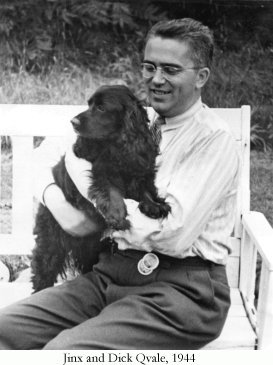 "Of everything, I am most proud of my gift of being able to get along
with animals -- all kinds of them. There used to be a kangaroo rat who would
call on me at the Nevada Test Site every evening and allow me to handle him
gently. There was a wild squirrel at the home on Gleason Lake Road who
would come to the kitchen window and shake the screen until I came out; he
would sit on my knee.
"I remember once when Queenie and I returned to her old family ranch
in Arizona. There was nobody there but out of the garage came three watch
dogs, barking, snarling and snapping outside the car. I got out very slowly,
talking to the dogs, and extended my hand which one of the dogs took in his
mouth. After that they were so friendly; they wagged their tails, jumped all
over me and followed us around the ranch. I swear we could have taken them
home with us.
"There was this horse once at Gleason Lake Road that got tangled in
barbed wire. It was terrible. A man there said, "Stay away from him -- he'll kill
you!" There's only one answer to that, and that's bullshit. I began talking very
softly to the horse and got him untangled. He just stood there, shivering.
"I used to talk to my horse, Daisy. She had a sense of humor. You
didn't need to tie her up; you could leave her in the back and just whistle for
her. She used to lean on me like a dog.
"There was once an owl sitting up in a tree. I put out my finger and the
owl hopped onboard and went home with me.
"I took your mother to a Great Dane
kennel at the lake. There were five or six full-grown ones in a pen. "Let them out," I said.
"Are you sure?"
"When I said yes, the dogs knocked me down, sat on me, stepped on me
and licked me all over.
"I remember teaching your mother
how to drive. I took her out in the Cadillac down Gleason Lake Road. There was some
poor S.O.B. walking along the side of the road and I swear she missed him by about six inches.
I was astonished. She said, "Poppy, was he supposed to be there?"
"Of everything, I am most proud of my gift of being able to get along
with animals -- all kinds of them. There used to be a kangaroo rat who would
call on me at the Nevada Test Site every evening and allow me to handle him
gently. There was a wild squirrel at the home on Gleason Lake Road who
would come to the kitchen window and shake the screen until I came out; he
would sit on my knee.
"I remember once when Queenie and I returned to her old family ranch
in Arizona. There was nobody there but out of the garage came three watch
dogs, barking, snarling and snapping outside the car. I got out very slowly,
talking to the dogs, and extended my hand which one of the dogs took in his
mouth. After that they were so friendly; they wagged their tails, jumped all
over me and followed us around the ranch. I swear we could have taken them
home with us.
"There was this horse once at Gleason Lake Road that got tangled in
barbed wire. It was terrible. A man there said, "Stay away from him -- he'll kill
you!" There's only one answer to that, and that's bullshit. I began talking very
softly to the horse and got him untangled. He just stood there, shivering.
"I used to talk to my horse, Daisy. She had a sense of humor. You
didn't need to tie her up; you could leave her in the back and just whistle for
her. She used to lean on me like a dog.
"There was once an owl sitting up in a tree. I put out my finger and the
owl hopped onboard and went home with me.
"I took your mother to a Great Dane
kennel at the lake. There were five or six full-grown ones in a pen. "Let them out," I said.
"Are you sure?"
"When I said yes, the dogs knocked me down, sat on me, stepped on me
and licked me all over.
"I remember teaching your mother
how to drive. I took her out in the Cadillac down Gleason Lake Road. There was some
poor S.O.B. walking along the side of the road and I swear she missed him by about six inches.
I was astonished. She said, "Poppy, was he supposed to be there?"
 "When your mother was in high school I took her to McCarthy's and she
ordered a New York cut steak which was very well, but then she ordered
ketsup to go with it. I wouldn't let her have it; I couldn't see the sense in her
ruining a good steak.
"I remember later on coming out to visit your parents and going with
your mother to Spengers for lunch. I ordered two lobster thermadores (both
for me), an order of onion rings and another of garlic toast. Did I ever feel
sick! They had to prop me in a chair for the rest of the day.
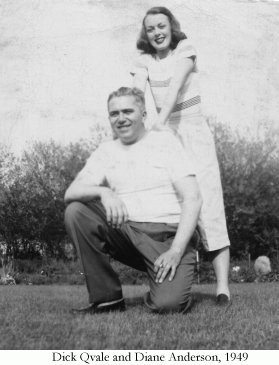
"I really liked your father. He was
one of my favorite people. I handpicked him for your mother myself.
"When your mother and father were
engaged, I recall Rube and Viola
coming over to our house for dinner. It was winter; our driveway was steep
and icy and their car couldn't make it up the hill. They had to walk up through
the snow.
"When we went to their home for dinner, your
Aunt Ceola had on a hat.
Diane said, "Get a stick and kill it."
"I remember saying to your father,
"Dick, why in the hell did you go to that damn trade school?" -- a place I wanted to go to so bad I could taste it.
[Grins] Your father was speechless for a few minutes.
"Your father and I went out drinking one evening and when we came
back home to Gleason Lake Road, he was heaving over the back fence. Your
mother came out of the house saying, "I'm going to give him a piece of my
mind!"
"I said, "You leave him alone; he doesn't want to hear anything from
you."
"When your mother was in high school we went to a movie downtown.
Then we went to Ivy's -- one of the greatest spots in the Twin Cities area for
pastry. We had French pastries and hot fudge sundaes. On the way home
down Wayzata Boulevard we noticed that there was a new malt shop so we
stopped in to have a malt. We finally got home, and what were we having for
dinner? Waffles! I passed on that.
"Your mother had a chance to go to two other colleges but she wanted to
go to the U. because I had gone there. I took her over there and introduced
her to my teachers. The faculty was a group of the finest people ever. My favorite was Dr. Gruner, a graduate of Heidelberg.
He was professor of both Mineralogy and Crystallography. He was the best instructor I have ever known. As the years
went by I would stop in to see him from time to time. I told him that I remembered more of his courses than any other.
He had a personal collection of minerals and crystals. When I had a research project involving industrial
diamonds at Minnesota Mining I picked three of the best diamond crystals and gave them to Dr. Gruner for
his collection. We used to have faculty dinners at the fraternity which helped.
"Money was never important to me; you know that's true. I probably
could have made more money if I had followed the course Dad set out for me.
But I wouldn't have had as much fun."
"When your mother was in high school I took her to McCarthy's and she
ordered a New York cut steak which was very well, but then she ordered
ketsup to go with it. I wouldn't let her have it; I couldn't see the sense in her
ruining a good steak.
"I remember later on coming out to visit your parents and going with
your mother to Spengers for lunch. I ordered two lobster thermadores (both
for me), an order of onion rings and another of garlic toast. Did I ever feel
sick! They had to prop me in a chair for the rest of the day.
"I really liked your father. He was
one of my favorite people. I handpicked him for your mother myself.
"When your mother and father were
engaged, I recall Rube and Viola
coming over to our house for dinner. It was winter; our driveway was steep
and icy and their car couldn't make it up the hill. They had to walk up through
the snow.
"When we went to their home for dinner, your
Aunt Ceola had on a hat.
Diane said, "Get a stick and kill it."
"I remember saying to your father,
"Dick, why in the hell did you go to that damn trade school?" -- a place I wanted to go to so bad I could taste it.
[Grins] Your father was speechless for a few minutes.
"Your father and I went out drinking one evening and when we came
back home to Gleason Lake Road, he was heaving over the back fence. Your
mother came out of the house saying, "I'm going to give him a piece of my
mind!"
"I said, "You leave him alone; he doesn't want to hear anything from
you."
"When your mother was in high school we went to a movie downtown.
Then we went to Ivy's -- one of the greatest spots in the Twin Cities area for
pastry. We had French pastries and hot fudge sundaes. On the way home
down Wayzata Boulevard we noticed that there was a new malt shop so we
stopped in to have a malt. We finally got home, and what were we having for
dinner? Waffles! I passed on that.
"Your mother had a chance to go to two other colleges but she wanted to
go to the U. because I had gone there. I took her over there and introduced
her to my teachers. The faculty was a group of the finest people ever. My favorite was Dr. Gruner, a graduate of Heidelberg.
He was professor of both Mineralogy and Crystallography. He was the best instructor I have ever known. As the years
went by I would stop in to see him from time to time. I told him that I remembered more of his courses than any other.
He had a personal collection of minerals and crystals. When I had a research project involving industrial
diamonds at Minnesota Mining I picked three of the best diamond crystals and gave them to Dr. Gruner for
his collection. We used to have faculty dinners at the fraternity which helped.
"Money was never important to me; you know that's true. I probably
could have made more money if I had followed the course Dad set out for me.
But I wouldn't have had as much fun."
Notes:
'Queenie' Qvale comments: "Dick was president of the University of
Minnesota Alumni Association -- Sun City Chapter -- in 1976 & 1977.
We received a huge banner in 1977 declaring us the largest and most
active of all chapters in the world!!! He created the Turf Paradise
University of Minnesota Day which became one of the most popular
activities and was so well attended by the members. He was also the
coordinator for building, equipment, design and troubleshooting for
the Sun City Bell Recreational Center. It won a national award that
year."

