|
 etween 1880 and 1919 more than twenty-three million people immigrated to the United States, representing more than
one-third of the nation's population increase during those years. Of these immigrants, seventeen million settled in New
York City. Two-thirds of the nation's imports came through New York harbor, and the city was rich in industry and retail
trade, depending for its prosperity on cheap labor and an immigrant workforce.
etween 1880 and 1919 more than twenty-three million people immigrated to the United States, representing more than
one-third of the nation's population increase during those years. Of these immigrants, seventeen million settled in New
York City. Two-thirds of the nation's imports came through New York harbor, and the city was rich in industry and retail
trade, depending for its prosperity on cheap labor and an immigrant workforce.
Because of its close proximity to work, immigrants settled on the Lower East
Side, forming ethnic enclaves. Soon after the successive waves of European immigrants, a great migration of blacks took
place from the rural South to the urban North. The first influx of blacks, from 1910 to 1920, brought more than three
hundred thousand people to New York City, Detroit, and Chicago, where most settled in tenements. Jewish immigrants
. . . brought with them a greater experience in urban living than some other immigrant groups. They came over
as families and were prepared to settle for good in the United States. Many Eastern European Jews were fleeing religious
and political persecution, which made permanent settlement necessary. However, despite the policy of open immigration for
Europeans, which was ended by the Johnson-Reed Act of 1924, immigrants were not warmly welcomed, as illustrated by
Woodrow Wilson's assessment in 1902:
The immigrant newcomers of recent years are men of the lowest class from the South of Italy, and men of
the meaner sort out of Hungary and Poland, men out of the ranks where there was neither skill nor energy, nor any initiative
of quick intelligence.¹
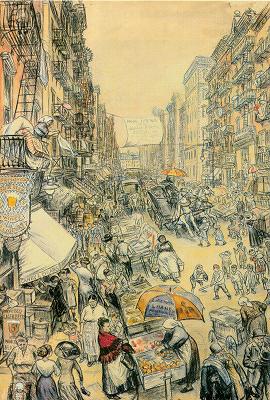 . . . . In the 1870s, existing and new tenements began to be altered
in response to rampant cholera and smallpox epidemics. Transoms were cut above the doors of inner rooms to permit a better
flow of air in existing buildings, and the new tenements were dumbbell shaped, providing an airshaft at the core of the building
for the same reason. Unfortunately, thse shafts often became the depository for kitchen and chamber pot waste.
. . . . In the 1870s, existing and new tenements began to be altered
in response to rampant cholera and smallpox epidemics. Transoms were cut above the doors of inner rooms to permit a better
flow of air in existing buildings, and the new tenements were dumbbell shaped, providing an airshaft at the core of the building
for the same reason. Unfortunately, thse shafts often became the depository for kitchen and chamber pot waste.
Greatly increased immigration in the 1880s resulted in the construction of
even more substandard tenements. Jacob A. Rüs's exposé How the Other Half Lives of 1890
revealed the conditions in downtown tenements, which he also presented in public lectures urging reform. To Rüs
and other reformers the immigrants and the slums were the antithesis of middle-class morals, stability, and home life.
Rüs appealed to the Christian conscience of the middle class and elected officials to provide charity and assist the
"slum dwellers."²
The Tenement House Exhibition held in 1899 and 1900 in New York City led to
new building codes and the creation of new building types. The organizer of the exhibition, Lawrence Veiller (1872-1959),
a housing reformer, stated that his goal was:
to prove to the community the fact that in New York City the working-man is housed worse than in any other city
in the civilized world, nothwithstanding the fact that he pays more for such accommodation than is paid anywhere else.³
Provisions that Veiller promoted, and that were introduced in the 1901
building codes, included mandatory running water on each floor, at least one indoor toilet for every two families, and the
installation of windows in the interior rooms to provide for airflow. . . . However, the basic premise of tenement
living remained constant; to house the greatest number of people while providing the fewest number of amenities.
by Diana L. Linden, The Magazine ANTIQUES, August 2001
¹Woodrow Wilson, History of the American People (Harper and Brothers, New York, 1902), quoted in Kessner,
Golden Door p. 25.
²Quoted in Trachtenberg, The Incorporation of America, pp. 127-128.
³The Tenement House Problem, Including the Report of the New York
State Tenement House Commission of 1900, ed. Robert W. De Forest and Lawrence Veiller (Maxmillian
Company, New York (1903), vol. 1 p. 105.
|