 |
 aketown is situated in the north-eastern part of the county, and includes all of congressional township 116,
range 24. The first settler in the town was Lenhart Breher. He came in April, 1853, and located in the south-east
quarter of section 24, where he has since lived. About the same time came Paul Martel, and located in the north-west
quarter of section 24, where he continued until his death a few years since.
aketown is situated in the north-eastern part of the county, and includes all of congressional township 116,
range 24. The first settler in the town was Lenhart Breher. He came in April, 1853, and located in the south-east
quarter of section 24, where he has since lived. About the same time came Paul Martel, and located in the north-west
quarter of section 24, where he continued until his death a few years since.
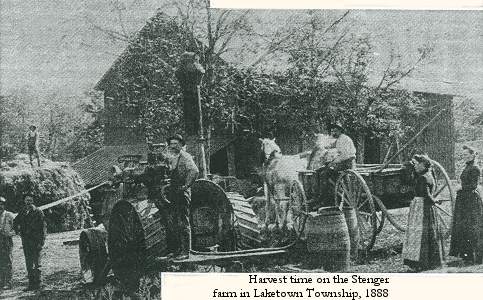
Among other early settlers were Lorenz Webber, Martin and Lorenz Steger,
John Pierson, Anton Keller, Andrew Riedele, Henry and Andrew Schraan, John Rau, Henry Gerdsen,
John Meier and step-son, Martin Schmidt, John Salter, Michael Diethelm, Peter Gregory, John Schmieg,
John Neunsinger, Tobias Ottinger and Jacob Rudiger. The most of these men are still living in the town.
Mr. Diethelm is now living in Shakopee, and Mr. Riedele in Chasaka, where he keeps a hotel. Martin Steger
served four years in the war, and died a few years since. Mr. Neunsinger died in Chaska in 1878. Mr. Rudiger died
in 1865. Population is mostly German. A Scandinavian settlement in the north-west.
The meeting for organizing under the name of the town of Liberty was held at the house
of Merritt Green, in section 1, May 11, 1858. The record of the meeting being lost, a full account of it cannot
be given.
Officers elected: John Groebach, chairman; Henry Wetzig and
Frederick Reitz, supervisors; Andrew Bergquist, clerk; John G. Maetzold, collector,
Charles Kaufmann, assessor; Henry Wetzig, overseer of poor; John Groetach
and Joseph Schaaf, justices of the peace, and Henry Schwartz, constable.
Considerable dissatisfaction was manifested from the fact that comparatively
few of the electors of the newly formed town were present at the meeting for organization, and another meeting was called to
be held at the house of Henry Wetzig in section 21, June 22 following. At this meeting a vote was taken approving
the acts of the meeting held May 11, and another taken changing the name of the town to Laketown. The name was suggested
by John Salter, and adopted as appropriate from the fact of there being so many lakes in the town.
To stimulate the enlistment of soldiers to fill out the quota of the town whenever
called upon for troops during the war with the South, a bounty of $250 was voted to each person enlisting from the town. Taxes
collected upon the property of soldiers then in the field, to raise those bounties, were refunded to their families.
The first school in the town was taught by John Groetsch during the winter of
1859 at his residence in section 29. It was a double log structure, one and a half stories. He had about twenty
scholars. Mr. Groetsch taught there several terms, when a log school-house was bult in the south-east quarter of section 29,
in what is now district number 20. This building was subsequently burned, and a frame erected in its place. There are now
six school-houses in the town, all frame, and furnished with plain seats excepting the one in number 16, which has patent seats.
In the spring of 1855 a large party of Scandinavians settled in the north-west part
of the town, along and near the eastern shore of Clearwater lake. Their pastor, F. O. Nelson, came with them, and
their religious services were the first in the town. They were conducted in a bark shanty on John Anderson's claim in the south-east
quarter of section 7. Several families were living in it at the time. Services were thus conducted in the shanties of the
settlers until the following summer, when a log church was built in section 7 near the east shore of Clearwater lake.
This building is still in use. The church organization took place at Andrew Peterson's house in August, 1855, with eleven
members. Present pastor, John Fogolstrom.
A cemetery was established on land deeded by Andrew Bergquist in section 18,
a few rods east of the church. The first person buried in it was Peter Swenson, of Waconia, buried in 1859.
 Catholic services were held by Father Bruno in 1856 at the house of
Michael Diethelm, in section 13. They were conducted there about a year, when the congregation called St. Victoria
was established and a log church was built in the same section. This building was used until 1870, when the present fine brick
structure was erected at a cost of $7,000. The present pastor is Rev. Father Ambrosius, who resides at Chaska.
Catholic services were held by Father Bruno in 1856 at the house of
Michael Diethelm, in section 13. They were conducted there about a year, when the congregation called St. Victoria
was established and a log church was built in the same section. This building was used until 1870, when the present fine brick
structure was erected at a cost of $7,000. The present pastor is Rev. Father Ambrosius, who resides at Chaska.
A parochial school is taught in connection with the church. A new building
for this purpose was erected just south of the church in 1877. The cemetery is located just north of the church.
The Laketown Moravian church was organised October 31, 1858, at the house
of John Holtmeier in section 11, by the Rev. Martin Erdmann. For about two years previous to that time services
were conducted at his house by different denominations, among them Lutheran services by Rev. A. C. Hoyer. In
1860 a log church was built on land deeded by Mr. Holtmeier, which was used until 1878, when a fine brick church was built
near the old site at a cost of $2,500. The present membership is seventy-four.
A cemetery is located in the plot of land owned by the church. The first
person buried in it was Mrs. Frederick Klatt, in May, 1862.
Zoar Moravian church was organized about the same time as the above, and by the
same minister. Their meetings were held at the house of Mr. Rudiger in section 33, until their church as built in 1863.
The lot embraces two acres of land in section 32, deeded by Theodore Rudiger. When organized the church had about ten
members; present pastor Rev. Theodore Sonderman. Attached to the church lot is a cemetery. The first person buried
in it was the wife of Fritz Rudiger, in the fall of 1856, being one of the first persons that died in the town.
The first white birth in the town, also in the county, was that of
John Breher. He was born in August, 1854, and was the son of Lenhart Breher.
The first post-office in the town was Scandia. It was established in the fall
of 1858; Andrew Bergquist, postmaster, and the office located at his house in section 18. It was discontinued about
1870, and its business transferred to Waconia.
Oberle's Corners post-office was established in 1859, with Fritz Oberle postmaster,
and the office located at his house near the town line in section 34. The office is now about a mile further north
and the postmaster is Anton Keller.
Laketown post-office was established in 1860, John A. Salter postmaster,
and the office located at his house in section 14. Mr. Salter still continues to hold the office.
1880 -- Valuation of real estate, $235,918; personal, $39,610; population, 1,056.
"Laketown, Carver County" from History of the Minnesota Valley (1888), pp. 27-28
|


