 |
 s far as my job
was concerned, I felt that I had gone as far as I could possibly go with Firestone. I really
didn't want any of the jobs that they presented to me. I had been offered the job of supervising
all the retread shops in the United States which were in all the major cities in the country. That
would have meant I'd be gone from home most of the time and would not be with my wife and kids.
So I turned that one down. s far as my job
was concerned, I felt that I had gone as far as I could possibly go with Firestone. I really
didn't want any of the jobs that they presented to me. I had been offered the job of supervising
all the retread shops in the United States which were in all the major cities in the country. That
would have meant I'd be gone from home most of the time and would not be with my wife and kids.
So I turned that one down.
When an opportunity came up at that time to make
a move to St. Paul with a company called Mutual Dealers I took it. They wanted me to come in
and run a retread shop that they were creating from scratch. They actually offered double my salary.
I had been making about $6,000 in Omaha. The first year in St. Paul, I made over $10,000.
So it was a real opportunity, and I decided to take a flier at it.
I hadn't worked on the job for long, before I
realized I was in the wrong place. It was a small company run by people who had been friends for years,
and I felt like an outsider. They wouldn't let me operate the way I wanted to, and they kept
interfering. So I became discouraged in spite of the good salary, and I wished I were back at
Firestone. At that point, an opportunity came along for me to go into business for myself.
A supplier, Bob Vanderpas, suggested that he
could set me up in a retread shop of my own, and I could be an independent. Vanderpas had a
whole shop full of equipment and supplies he had purchased from a shop that had gone out of
business. It was old equipment, really next to junk, but it was something I could work with. I
was mechanic enough to patch it up and make it go. I was indebted to him for about $12,000 after
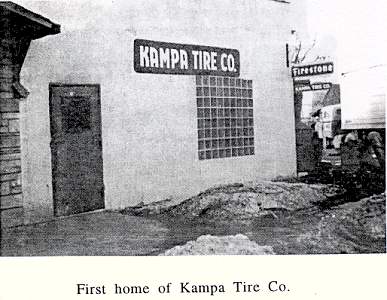
I got the shop established. I rented a small place on 29th Avenue in Minneapolis right near University
Avenue.
I got the place pretty well organized and set up, and
became very successful right from the start. I worked alone to begin with and was able to get quite
a bit of business from associations I had from the previous job. A lot of customers followed me.
So I had kind of a running start, although I just about worked myself to death the first year. I
think I went into business in June or July of 1952 and it was almost a year later before I hired
any help. Needless to say, I made a lot of money, which we really needed to keep us out of debt.
When I started, I had no money at all. To get some
cash to operate on, I sold our car. Then I borrowed some from a loan shark, so that was what we
started up the business with. When I told Dorothy that I wanted to start up the business, she
objected to it quite strenuously, but finally gave in with the understanding that I would not
work myself to death and that I would not try to get too big. I had to agree that when we got
to the point where we were making good money, I would let it go at that, rather than try to make all
the money in the world. Actually, this came to be the only thing we ever argued about in our
whole married life. After things were going well, I could see that the business had the potential
to be much bigger, and I wanted to expand. She absolutely refused to allow me to do it. I wanted
to buy more equipment, and she wouldn't allow it. Looking back, I think it probably was a good thing.
Getting Dorothy involved in the business was one
of the best things I ever did. She had little confidence in the project to begin with and was so
worried that she applied for a job at Montgomery Ward. When I found that out, I asked her to
come in with me and run the office. I said, "Well, if you want to work, you come down and work
with me. You can help me out in the office." This turned out to be an advantage to both of us
since it relieved a lot of tension and turned out to be a good business decision as well.
I asked Don Sexter, who was our accountant at the
time, to teach her how to keep a set of books. I had coached her on how to do the billing. I
remember one thing she had difficulty with at first was percentages. I wasn't exactly a bookkeeper
myself, but I did know the math involved. She grasped it quickly and became very efficient at it.
She seldom made an error. Don picked up the books at the end of every month and prepared a profit
and loss statement. Dorothy kept the books and was so good at it she even got high praise from
the IRS once when we had an audit. However, her contribution was not only bookkeeping for she made
a great impression on the customers with her friendly chit chat.
We were very conservative in our dealings. (I can
hear people who know me saying, "Oh, no! -- in mock disbelief.) Nevertheless, handling money conservatively
was an important part of our success. We paid off our original investment to Vanderpas which was
about $12,000 or $14,000 in about 14 months. So we were free of debt. From then on, we bought
equipment and supplies on a 30 to 90 day basis. We always got a 2% discount from
Firestone who was our chief supplier of tires and retreading material by paying in 30 days,
and we never missed that once all the years we were in business. In some of our tougher times, that
2% was all the profit we had. Of course, most of the time we did much better than that.
When we were dealing with Firestone, they offered
what they called "dating terms" in the summer. If you bought a six months' supply in advance, you
could pay for it in three payments and get an additional 2% or 3% discount. This gave us a
little extra boost, too. We had the money to work with and kept ourselves in good financial condition.
That made it possible for us to take advantage of the discounts and make that much more money.
We did not pass the discount on to our customers which was the usual practice in the trade.
I had very little formal education, but I learned a great
deal from my experience with Firestone during the 15 years I worked for them. I used to
sit in on the monthly meetings and they would explain various aspects of the business. One thing they
always talked about was the importance of good service. That made an impression on me. However,
when I was at Firestone, I noticed that they didn't practice what they preached. The first man that
they fired or laid off when business became slow as the service man. When I went into business
for myself, I resolved to follow the good business principals I had learned and not just pay
lip service.
Firestone also taught me the value of good
accounting practices. They issued a profit and loss statement every month on the operation. They
insisted that it be followed up on, and, if you weren't very profitable, they wanted to know why.
This made sense to me because you can't make a profit unless you know where the problem is. So I
absorbed that and when I got into business for myself, the first thing I did was get a good accountant.
As I mentioned earlier, that was Don Sexter, who turned out to be a long-time friend, as
well. He set up the books for us. Today, he is a multi-millionaire due to his successful real
estate investments.
I initiated the practice of offering our customers
unlimited warranty on anything they bought from us. Anytime they weren't satisfied they could
bring the purchase back and get credit, or cash, if they wanted it. They rarely asked for cash, and
most of the time we could satisfy them by giving them a generous settlement with credit to their
account. I think this is one of the things that brought customers to us, and a reason why our
customers stayed through so many years. It actually didn't cost us anything. We chalked it up as
sales expense when we figured our finances. It brought us a lot of good will and faithful
customers.
All the truckers we dealt with were long distance haulers.
Naturally, there were times when they would break down on the road with something they bought from
us. This was inevitable because tires were subjected to such abuse they were bound to have breakdowns
occasionally. So if they broke down on the road out of town, our customers could go to any
Firestone outlet and get taken care of without any out-of-pocket expense. The bill was always sent to
me at Kampa Tire Company and we gave the customer credit or charged him for the amount of use he had
from the tire, whichever was fair. This sort of practice was very unique at the time. Since
then, I think businesses have become more liberal in handling customers. But that was unusual in
the days when we were operating. It was one of our strong points.
I'd like to enlarge upon the role that Dorothy
played in the business. It was a very important part. She wasn't in the forefront, but she
arranged things from the sidelines. She was very good at her job, kept a top notch set of books,
and was well liked by the customers.
She had a real knack for talking to the truckers.
We'd be working on their trucks and they'd be sitting in the office gossiping with her. She'd
ask them about their wives and children, and she'd often listen to their personal problems. I
think she was a kind of "Dear Abby" for some of them. She helped them out many times. They got
along really well. In fact, so well that one of them asked her out one time. I suppose he got
the wrong idea because she was very friendly to him. He must have thought, "Oh, boy, she really
goes for me!" But he found out different. Many of them would tell her all their troubles -- she was
a very good listerner and made a lot of points with the boys.
The things that we worked for were very important
to both of us, and very important to the outcome of our business. As I said earlier, when I
proposed going into business for myself, she was concerned. She knew me well enough to know that
I would give it my all and work very hard, and she worried that I would work too hard and ruin my
health.
After about the first ten years, our business was going
along so well that I started thinking about becoming bigger and expanding, but every time I mentioned
it Dorothy would put the brakes on, reminding me of our agreement. I fought it for awhile, but
realized it was a losing battle, and we got along happily after that.
Dorothy knew that I had a lot of energy, and since
I wasn't going to expand the business, she thought I needed a diversion. That's when she started
encouraging me to take up golf. I was slow in getting used to the idea of taking time off of
work. It didn't seem like a thing I should be doing, but as time went on, I played more and more.
By the time we retired, I was playing 4 or 5 times a week and really enjoying it. Dorothy liked
taking over the shop while I was gone and running the show. We had a happy relationship in that
regard.
So that is the kind of partnership we had, which worked
out very, very well. She learned to keep books and she did the billing. One of her main benefits
to the company was the fact that the customers liked her. She enjoyed that part and she enjoyed
working. In fact, I think she would have been happier if we had never retired and just kept on
working. She would have liked that.
 'd like to elaborate
on some of the events in the development of the Kampa Tire Company. As I said, we were completely
out of debt in about 14 months. But I worked so hard, I felt I was on the verge of a nervous
breakdown. Then I started hiring people. I hired two or three guys to help me, and we gradually
built the place up as the years went by. Eventually, before we sold out, I had twelve employees
with a really fantastic organization. Our first shop was on 29th Avenue and 4th St. S.E.
Later we moved the Kampa Tire Company to Bedford and 4th Street, across from KSTP-TV at the
St. Paul/Minneapolis city limits. 'd like to elaborate
on some of the events in the development of the Kampa Tire Company. As I said, we were completely
out of debt in about 14 months. But I worked so hard, I felt I was on the verge of a nervous
breakdown. Then I started hiring people. I hired two or three guys to help me, and we gradually
built the place up as the years went by. Eventually, before we sold out, I had twelve employees
with a really fantastic organization. Our first shop was on 29th Avenue and 4th St. S.E.
Later we moved the Kampa Tire Company to Bedford and 4th Street, across from KSTP-TV at the
St. Paul/Minneapolis city limits.
One of the things that made it possible for us to
succeed right from the start was that we had this old equipment that cost us practically nothing.
Buying it new would have cost ten times as much. I was able to get by with it very well. In fact,
some of that equipment was still in operation 27 years later when we finally sold the place.
Another phase of our operation that helped us
immensely from the start was that I had made some contacts for retreadable casing from my previous
job at Mutual Dealers. One was with Doc McCauley in Fort Worth, Texas. This became a
very profitable connection for us. There were many people in the area, including Firestone and a
couple of other local retreaders, who wanted me to get them tires from this connnection. So I
arranged for McCauley to ship retreadable passenger casings to Firestone and to these other people.
He billed the tires to me and I would turn around and add a dollar or a dollar and a half to the
price that he charged me. So I would resell them to Firestone and the others. I would make
$400 to $500 a carload, and I'd get a carload a month. That was quite a bit of money in those
days, and, of course, it was all clear profit. We didn't even have any money invested. So that
worked out pretty nicely, and gave us a chance to get on our feet right away.
Another thing that helped was that we specialized in
nothing but truck tires. The equipment we had would handle about three sizes of truck tires.
In order to recap anything else, such as car tires, or small trucks, it would have taken a much
larger investment. So that specialization made it very efficient and profitable.
One of the single most important things that
influenced our success in business was that we took such pride in our service and in our work.
We took pride in having the best labor force and the best knowledgeable people. If they weren't
knowledgeable to begin with, we made sure that they learned quickly. They were taught to do things
the right way from the start. We always backed up our claims for good service. If we didn't perform
up to snuff, we would apologize and make sure the customer didn't suffer from our lack of
attention or knowledge. We made restitution right on the spot, without question, even sometimes
when we didn't think the customer was right in his claim. As far as we were concerned, the
customer was always right.
We learned quickly that we had to be careful when extending
credit. The first year we went into business, it seemed that every deadbeat in the country came
to us for credit. In spite of the fact that we turned quite a few of them down, we lost about
10 percent of our gross in bad debts that year. After that, Dorothy took over the credit
operation, and she did a great job. I was always too easy with people. She insisted on handling
that and I let her do it and it worked out fine. She was tough as nails when it came to credit.
There was one occasion when my soft-heartedness did do us some good, but it was purely accidental.
We had been in business just a matter of weeks and
there was a trucker who owed some money and fell behind in his payments. It was a weekend, so I
thought he would be in town. I was in the office on Saturday morning catching up on my desk work.
So I called his house and his wife answered. I told her what I wanted, and she said, "He died last
night." Of course, I felt terrible. I felt so bad that I sat down and wrote a credit for the $300
or $400 that he owed me. I really did it just because I felt so bad and wanted to help out a
little, but it turned out to be a great benefit to me as far as public relations were concerned.
He had a lot of friends who were truckers and who happened to be there when the letter came. They
appreciated the stand I took on the matter, and it brought me a lot of customers and a lot of
good will.
One of the things we did that many of our competitors
did not do was remain extremely loyal to our supplier. We did business with Firestone all the while
we were in business. It's quite a common practice in business for people to take on half a dozen different
accounts. If you pass some of the dealerships in town today, you see Michelin, Goodyear, Pirelli,
and dozens of different signs up for different makes. My feeling was that if you sold all those
different accounts, you didn't believe in them yourself. And how could you sell something that
you didn't believe in? My principle was to believe in the product I sold, back it up, and
sell just one product. Once I did make an exception to that, but I was sorry I did. When Michelin
first came to town, they were very aggressive and I agreed to let them set us up as a dealership.
They were very dictatorial in their methods. They wanted us to concentrate on Michelin alone,
but I had been associated with Firestone too long to do that. They put pressure on me to sell
more Michelin and I resented their methods. I told them if they weren't satisfied, they could
take their franchise and shove it. Then, of course, they surprised me by doing it. I didn't
think they would. That cost us a little business, but we came out smelling like a rose and our
business was even more profitable afterwards.
I learned in my association with Firestone that
they used a lot of natural rubber for the best results. When I set up my recap shop, I used all
natural rubber. It was more expensive, but the results were there, and we got a premium for it
when we sold it. It really furnished the mileage. We stuck with natural rubber until the advent of
cold-capping. That's a process that's still in vogue, particularly with trucks. The rubber is
cured and pre-formed before you put it on, then it's cemented on with a cold process. They call
it a cold process, but actually the tire is subjected to some heat in order to cure the tread
properly to be carcassed. It's been very successful, especially with radial tires. We got into it
during the last few years I was in business.
We had a large volume of business, and no sales
department. Most businesses that have the volume we had would have had two or three salesmen, but
we had none. Consequently, our profits were always good. And all through the years we had the
McCauley connection.
After we got the business going so that we were
making a few dollars and I wasn't working my head off, we started to relax a little and bought
a few things. We paid cash for everything. I think we financed the first car we bought after
we went into business, but that was the only time we ever financed a car. We bought all of our
equipment at the shop on a cash basis, usually a three monthly payment basis. That was an
agreement we had with the supplier that would be the same as cash.
By doing that, we managed to stay out of debt
and establish ourselves financially which gave us a lot more security, and our estate built up much
faster. We might have expanded our business and made a lot more money, but on the other hand, we
might have gone broke. So I think we made the right decision. We made more money staying small
and keeping a low overhead than most people with ten times the size of the operation. We had a
very smooth operation. If you are going to expand you have to have more employees and more
overhead and it takes more to handle it on the same amount of profit.
 f course everything
wasn't smooth sailing all of the time. We had our share of problems and ups and downs in the
business. I had one employee who I had helped out a lot by loaning him money when he was in need,
and I felt that I had treated him very fairly. But for some reason, he built up a resentment against
me. He came to our house one Sunday morning when Dorothy and I were having breakfast out on the
back porch, and he dropped the keys to the shop on the table. He said, "You've made yours;
now I'm going to make mine." He was very nasty about it. He had decided to go into business for
himself. He had an offer from a fellow with a failing business who wanted to turn it over to him.
So he went there and about a week later his wife called me up. She wanted to know if I would
take him back. I might have been fool enough to do it, except that Dorothy wouldn't let me.
Eventually, he just walked away from that business. He didn't have any money invested in it.
He was a roustabout around town for a number of years, and I don't know what became of him. That
was one of the bad experiences I had. f course everything
wasn't smooth sailing all of the time. We had our share of problems and ups and downs in the
business. I had one employee who I had helped out a lot by loaning him money when he was in need,
and I felt that I had treated him very fairly. But for some reason, he built up a resentment against
me. He came to our house one Sunday morning when Dorothy and I were having breakfast out on the
back porch, and he dropped the keys to the shop on the table. He said, "You've made yours;
now I'm going to make mine." He was very nasty about it. He had decided to go into business for
himself. He had an offer from a fellow with a failing business who wanted to turn it over to him.
So he went there and about a week later his wife called me up. She wanted to know if I would
take him back. I might have been fool enough to do it, except that Dorothy wouldn't let me.
Eventually, he just walked away from that business. He didn't have any money invested in it.
He was a roustabout around town for a number of years, and I don't know what became of him. That
was one of the bad experiences I had.
A similar thing happened with another employee who
had originally worked for Hart Motor Express as a tire man. I used to call on him to try to get
some Hart Motor Company business, so he gave me some once in awhile. Then one day he wanted me
to come out to his house to pick up some tires. I knew that was dishonest. These were tires that
he was stealing from Hart Motor Express. I did it just once and told him afterwards, "I can't do
this anymore." Then one day he came looking for a job, and I hired him. I should have known that
the guy was dishonest, but he was a fantastic worker. I knew that he was kind of slippery, and I
always watched him to make sure that he wasn't stealing any of the customers' tires or anything.
I put him in charge of an account and he did a great job with them. In fact, he was so good that
the customer wanted him to come out and work for him. He eventually let and started his own
tire service business, and in the process, he took that account, Douglas Trucking, with him.
That was a real disappointment. I had done a lot for the guy and there was no reason he should
pull the rug out like that. He did not improve himself financially by the move, as he was doing very
well with me. Once when he had his appendix out, he was off for three weeks or so, and I paid him his
full salary. He thanked me at the time, saying, "This is the first time in my life anyone has
ever paid me for not working." So he had every reason to be faithful to me. But I guess he was
self-seeking, more than anything else. He turned out to be an alcoholic, and I don't know how he
ended up.
We always dealt with truck tires and discouraged
automobile business from coming in at all. Over the years, the McKee Company was a steady
customer. Once of our biggest customers towards the end was Dart Transit Company. We wouldn't
do business with Admiral Merchants because their credit was no good. As I said, Dorothy was in
charge of the credit and she wouldn't give an inch. If they had a reputation of not paying
their bills, or not paying on time, she wouldn't have anything to do with them.
As the tire business changed, I didn't sell any more
carloads of tires from Texas. But I bought truck tires from Doc McCauley for my own use for
re-capping. I would get a trailer load a month from him. That connection in Texas was always a
good one. We always had a pleasant relationship because he was so trusting. He would call
Dorothy once in awhile and ask her how much we owed him. Doc was a good guy, but a poor
bookkeeper. Dorothy and I went through Texas once and called him up. We had just checked into
a motel, and he insisted that we check out. He said, "You come over here and stay at my place."
But Dorothy wouldn't go there to stay. We did go to visit him. Doc died a few years ago in
1979 of a heart attack.
|

