
 |
 HE BEGINNING OF THIS STORY
goes back a century and a quarter to the second administration of Andrew Jackson "the turbulent 1830's" when
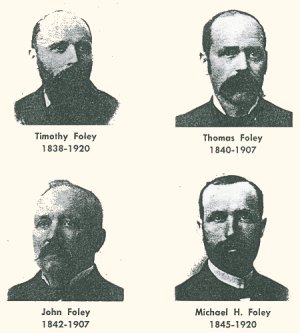
John Foley, father of the fabulous Foley Brothers arrived on the bleak
and stony frontier of Lanark County, Ontario. As many another Irish lad, John had
cut home ties and set forth with the paternal blessings and proverbial shilling to carve out for himself a
career in the new world. Apt in book lore, he was ill-equipped in all save courage and determination to wrest from
the Canadian wilderness a home and livelihood for his young bride and the six sons and six daughters that were
born to them.
As the family grew the farm was over-taxed to support them, so Timothy, the
eldest, born in 1838, when a mere lad of ten took a team to the woods for the winter logging. As his brothers grew
old enough they followed his example, and at high school ages they were riding the log drives down the great
waterways and through the mills, learning the lumbering trade the hard way. As lumbermen they first established
themselves in their eastern Canadian homeland. HE BEGINNING OF THIS STORY
goes back a century and a quarter to the second administration of Andrew Jackson "the turbulent 1830's" when
John Foley, father of the fabulous Foley Brothers arrived on the bleak
and stony frontier of Lanark County, Ontario. As many another Irish lad, John had
cut home ties and set forth with the paternal blessings and proverbial shilling to carve out for himself a
career in the new world. Apt in book lore, he was ill-equipped in all save courage and determination to wrest from
the Canadian wilderness a home and livelihood for his young bride and the six sons and six daughters that were
born to them.
As the family grew the farm was over-taxed to support them, so Timothy, the
eldest, born in 1838, when a mere lad of ten took a team to the woods for the winter logging. As his brothers grew
old enough they followed his example, and at high school ages they were riding the log drives down the great
waterways and through the mills, learning the lumbering trade the hard way. As lumbermen they first established
themselves in their eastern Canadian homeland.
The Start in Minnesota
Michael, Timothy's junior by seven years, was the first to venture
into the Northwest in the late 1860's. Returning home a couple of years later, he persuaded his brothers --
Timothy, Thomas and John -- that their fortunes lay on this farther frontier, and the middle '70's found the firm
of Foley Brothers firmly established in Minnesota. Trained lumbermen, they naturally took to the forests and soon
pine and oak were pouring from mills they built at Saint Cloud, Foley, Foreston and Milaca.
In those early days the prime mover in both logging and grading
was the horse team. It was inevitable that the ambitious quartet would also engage in grading or "dirt moving" as
it is more picturesquely called. This work kept their fast-growing strings of teams as busily engaged in the summer
months as did logging during the winter snows. Gradually construction eclipsed lumbering as dawned the epic era of
building the great railroads of the northland. In this, destiny cast the vigorous brothers to play a leading role.
The Northern Pacific was being steadily pushed across plains wrested
from Sioux and Cheyenne, westward over mountain passes on trails blazed by Lewis and Clark. The line was joined from
Minnesota to the Pacific in 1883. On its heels came the Canadian Pacific which spanned the continent in 1885. Eight
years later the Great Northern reached the West Coast. Over the ensuring years Foley Brothers and their associates
built literally thousands of miles for thse lines as they progressively extended a great web of branches to open up
and develop the unsettled northland. Following these pioneer lines a third, the Milwaukee, was driving on the American
side from the prairies to Puget Sound, and the Soo Line embarked on its great program of expansion in Minnesota,
Wisconsin and North Dakota. On the Canadian side two new transcontinentals, the Grand Trunk Pacific and McKenzie Mann's
Canadian Northern (today merged as the Canadian National Railway) were racing to see which would reach from ocean to ocean
first.
Always in the forefront in this vast program, Foley Brothers over the
years built up a powerful organization and gathered a loyal following of the ablest sub-contractors and
station men. Gifted with daring, energy and resourcefulness, they were gaining an enviable reputation for always
doing a good job and completing it on time no matter the cost or the obstacles. They were unrivaled in what today
is called logistics -- the science of moving and supplying armies. Their far-flung operations in remote wildernesses
required not only veritable armies of men and draft animals, but also the transport and distribution of their
supplies, equipment, materials, tools, explosives, food, clothing, hospital and medical stores -- in fact everything that
man and beast required.
As the magnitude of their accomplishments increased with the passing
years, their reputation became legendary in the north country and around them developed one of the world's great construction
groups. The lines of railway built by the Foley companies if laid end to end would aggregate well over 25,000 miles,
enough to encircle the world at the equator with a substantial lap-over. Their total cost exceeded a billion dollars.
The Associates
For the first twenty-five years after its founding in the 70's, Foley
Brothers was a partnership in which the four brothers -- Timothy, Michael H., Thomas and John
-- participated equally. It has operated in corporate form since the turn of the century.
In 1880 Archie Guthrie, Timothy's brother-in-law, was taken in as a
partner, and operations were conducted under the name of Foley Brothers & Guthrie until Archie withdrew to form his own company
in 1897. Shortly afterwards, joining forces with Peter Larson, Patrick Welch and John W. Stewart, the
brothers Foley entered upon the most spectacular phase of their long career. This powerful combination quickly achieved
and for twenty years held a dominant place in the wave of railroad building that surged through the Northwest and Canada.
They operated first as Foley brothers, Larson & Company. After the death of John Foley,
Thomas Foley and Peter Larson in 1908, the firm was known as Foley Brothers, Welch & Stewart and sometimes as
Foley, Welch & Stewart.
From time to time were also associated with the old firm on one project
or another many of the other noted builders of that day -- among them Dan (Sir Donald) Mann, the Porter Brothers, L. E. Shields,
Gilbert Fauquier, Sandy Mann, "Big Archie" MacKenzie, W. D. Barclay and numerous others whose
names were bywords. The last survivor of these construction greats of a bygone day, whose period of sixty-three years
continuous service in the ranks and in command spanned three generations of Foley Brothers history and continued
vigorously until his death in 1948, was Oscar W. Swenson. He took service with Foley Brothers in 1885 when
he had barely entered his twenties. A born woodsman, "O. W." gravitated to the wilderness lines that were
being pioneered across the northland. He steadily rose until as field manager he handled some of the firm's major
projects. At the time of his death, he had headed the New York company for 18 years.
The Heights Achieved
Foley Brothers, Welch & Stewart reached its peak of accomplishment in the
decade preceding World War I. Its projects then spanned the continent, including some 2,000 miles of rail lines under
construction at one time -- about the distance from New York to Denver. On their combined jobs over 50,000 men and unnumbered
horses and mules were being utilized in combination with the most advanced machinery of the times. Many of their projects are
outstanding to this day. To mention a few --
The space limitations imposed by an article of this sort permit a brief description of only the three last named, which well exemplify the magnitude and pioneering character of the Company's work. PORT ARTHUR-SUDBURY LINE In less than three years the main line of the Canadian Northern between
Port Arthur and Sudbury was pushed by Foley Brothers & Northern Construction Company through the trackless wilderness
lying between Lake Superior and Hudson's Bay. It is a harsh and difficult country: miles of muskeg swamps scattered
among granite ridges, boulder-strewn hills, rock-bound lakes and streams, heavily-wooded terrain. Most of the line
lies north of the height of land whence the rivers empty into Hudson's Bay. Deep snows and intense cold -- as
much as 60° below zero precede the spring breakup, generally late in May, when great stretches of land are entirely
under water and swarms of black flies and mosquitos darken the air. Except in winter most of it is impassable to
horses. Camps, hospitals, warehouses, shops, powder magazines, stables, stopping places, all had to be built of logs
ahead of actual construction. Snow-tote roads sprinkled to icy smoothness were run in from vantage points on the
Canadian Pacific, which roughly parallels the Canadian Northern 50 to 125 miles to the south. On these iced roads
thousands of teams had to sled an average distance of 100 miles their own forage as well as a year's supply of everything
imaginable that 12,000 men would need for the work itself and for their housing and subsistence. Stark necessity
demanded that the myriads of items be accurately anticipated. Between spring breakup and the following winter nothing could
be brought in except by canoes on the waterways on on men's backs over the portages.
CONNAUGHT TUNNEL This bore which allows the Canadian Pacific Mainline tracks to run for
five miles under Mount Sir Donald at the famed Rogers Pass near Glacier, British Columbia, is the longest double-track
tunnel in the western hemisphere. The combined record of speed and cost made on this tunnel still stands. It was
made possible by the invention and first use there of the pioneer or pilot tunnel method whereby a small bore is
driven parallel with and ahead of the main tunnel, permitting the excavation and lining of the latter to be carried on at
numerous places simultaneously. The great height of the mountain rendered intermediate access impracticable and the tunnel
had to be driven from the ends so the pioneer idea, which allowed beehive-like activity all along its length, proved
invaluable.
GRAND TRUNK PACIFIC From Saskatoon in Saskatchewan across the plains and mountains through
what is now known as Jasper Park, to Prince Rupert on British Columbia's north Pacific coast is nearly 1,300 miles.
Starting from both ends and hauling ahead with "four-up" teams the vast miscellany of equipment, tools, materials
and supplies required to complete yearly about 100 miles from each, the old firm drove the Grand Trunk Pacific the
entire distance in a continuous series of contracts. The final section beginning at Tete Jaune Cache, down the Fraser River
to Fort George and on to Aldermere, encompassed 400 miles. The determination to close in one operation this enormous
gap of uninhabited mountain country, accessible only from each end, presented a transport and supply problem of the first
magnitude. Again the "four-ups" surged ahead but hauled first disassembled engines, boilers and ships' gear and
equipment. Trees were felled, lumber was cut and a fleet of steamships and barges quickly built on the Fraser at Tete
Jaune. Though rocks and rapids took a heavy toll, these boats helped distribute the great tonnage required to permit
work all along the line. Thus the 400-mile closure was accomplished in a little over two years.
An Era Closes
World War I marked alike the finale of the tremendous epic of railroad
bulding on the North American continent and the dissolution of the great firm of railroad builders, Foley Brothers, Welch
& Stewart. Their major projects were all completed. J. W. Stewart, who had managed their work in the
Canadian West, was overseas, a general in command of the British engineering forces. Edward T. Foley, the
son of Michael H., who for several years had been increasingly active in the company's affairs, was serving as
an engineer officer in the American Army. Timothy and Michael Foley, both past seventy, had been gradually easing
off and wished to retire to a well-earned leisure. Unhappily, Timothy died in May 1920, aged 82, and Michael, who
had turned 75, followed him five months later. They had been inseparable companions and business partners for more than
half a century.
Rarely have two men teamed to better advantage. Michael had an unusually
fine mind, coupled with originality and vision. A brilliant analyst, he was more than often the policy-shaper and
guilding spirit. Timothy was a six-footer of powerful physique and commanding presence. Witty, shrewd and hardheaded,
he was gifted with a dominating yet winning personality and great executive ability. A born leader of men, he had headed
the concern since its founding.
|

 ChronologicalBy Relationship
Family StoriesFamily PhotographsOrphan Photographs
MapsContact UsResourcesWhat's New
ChronologicalBy Relationship
Family StoriesFamily PhotographsOrphan Photographs
MapsContact UsResourcesWhat's New
