 |
 n the morning of July 3, 1863, sixty-three-year-old Nathan Lamson and his son,
Chauncey, left the town of Hutchinson on the Minnesota frontier to return to their farm. About
six miles north of the city, they encountered Indians. The white settlers of Hutchinson had
been in a constant state of alert since the eastern Sioux, or Dakota, Indians had begun a war
eleven months earlier. Lamson's thoughts turned to the many whites who had been killed in the fighting,
and he immediately stalked the two adversaries he saw plucking raspberries near a poplar grove. When in
range, Lamson fired, wounding the larger man in the groin. Other shots quickly rang out as Chauncey,
his father, and the wounded Indian maneuvered through the brush straining to get nearer to each other.
When the gunshots ceased, Lamson lay wounded in the brush, and the larger of the two Indians was close
by, shot mortally in the chest. Young Chauncey, without ammunition and under the belief that his
father had been killed, raced back to Hutchinson for help, leaving the wounded men alone in the raspberry
patch that had suddenly become a battlefield.
n the morning of July 3, 1863, sixty-three-year-old Nathan Lamson and his son,
Chauncey, left the town of Hutchinson on the Minnesota frontier to return to their farm. About
six miles north of the city, they encountered Indians. The white settlers of Hutchinson had
been in a constant state of alert since the eastern Sioux, or Dakota, Indians had begun a war
eleven months earlier. Lamson's thoughts turned to the many whites who had been killed in the fighting,
and he immediately stalked the two adversaries he saw plucking raspberries near a poplar grove. When in
range, Lamson fired, wounding the larger man in the groin. Other shots quickly rang out as Chauncey,
his father, and the wounded Indian maneuvered through the brush straining to get nearer to each other.
When the gunshots ceased, Lamson lay wounded in the brush, and the larger of the two Indians was close
by, shot mortally in the chest. Young Chauncey, without ammunition and under the belief that his
father had been killed, raced back to Hutchinson for help, leaving the wounded men alone in the raspberry
patch that had suddenly become a battlefield.
Nathan Lamson lay hidden in the brush, fearful of moving,
as he listened to the larger Indian gasp for breath in a sequence that foreordained an agonizing death. Soon, another human voice broke
the rhythm. A young Indian boy, about sixteen years old, moved forward and knelt beside the
wounded Indian, who addressed him in a subdued voice. It was a strange scene to Lamson, and his thoughts
turned from the excitement of the skirmish to an interest in what was being said. It seemed as though this
dying, middle-aged man was giving what final instructions he could, telling the boy that he would now
have to continue alone. Then, the still unidentified Indian died, and the boy quietly took new moccassins
from a bag, dressed the man's feet, covered his body with a blanket, and left. The battle had ended
and so had the life of Taoyateduta, better known to Lamson and his fellow settlers as the Dakota
chief Little Crow, the man who had led the so-called "Great Sioux War." Lamson failed to recognize
the man he had shot or the symbolism surrounding his death.
The inglorious death of an unidentified Indian was greeted
with jubilation in the frontier settlements of western Minnesota. The eastern Sioux, architects of
conflagration that had resulted in the deaths of at least four hundred civilians, had become
incarnations of the devil. The frenzied Hutchinson townspeople celebrated the killing by moving
the body of the Indian to town, where it was left lying in the main street. Boys, in a festive mood,
spent the Fourth of July placing firecrackers in the ears and nostrils of the corpse. A few people
speculated about the identify of the man, one or two suggesting that the corpse resembled Little
Crow, but others who claimed to have known the notorious chief challenged this assertion. The head
had been scalped by the time the body reached town and nearly all of the hair removed, making any
identification based upon facial features dubious. Lampson had wanted the trophy in order to
collect the seventy-five-dollars-a-head offered by the state for the scalps of hostile Sioux
Indians.
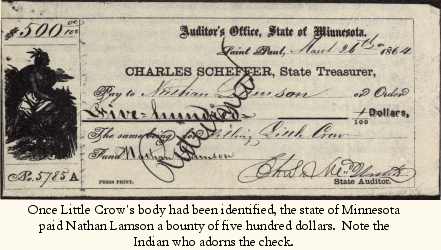 Toward evening, when the desecration ceased to be
amusing, Dr. John Benjamin convinced others to help him move the corpse to a refuse pit
outside of town. Dr. Benjamin covered the body with some dirt, but a cavalry officer dug it
up and severed the head from the torso. The doctor managed later to retrieve the skull, but then
the torso disappeared from the garbage pit. By the time most of the flesh had fallen from the bones,
making it possible to verify that it was Little Crow. The severe breaks in Little Crow's wrists,
his double teeth, coupled with the testimony of his son Wowinape, who had been with him at his
death and had been captured in August, verified the earlier speculation of the Hutchinson townspeople.
The notorious chief, leader of one of the bloodiest frontier wars in American history, had been
killed while picking raspberries.
Toward evening, when the desecration ceased to be
amusing, Dr. John Benjamin convinced others to help him move the corpse to a refuse pit
outside of town. Dr. Benjamin covered the body with some dirt, but a cavalry officer dug it
up and severed the head from the torso. The doctor managed later to retrieve the skull, but then
the torso disappeared from the garbage pit. By the time most of the flesh had fallen from the bones,
making it possible to verify that it was Little Crow. The severe breaks in Little Crow's wrists,
his double teeth, coupled with the testimony of his son Wowinape, who had been with him at his
death and had been captured in August, verified the earlier speculation of the Hutchinson townspeople.
The notorious chief, leader of one of the bloodiest frontier wars in American history, had been
killed while picking raspberries.
from Little Crow: Spokesman for the Sioux by
Gary Clayton Anderson, Minnesota Historical Society Press, St. Paul (1986), pp. 7-8
|

