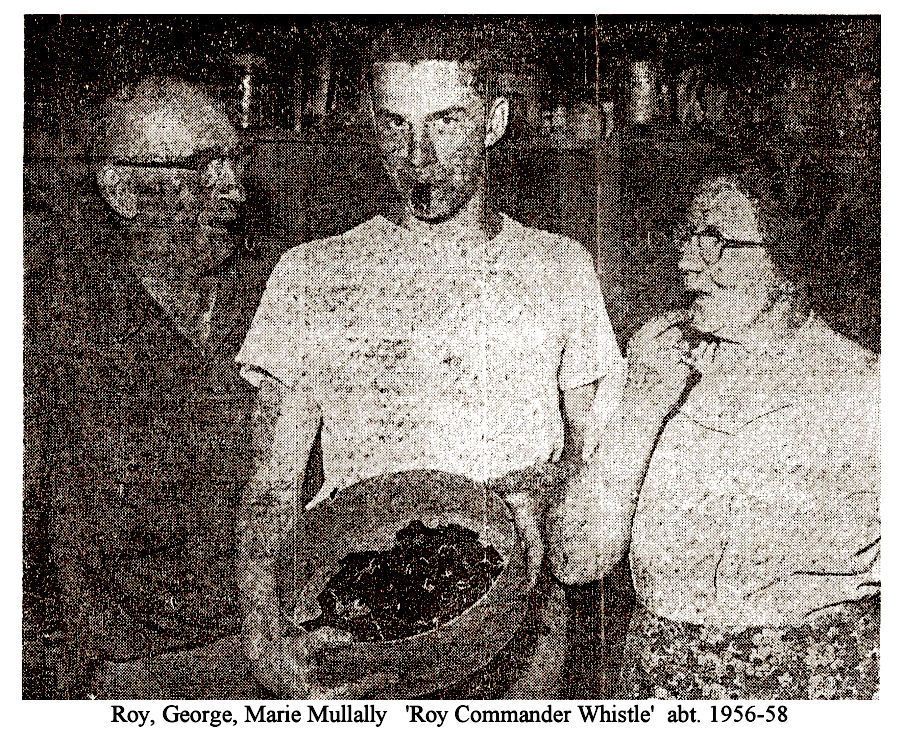
A whistle factory is a light (and not altogether imposing) industry.
In fact, the factory, when lined up on Roy Mullally’s work bench, amounts to
four pieces of iron, a blow torch, a bottle of cork balls and a box of red granules.
Put them all together and you’ve got mother furious. A tiny
plastic blaster results, which when blown, emits a screamingly high pitch. “That’s so the dogs can hear the whistle,”
said Mullally to me. “Our business is concerned mostly with dog trainers. And a dog’s ear, as you know, is tuned to
a higher frequency than a human’s.”
“This idea,” continued Mullally, “that the so-called
silent whistles are better than noisy whistles is clap-trap. The silent whistle entered our trade as sort of a fad.
People became enchanted with a whistle they could not hear, but that a dog could. But it’s very impractical.”
“. . . Impractical because a dog can’t hear the
whistle against the wind. And because when the whistle is out of order, the whistle-owner cannot tell it, so he
blames the dog.”
In his business career, Roy Mullally wears two
hats . . . one as a skilled tool and die maker with a company in St. Cloud . . . the other as president of the
Roy Commander Whistle Company of Sauk Rapids.
How did Mullally get started in the whistle
business?
“I was sick in bed, you see. That was in 1941.
I had to have something to do with myself. I couldn’t just lie there. So one day I picked up a screwdriver with a
yellow handle. I got my jack-knife and carved a whistle. Oh, I knew how to make a whistle, all right - ever since
my boyhood when I carved the sliding variety out of willow.
“When I finished, the whistle blew a beautiful
note. And it was a natty plastic color -- bright yellow. I gave it away and told my wife to go downtown and get me
another screwdriver.”
At this point Mrs. Mullally,
book keeper and treasurer of the Roy Commander company, said: “I didn’t mind buying him a few plastic screwdrivers,
but after a while I as detailed to buy one a day -- at $1.50 per piece. So I told him to sell them, if they were so
good.”
Which is what Mullally did.
And after he recovered his health he would meet
with dog trainer friends with this question: “What sort of whistle do you use?”
They would answer that they preferred either the
Acme Thunder-buster, a London import, or a St. Louis Brass.
“Take this one,” Mullally would say. “And try
it out on your dog. I think he’ll respond more quickly.”
Today the Roy Commander Whistle Company has an
exclusive clientele. Mullally doesn’t have to advertise. He doesn’t have to. The references fly among dog trainers.
Orders come into the Roy Commander Company from 40 states. Mrs. Mullally replies and encloses a whistle.
Downstairs, in his cellar, Mullally putters with pieces of iron mould, the bottle of cork balls, and the box of
granules.
“Of course,” said Mullally, “we had to
learn the tricks of the trade the hard way. When I started in this business, I was making them out of dental
plastic. It meant hours of boiling for each whistle, while Mrs. Mullally stirred the pot.”
Then, after experimentation, Mullally switched
to the present method. He first assembles the iron pieces together. “That’s my mould,” he says.
Then he takes a quantity of granules, heats it
over the blow torch, and its plastic. Then he pours it into the mould. Just how he gets the cork ball inside, I
don’t know. He told me how he does it. . . . When the whistle is completed, it is either deep brown in color or
-- if you want a flashier one -- a flashy crimson. It measures ¾-ths of an inch wide by 2 inches long, with
a little ring dangling for tying purposes. The cork ball rattles inside. On the base is stamped, with a smack of
craftsmanship:
A whistle factory is a light (and not altogether imposing) industry.
In fact, the factory, when lined up on Roy Mullally’s work bench, amounts to
four pieces of iron, a blow torch, a bottle of cork balls and a box of red granules.
Put them all together and you’ve got mother furious. A tiny
plastic blaster results, which when blown, emits a screamingly high pitch. “That’s so the dogs can hear the whistle,”
said Mullally to me. “Our business is concerned mostly with dog trainers. And a dog’s ear, as you know, is tuned to
a higher frequency than a human’s.”
“This idea,” continued Mullally, “that the so-called
silent whistles are better than noisy whistles is clap-trap. The silent whistle entered our trade as sort of a fad.
People became enchanted with a whistle they could not hear, but that a dog could. But it’s very impractical.”
“. . . Impractical because a dog can’t hear the
whistle against the wind. And because when the whistle is out of order, the whistle-owner cannot tell it, so he
blames the dog.”
In his business career, Roy Mullally wears two
hats . . . one as a skilled tool and die maker with a company in St. Cloud . . . the other as president of the
Roy Commander Whistle Company of Sauk Rapids.
How did Mullally get started in the whistle
business?
“I was sick in bed, you see. That was in 1941.
I had to have something to do with myself. I couldn’t just lie there. So one day I picked up a screwdriver with a
yellow handle. I got my jack-knife and carved a whistle. Oh, I knew how to make a whistle, all right - ever since
my boyhood when I carved the sliding variety out of willow.
“When I finished, the whistle blew a beautiful
note. And it was a natty plastic color -- bright yellow. I gave it away and told my wife to go downtown and get me
another screwdriver.”
At this point Mrs. Mullally,
book keeper and treasurer of the Roy Commander company, said: “I didn’t mind buying him a few plastic screwdrivers,
but after a while I as detailed to buy one a day -- at $1.50 per piece. So I told him to sell them, if they were so
good.”
Which is what Mullally did.
And after he recovered his health he would meet
with dog trainer friends with this question: “What sort of whistle do you use?”
They would answer that they preferred either the
Acme Thunder-buster, a London import, or a St. Louis Brass.
“Take this one,” Mullally would say. “And try
it out on your dog. I think he’ll respond more quickly.”
Today the Roy Commander Whistle Company has an
exclusive clientele. Mullally doesn’t have to advertise. He doesn’t have to. The references fly among dog trainers.
Orders come into the Roy Commander Company from 40 states. Mrs. Mullally replies and encloses a whistle.
Downstairs, in his cellar, Mullally putters with pieces of iron mould, the bottle of cork balls, and the box of
granules.
“Of course,” said Mullally, “we had to
learn the tricks of the trade the hard way. When I started in this business, I was making them out of dental
plastic. It meant hours of boiling for each whistle, while Mrs. Mullally stirred the pot.”
Then, after experimentation, Mullally switched
to the present method. He first assembles the iron pieces together. “That’s my mould,” he says.
Then he takes a quantity of granules, heats it
over the blow torch, and its plastic. Then he pours it into the mould. Just how he gets the cork ball inside, I
don’t know. He told me how he does it. . . . When the whistle is completed, it is either deep brown in color or
-- if you want a flashier one -- a flashy crimson. It measures ¾-ths of an inch wide by 2 inches long, with
a little ring dangling for tying purposes. The cork ball rattles inside. On the base is stamped, with a smack of
craftsmanship:
The Roy Commander.
“When we’re finished making one, we test it,”
said Mullally . . . and he blew one. My ears were still ringing when I got back to the office.
“An important thing,” added his wife, “is that
the whistles are of the right pitch. They have to sort of make your earlobe tingle. I’m used to it. I can work in
the kitchen upstairs and Roy is blowing away down here to pitch the whistles, and I never hear it.”
An ideal combination.
The Roy Commander Whistle factory has provided
education money for James. Jim worked downstairs in the cellar during the
summers while he was going to Marquette. “He really put in the overtime, too,” said Mullally. “And he was a
livewire on sales, too.” James is through Marquette, now and his brothers have succeeded him at the workbench with
the four pieces of iron - Bob, then Leo,
then John, who whistled his way through St. John’s, and now George.
(Later, Ralph.)
We’re on an equal give-and- take footing with the
Acme Thunder-buster Company of London, now.” said Mullally, “and I think our product has passed up the St. Louis
Brass whistle company. But we’re pushing ahead with improvements to meet the ever-threatening competition.”
St. Cloud Times, St. Cloud, Minnesota (written 1950s)
-- saved and sent by George P. Mullally, 2011