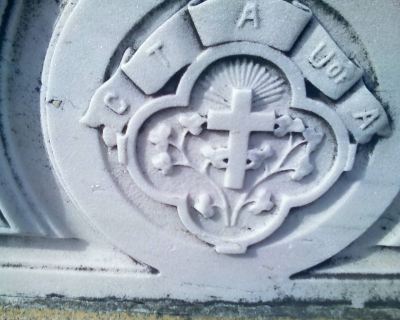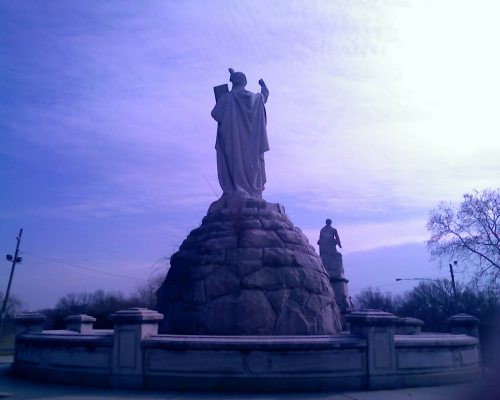
The fountain is located right across the street from the Mann Center for Perfoming Arts in Fairmount Park, Philadephia, PA.
| In 1871 the wave of agitation against the evils of
intemperance, which had led to the formation of numerous Catholic total abstinence societies
in the United States, reached Philadelphia, and a young man named James D. Howley
took up the work in the southwestern part of the city, and organized St. Charles Borromeo T. A. B. Society.
The necessity for some such organization being apparent, the new society attracted attention,
and other societies were shortly afterwards formed in adjoining parishes.
On March 17, 1872, St. Charles' and a cadet society formed a union, of which Mr. Howley was the founder and first president. The movement was of limited extent until the formation of a society in the Cathedral parish gave prominence to the subject, and the brilliant lead which that society at once took and has since maintained caused the agitation to become universal, and at this date the Catholic Total Abstinence Union of Philadelphia, commenced by Mr. Howley, and perfected and put into shape by John H. Campbell, the president of the Cathedral T. A. B. Society, numbers seventy-seven societies and eight thousand two hundred and fifteen members, and stands unrivaled at the head of the whole Catholic total abstinence movement in America. Mr. Howley died early in March, 1873, beloved by all his associates, and the Union some years afterward erected a neat momument, with appropriate inscriptions, over his grave in the Cathedral Cemetery, West Philadelphia. In January, 1875, at the suggestion of Mr. Campbell, who had just been elected president, the Union established an emigration committee to look after the interests of destitute emigrants landing at this port. This committee has faithfully attended to its work ever since. Its agents are at the wharf upon the arrival of every European steamer. Young girls are protected from strangers, friendly advice is given to all, situations obtained for emigrants desiring to settle in Philadelphia, and pecuniary aid extended to needy persons. For years every case of distress has been attended to, and nowhere in the United States is such excellent care taken of the newly-arrived emigrants from other lands. Much of the success of the committee's work is due to Owen Kelly, the chairman of the committee, and Bartholomew Gillin, the wharf agent, the latter of whom speaks Irish fluently. Early in 1873, Dr. Michael O-Hara, John H. Campbell, and some other active Irish-Americans connected with the movement conceived the idea of having the Union take a prominent part in the United States Centennial Exhibition, and the project of erecting a magnificent fountain in Fairmount Park was inaugurated. It was thought that a fountain of water, surrounded by statues of prominent Revolutionary heroes of Irish birth or decent, and of the Catholic faith, would be a lasting memorial of the principles of the organization and of the patriotism of the Irish element in America during the Revolutionary war. Accordingly plans were prepared, and a young Philadelphia sculptor of great ability, Herman Kirn, was selected to carve the five beautiful marble statues which now form a part of the group comprising the fountain. The central figure is Moses the lawgiver, who redeemed his people from the bondage of slavery, as the Union would redeem its members from the bondage of drink, and who brought forth the living waters from the rock in the wilderness, just as the Union would supply the same beverage to the weary and famishing drunkard. First of the four remaining statues is that of Father Mathew, "the apostle of temperace," and upon the base are recorded the high honors paid to him by the United States Senate and House of Representatives. The second is Charles Carroll of Carrollton, the patriot signer of the Declaration, and next to him stands Rev. John Carroll, the first Catholic bishop in the United States, who was selected by the Continental Congress as one of the commissioners to the Canadas. Last, but not least, is Commodore John Barry, the "father of the United States navy," whose gallantry during the Revolutionary war is one of the bright pages of that glorious struggle. Each of these four statues is nine feet high, and that of Moses fifteen 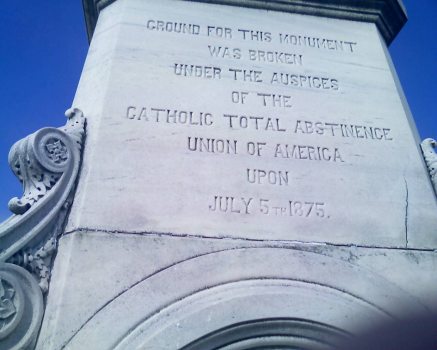 and one-half feet high, carved -- every one of them -- out of a single block of Tyrolese
marble. Moses is the largest single-piece marble statue in America. As works of art they
are beautiful, and help greatly to adorn our beautiful park. Around the basin of the fountain
there are carved medallion portraits of Lafayette, Kosciusko, De Grasse, Stephen Moylan,
George Mende, Orono (the Catholic chief of the Penobscot Indians), and Pulaski, all
of the Catholic patriots of the Revolution. and one-half feet high, carved -- every one of them -- out of a single block of Tyrolese
marble. Moses is the largest single-piece marble statue in America. As works of art they
are beautiful, and help greatly to adorn our beautiful park. Around the basin of the fountain
there are carved medallion portraits of Lafayette, Kosciusko, De Grasse, Stephen Moylan,
George Mende, Orono (the Catholic chief of the Penobscot Indians), and Pulaski, all
of the Catholic patriots of the Revolution. The fountain cost fifty-four thousand dollars, and was erected under the auspices of the Catholic Total Abstinence Union of America, the societies of that body outside of Philadelphia contributing about ten thousand dollars of the cost, the Philadelphia societies contributing the remainder. Ground for the monument was broken July 4, 1875, Hon. Joseph R. Chandler delivering the address on that occasion. Upon July 4, 1876, it was dedicated to American liberty, the oration being delivered by Governor John Lee Carroll, of Maryland, a grandson of Charles Caroll of Carrollton. Upon July 4, 1877, it was delivered to the city of Philadelphia, in trust for the free use of the American people, in the presence of what was claimed to be the largest public gathering ever held within the limits of the city. The number of people present was variously estimated to be from forty-five thousand to sixty thousand. Addresses were made by Governor John Lee Carroll, of Maryland; Governor John F. Hartranft, of Pennsylvania; David W. Sellers, representing the Park Commission; and John H. Campbell, representing the Catholic Total Abstinence Union of America. A poem was read by Philip A. Nolan, now general 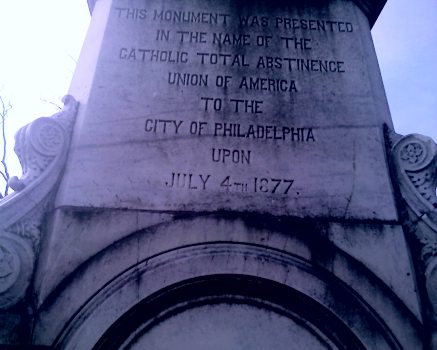 secretary of the latter body.
The Union of Philadelphia has at various times, principally upon March 17th (St. Patrick's Day); July 4th, and October 10th (Father Mathew's birthday), paraded its societies through the streets of the city, attracting much favorable attention, and in the Bi-Centennial celebration of the city it figured quite prominetly, being second only to the division of fire companies in numbers. The Union has accomplished and is doing much for the cause of good morals and sobriety in the city. Its societies hae enlisted thousands of boys into its cadet organizations, teaching them to grow up without knowing the taste of intoxicating liquors, and have in many halls and buildings fitted up to furnish amusement and instruction to the members, and especially designed to keep the young men from the temptations of idleness and drink. Circulating libraries, lyceums, dramatic and debating clubs, savings societies, night schools, etc., are among the prominent features of the movement in this city. The present officers are: President, John H. Campbell; Vice-President, James Jordan; Treasurer, John A. Smith; Recording Secretary, William J. Power; Corresponding Secretary, Phillip A. Nolan; Editor, John O'Callahan; Marshal, P. J. Hayes; Sergeant-at-Arms, John Stimmler. All of them are veterans in the cause of temperance, and upon their shoulders has rested for many years the structure which is known so prominently as the Catholic Total Abstinence Beneficial Archdiocean Union of Philadelphia. from History of Philadelphia, 1609-1884, pp. 1485-1486 |


 ChronologicalBy RelationshipFamily StoriesFamily PhotographsOrphan Photographs MapsContact UsResourcesFamily ForumWhat's New