 "Far from the fields of Europe, on the other side of the American continent, U.S. servicemen
and -women were also killed in the horrendous Pacific battles of World War II. The National
Memorial Cemetery of the Pacific on the Hawaiian island of Oahu was established to receive their
remains. It was officially dedicated on September 2, 1949, on the fourth anniversary of
V-J Day, for veterans who had given their lives in the Pacific between 1941 and 1945. Later it
also welcomed the remains of servicepersons from the wars in Korea and Vietnam. Today it contains more than
thirty-five thousand bodies, with almost no unused plots except for those set aside for spouses of the dead.
"Known as Punchbowl because of its shape, it lies in the middle of an extinct
volcano, the Puowaina Crater, a name that translates roughly as 'Consecrated Hill' or 'Hill of Sacrifice.' Long
before it was appropriated for its recent inhabitants, the crater was the site of secret royal Hawaiian
burials, and it was also the place where offenders of certain taboos were executed.
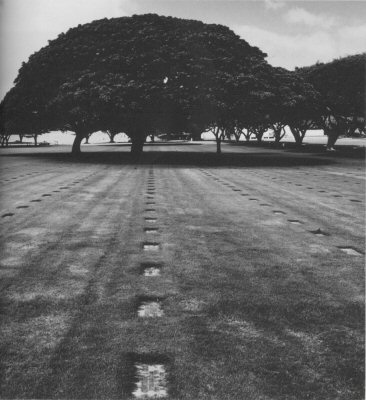
"As you drive through the entry, you are struck by the huge expanse of consecrated ground. Row upon
row of flat stones embedded within acres of grass stretch out under large protective trees. Pink plumeria blossoms scent the
air and fall upon the gravestones like sacred offerings. Dramatic bouquets of cut flowers -- orange lobster claw, red anthurium and ginger,
and orange and blue birds of paradise -- attest to the continued devotion of family members and friends.
"Far from the fields of Europe, on the other side of the American continent, U.S. servicemen
and -women were also killed in the horrendous Pacific battles of World War II. The National
Memorial Cemetery of the Pacific on the Hawaiian island of Oahu was established to receive their
remains. It was officially dedicated on September 2, 1949, on the fourth anniversary of
V-J Day, for veterans who had given their lives in the Pacific between 1941 and 1945. Later it
also welcomed the remains of servicepersons from the wars in Korea and Vietnam. Today it contains more than
thirty-five thousand bodies, with almost no unused plots except for those set aside for spouses of the dead.
"Known as Punchbowl because of its shape, it lies in the middle of an extinct
volcano, the Puowaina Crater, a name that translates roughly as 'Consecrated Hill' or 'Hill of Sacrifice.' Long
before it was appropriated for its recent inhabitants, the crater was the site of secret royal Hawaiian
burials, and it was also the place where offenders of certain taboos were executed.
"As you drive through the entry, you are struck by the huge expanse of consecrated ground. Row upon
row of flat stones embedded within acres of grass stretch out under large protective trees. Pink plumeria blossoms scent the
air and fall upon the gravestones like sacred offerings. Dramatic bouquets of cut flowers -- orange lobster claw, red anthurium and ginger,
and orange and blue birds of paradise -- attest to the continued devotion of family members and friends.
 "Everything in this site honors the fallen warriors on a grand scale. Some
112.5 acres extend upward to a mammoth memorial set back against the bowl wall. The memorial consists of monumental stairs
flanked by ten Courts of the Missing. On the walls of these courts, in alphabetical order and by service branch, are the names of
28,778 servicemen and servicewomen missing, lost, or buried at sea. And at the top of the stairs,
towering above the amphitheater-like ensemble, a thirty-foot-tall female figure with a laurel branch in her hand stands on the symbolic prow
of a U.S. Navy carrier. Engraved below her are the words that President Lincoln extended to the mother of
five sons who had all died in battle: '. . . the solemn pride that must be yours to have laid so costly a sacrifice upon the altar of
freedom.'
"For all the overarching grandeur of the memorial, the most
wrenching experience is to be found in the carpet of grass stretched out below. Moving slowly along a row of 130 flat
stone marking the graves of servicemen who had died in World War II (one row among hundreds!), I was struck by
the wide range of their origins: almost every state of the Union was represented in that single line of rectangular markers. Most
of the stones bore crosses, a few were marked with Buddhist lotus motifs or Jewish stars, and a very few said only:
"Everything in this site honors the fallen warriors on a grand scale. Some
112.5 acres extend upward to a mammoth memorial set back against the bowl wall. The memorial consists of monumental stairs
flanked by ten Courts of the Missing. On the walls of these courts, in alphabetical order and by service branch, are the names of
28,778 servicemen and servicewomen missing, lost, or buried at sea. And at the top of the stairs,
towering above the amphitheater-like ensemble, a thirty-foot-tall female figure with a laurel branch in her hand stands on the symbolic prow
of a U.S. Navy carrier. Engraved below her are the words that President Lincoln extended to the mother of
five sons who had all died in battle: '. . . the solemn pride that must be yours to have laid so costly a sacrifice upon the altar of
freedom.'
"For all the overarching grandeur of the memorial, the most
wrenching experience is to be found in the carpet of grass stretched out below. Moving slowly along a row of 130 flat
stone marking the graves of servicemen who had died in World War II (one row among hundreds!), I was struck by
the wide range of their origins: almost every state of the Union was represented in that single line of rectangular markers. Most
of the stones bore crosses, a few were marked with Buddhist lotus motifs or Jewish stars, and a very few said only:
Unknown
Pearl Harbor, Dec. 7, 1941
"Hawaiians do not forget their veterans, and they honor them in a special Hawaiian way.
Every year before Memorial Day a call goes out asking residents to make leis to be placed on graves at Punchbowl and at all the state's veterans' cemeteries.
In 2004, the City of Honolulu posted this request:
LEI NEEDED FOR MEMORIAL DAY
Fifty thousand lei are needed for placing on the graves of veterans, in memory of their service to our country. . . . Each year, the graves are decorated by the Boy Scouts for Memorial Day. The lei have been provided through the generosity of individuals, schools, and organizations in our community.
INSTRUCTIONS FOR SEWING LEI:
All lei must be made of fresh flowers or ti leaves and must measure 20-24 inches before tying. All lei must be tied. Floral sprays such as ti leaf and anthurium bouquets are also welcome.
"Compared with the service at the Arlington National Cemetery, Memorial Day at
Punchbowl has a distinctly Hawaiian flavor yet also follows conventional military rites. Like Punchbowl itself, it reflects the
American idea that regional character can enhance a sense of national unity.
". . . . At present, there are more than two hundred military cemeteries created by the federal
government and the states for the burial of veterans and their dependents. . . . All veterans of the United States Army, Navy, Marine
Corps, Air Force, and Coast Guard have the right to be buried in a military cemetery. When their time comes, if they so wish, they may choose to spend
eternity among their comrades in arms."
The American Resting Place by Marilyn Yalom (2008), pp. 268-270

