|
 he early part of the 20th century is remembered as
the heyday of plantation agriculture in Hawai'i. It was a time when sugar barons ruled, and immigrant laborers unearthed prosperity
from furrowed fields of red dirt. Cane was king, and, along with pineapple, sugar was the Islands' principal export. he early part of the 20th century is remembered as
the heyday of plantation agriculture in Hawai'i. It was a time when sugar barons ruled, and immigrant laborers unearthed prosperity
from furrowed fields of red dirt. Cane was king, and, along with pineapple, sugar was the Islands' principal export.
Today the plantations are all but gone. Across the state, the old mills have
closed one by one, and once-productive fields lie fallow. In many places, however, vestiges of plantation life still
remain. Oddly enough, these include a handful of the state's oldest golf courses.
These are not the courses advertised in vacation planners and national golf
magazines. They are not attached to a resort or surrounded by luxury condominiums. Rather, they are unpretentious
nine-hole layouts, built in the days before mass tourism to provide recreation for plantation communities. "Hawai'i's plantation
courses are throwbacks to a time when golf was far less sophisticated," says Dave Koga, a former sports editor for The
Honolulu Advertiser. "Playing them takes you to out-of-the-way places you might otherwise overlook and allows you to
experience an older, more rural Hawai'i."
Over the years, some of the original plantation courses have been converted
into municipal or private layouts. Others, however -- most notably Ironwood Hills -- have remained relatively unchanged,
preserved as literal links to the past.
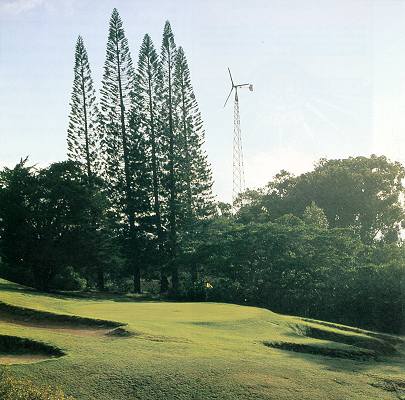
Ironwood Hills Golf Course's rustic layout is among the hidden surprises
of Hawai'i golf, set in Moloka'i's lush central highlands. It is not far from the cliffs overlooking the Kalaupapa peninsula,
site of the famous leprosy colony where Belgian priest Father Damien risked his life caring for the patients who were
banished there in the 1800s.
Built by the Del Monte Corporation for its pineapple workers in 1928, Ironwood
Hills was originally called Hanakekua Golf Course. In those early years, it abutted a dairy farm and was perfumed by the
smell of fresh manure. "We had to play around the cows back then," says eighty-year-old Sunshine Tamanaha, a retired
plantation store clerk. Other old-timers says the cows were such a nuisance that the club had to build fences around the
greens.
Ironwood Hills is today a challenging test of golf, with its wide
kukuya grass fairways framed by tall stands of pine, ironwood and eucalyptus. Golfers must thread drives through
narrow shoots of trees, fire approach shots into dime-sized greens and battle long uphill holes into the wind. First-timers
should just enjoy the experience, and not worry too much about their score.
|