|
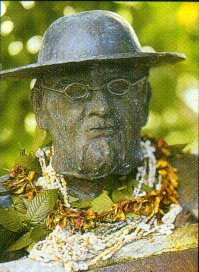 On June 4, 1995, Joseph de Veuster, known to the world as
Father Damien, was beatified in Belgium by Pope John Paul II. The priest who devoted his life to
serving the exiled victims of Hansen's disease on Moloka'i was, in his day, controversial, a scourge to
authorities, an outcast. His leprosy-ravaged face was an object of morbid fascination.
On June 4, 1995, Joseph de Veuster, known to the world as
Father Damien, was beatified in Belgium by Pope John Paul II. The priest who devoted his life to
serving the exiled victims of Hansen's disease on Moloka'i was, in his day, controversial, a scourge to
authorities, an outcast. His leprosy-ravaged face was an object of morbid fascination.
Father Damien was 33 years old when he landed at Kalaupapa in
1873. At the time of his arrival, the Hawaiian kingdom was staggering under the impact of contact with the
outside world. Within a hundred years of the arrival of Captain James Cook in 1778, 90 percent of the people
were dead of measles, cholera, typhus, and even colds. For Hawaiians, leprosy was by far the worst of the
plagues, for the idea of banishment struck right at the heart of their philosophy of aloha, a love that regards
each person as holy. Hawaiians called the disease mai ho' oko' awale, the separating sickness.
"Prepare for Moloka'i as for the grave" was a saying of the day.
Kalaupapa was a lawless society. The people -- bitter, weak, and desperate -- had nothing to lose. What sentence
passed could be worse than the one already handed to them?
Immediately Damien began badgering authorities for building
supplies, medicine, clothing, food. He slept outside, under a pandanus tree, until every patient had shelter.
He visited the sick, built coffins, and buried more than 6,000.
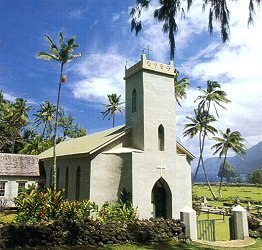
An excellent carpenter, Damien built several churches, the last of which
was St. Philomena. Its simple but elegant lines and clean surfaces gave the people a focus and ideal for a new
way of living. In the midst of the horror, Kalaupapa's little St. Philamena Church became a place
of joy. There were processions, hymns, pomp, and glory. Though leprosy attacks the vocal cords, Damien
assembled choirs. At times, it took two people to play the organ, so that together there would be 10 fingers to
make the music.
At some point, Damien contracted leprosy. He spoke of it as "a
shortcut to heaven." When he died, he was buried beneath the tree where he had first slept. He was the only
helper at Kalaupapa who contracted the disease -- 90 percent of Caucasians are immune. In 1936, amid wails and lamentations,
his body was exhumed and returned to Belgium.
At the beatification ceremony in Brussels, a relic was presented to
a delegation from Hawaii, some of whom were leprosy patients from Kaluapapa. It was the bones of the priest's right
hand, the hand that he blessed with. Catholic veneration of relics is consistent with Hawaiian belief in the
spiritual power of bones. Following Hawaiian custom, the bones were wrapped in traditional kapa (bark cloth), then
placed in a box of native koa wood.
The relic was welcomed in Honolulu in state ceremonies at Iolani Palace, where
Hawaii's kings are queens once reigned. Finally it came home to Kaluapapa and, with great jubilation, was returned
to the grave beneath the tree. More than 500 people flew in by small plane or hiked down the cliffs for the mass and a luau.
They recalled the words of the Pope:"Holiness is not perfection
according to human criteria; it is not reserved to a small number of exceptional beings. It is for everyone . . . .
In your daily life, you are called upon to make choices which sometimes demand extraordinary sacrifices. This is the
price of happiness."
|